

(VIDEO) Lego Supercar Built from 320,000 Bricks Reaches 111 km/h in Record-Breaking Test Drive
A Lego-built supercar achieves 111 km/h, showcasing engineering prowess and redefining modular construction possibilities.
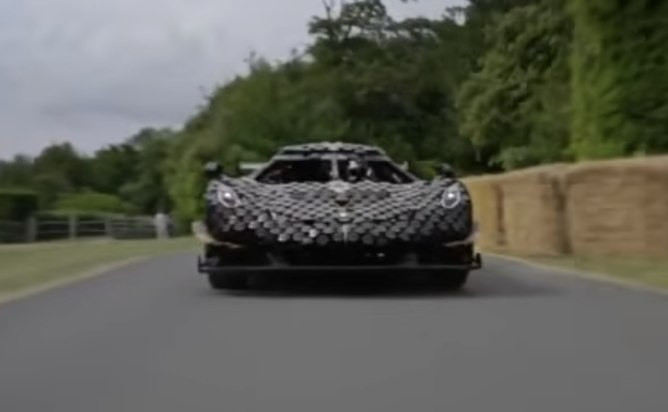
A full-scale supercar constructed entirely from Lego bricks has achieved a top speed of 111 kilometers per hour, showcasing remarkable engineering ingenuity and the potential for large-scale plastic block constructions to perform under real-world conditions.
The vehicle, modeled after a high-performance sports car and assembled using more than 320,000 individual Lego pieces, was put through its paces on a closed course in the United Kingdom. Engineers and enthusiasts involved in the project spent months designing and building the drivable prototype, which features functional steering, suspension and a powertrain capable of propelling the substantial structure at highway speeds.
The achievement highlights advances in structural engineering applied to modular construction. Traditional perceptions of Lego as a children's toy have evolved as hobbyists and professionals demonstrate increasingly ambitious applications, from static models to functional machinery.
Testing the vehicle required careful attention to weight distribution, aerodynamics and component durability. Lego bricks, while precisely manufactured, must withstand significant forces when assembled into large structures subjected to dynamic loads and high speeds.
Project organizers coordinated with safety experts to ensure the test met appropriate standards for experimental vehicles. The successful run at 111 km/h exceeded initial targets and sets a new benchmark for similar creations.
Engineering Challenges and Solutions
Building a drivable car from Lego pieces presents unique challenges. The chassis must support the vehicle's weight while allowing for suspension movement and power delivery. Engineers used reinforced internal frameworks and specialized connection techniques to maintain integrity at speed.
Power comes from an electric motor adapted to work with the modular system, providing sufficient torque without compromising the brick-based construction. Transmission components were custom-designed to integrate with standard Lego elements.
Aerodynamics played a crucial role in achieving stable high-speed performance. The body shape was optimized through iterative testing to reduce drag and improve stability, demonstrating principles applicable beyond the project.
Safety features included reinforced driver compartments and emergency shutdown systems. The driver wore appropriate protective gear during the high-speed run, which was conducted under controlled conditions.
Broader Implications for Modular Construction
The project pushes boundaries of what is possible with interlocking plastic bricks. Similar efforts have produced functional boats, airplanes and even bridges, but achieving automotive performance at this scale represents a significant milestone.
Educational value extends to STEM fields, inspiring students to explore engineering, physics and materials science through hands-on projects. The viral nature of such demonstrations increases public engagement with technical concepts.
Lego Group has supported select large-scale builds while maintaining focus on its core toy business. The company emphasizes creativity and learning, with official sets providing building instructions for enthusiasts of all ages.
Community-driven projects like this one often exceed official offerings in ambition and complexity. Online forums and social media facilitate knowledge sharing among builders tackling advanced challenges.
Record Context and Future Possibilities
Previous Lego vehicle records typically involved smaller scales or lower speeds. The 111 km/h achievement stands out for combining size, functionality and performance in a single build.
Future projects may explore even larger scales, alternative power sources or specialized applications such as emergency response vehicles. Advances in brick materials and connection systems could enable more robust constructions.
The event has generated widespread interest, with videos of the test drive circulating widely online. Enthusiasts have expressed excitement about potential collaborations between Lego and automotive manufacturers for promotional or educational purposes.
While not intended for commercial production, the supercar demonstrates engineering creativity and the joy of building. It serves as inspiration for makers worldwide to pursue ambitious projects using everyday materials.
The successful test run validates years of planning and iteration by the build team. Their achievement adds to the growing catalog of remarkable feats accomplished with modular construction techniques.
© Copyright 2026 IBTimes AU. All rights reserved.