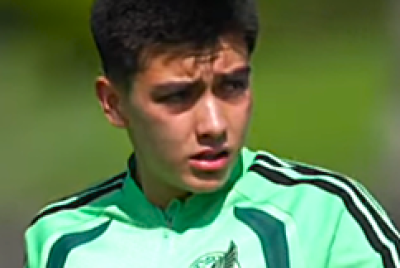
(VIDEO) Mexico Beats South Korea 1-0 on Goalkeeper Error to Become First Team Into World Cup Knockouts
A defensive error gifts Mexico a 1-0 victory over South Korea, securing their place in the World Cup knockout stage.

GUADALAJARA, Mexico — It wasn't pretty, distinguished by little other than its stark black-and-lilac color scheme, but Mexico became the first team at the 2026 World Cup to secure its place in the knockout stage, defeating South Korea 1-0 on Thursday in a match shaped almost entirely by a single goalkeeping error.
The result means Mexico is now all but certain to top Group A and remain in Mexico City for the next round, setting up the possibility of a high-stakes meeting at the historic Estadio Azteca in the round of 16. The question hanging over both Mexico and South Korea after their opening wins was whether they had genuinely impressed or simply benefited from poor opposition — and Thursday's match offered a fairly clear answer: neither side is overflowing with creative edge.
A Gift-Wrapped Goal
The only goal of the match arrived in the 50th minute, and it owed entirely to a defensive breakdown rather than any moment of attacking inspiration. South Korea goalkeeper Kim Seung-gyu came out to claim a looping header but jarred his elbow on the head of his own defender, Lee Ki-hyuk, in the process, spilling the ball into the path of Luis Romo. The Mexico midfielder hooked the loose ball into the net for his fifth international goal in his 64th appearance for the national team.
Romo was one of three changes Mexico manager Javier Aguirre made from the side's opening victory, coming into the lineup in place of Álvaro Fidalgo. Aguirre resisted significant public pressure to hand a start to 17-year-old prodigy Gilberto Mora, opting instead for experience in midfield.
Mexico nearly surrendered the lead in the closing minutes, when goalkeeper Raúl Rangel produced a remarkable double save to preserve the result. Rangel got down to parry a header from Cho Gue-sung before twisting his body and summoning the core strength to gather Yang Hyun-jun's sliced follow-up attempt, denying South Korea what would have been a deserved equalizer in the match's final stages.
Aguirre Reflects on a Maturing Team
Mexico's manager offered a candid assessment of his side's performance after the final whistle, acknowledging that the match had not been an aesthetic showcase but praising his team's tactical discipline. "It was quite a tactical match and hard to digest for the fans," Aguirre said. "The wins speak of our maturity as a team. We were caught off guard before Rangel's save but otherwise this speaks of a team that knows how to handle the game."
Aguirre, now in his third World Cup at the helm of the Mexican national team, also reflected on his own evolution as a coach over that span. "I used to be more stringent," he said. "I'm calmer, more serene. For instance, I don't mind them using their smart phones all the time; last time I was in a battle with them."
A New Stadium, an Old Rivalry of Circumstance
Thursday's match marked the first time Mexico had ever played a World Cup game in Guadalajara, yet the stadium was not full for the historic occasion. While attendance was nowhere near as sparse as it had been during South Korea's win over Czechia the previous week, plastic seats were visible in clear patches throughout the venue, particularly in the corporate tier that runs around the stadium's center section.
The venue itself carries no connection to Guadalajara's storied football history. This is not the old Estadio Jalisco, where England goalkeeper Gordon Banks famously kept out Pelé's header in 1970, and where French forward Bruno Bellone scored in the penalty shootout of the unforgettable 1986 quarterfinal against Brazil — a spot kick that struck the post and bounced in off the head of Brazilian goalkeeper Carlos. Thursday's match instead took place at Estadio Akron, officially rendered as Estadio Guadalajara under FIFA's de-sponsored naming convention, located roughly 15 miles west of the historic Jalisco venue. The stadium, which opened in 2010 and features a grass-covered exterior, rises from a flat plain on the western edge of the city of Zapopan, which borders Guadalajara proper.
A Cautious Affair Lacking Urgency
Both sides played with notably less urgency than they had shown in their respective tournament openers, a dynamic that may have stemmed from the format itself. With a win already secured by each team heading into the match, a draw would have been more than sufficient to advance both nations toward the knockout stage. The result was a contest with little risk or attacking adventure from either side — the match's first corner kick did not arrive until injury time.
The crowd appeared broadly accepting of the cautious approach, certainly more patient than the fans who had packed Estadio Azteca for Mexico's opening match and had booed when their team led 1-0 against a South African side that had been reduced to ten men. Still, even Guadalajara's more forgiving crowd had its limits — an extended spell of South Korean passing roughly eight minutes before halftime provoked a chorus of furious whistles from the stands, even if the protest had little bearing on the match's outcome.
A Friendship That Didn't Extend to the Pitch
South Korea and Mexico share a long-standing diplomatic and economic relationship dating back to 1905, when the first Korean migrants arrived in Mexico. Work began on a formal free trade agreement between the two nations in 2012, and although that agreement remains unconcluded, South Korea has since grown into Mexico's sixth-largest trading partner globally. A Friendship Pavilion donated by the South Korean government stands today in the seniors' garden at Chapultepec Park in Mexico City, a physical symbol of the bond between the two countries.
But that friendliness extended only so far on the pitch Thursday. When a team hands its opponent a goal on a platter, as Kim did with his costly error, there was never any realistic chance Mexico would decline the gift. Kim did partially redeem himself later in the match with a fine close-range block on a shot from Raúl Jiménez, though it is unlikely to be the moment anyone remembers from his evening in Guadalajara.
Off-Field Controversy Disrupts South Korean Preparations
South Korea's buildup to the match was complicated by an off-field controversy that disrupted the squad's preparations in the days leading up to kickoff. Video emerged of two individuals, believed to be journalists, making disparaging remarks about captain Son Heung-min's abbreviated term of mandatory military service. In protest, South Korean players refused to perform media duties two days before the match against Mexico.
The disruption appeared to weigh on the team's most recognizable star. Son, despite being only 33 years old, looked notably older and heavier-legged on the pitch, struggling repeatedly to navigate Mexico's offside trap and unable to free the ball from between his own feet when a genuine scoring chance presented itself in front of goal. He was substituted not long after that missed opportunity.
Looking Ahead to the Final Group Match
South Korea coach Hong Myung-bo offered a measured response to the defeat, signaling his team's intention to regroup before its final group-stage fixture. "Today's result is disappointing," Hong said. "The mistake we made was unfortunate but we shouldn't be discouraged because we will prepare better for the next match."
A draw against South Africa in South Korea's final group match would still be enough to send the team through to the knockout stage, though Thursday's performance offered little evidence that this particular South Korean side has the attacking quality to advance much further than that, even if it does survive the group phase. Mexico, for its part, has now won both of its group matches and all but secured a place in the round of 16 — but the co-hosts have so far shown little beyond a functional, results-oriented competence that has yet to translate into the kind of attacking spectacle their home fans are hoping to see as the tournament progresses deeper into the knockout rounds.
© Copyright 2026 IBTimes AU. All rights reserved.
- Recommended For You