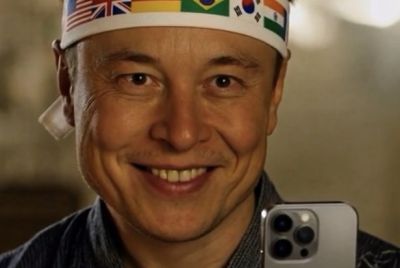
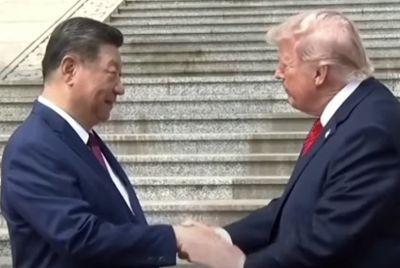
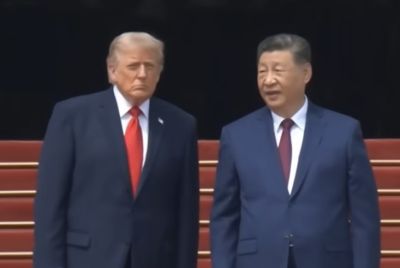
(VIDEO) Elon Musk Stands with Trump, Xi Jinping, Tim Cook and Jensen Huang in Historic Beijing Summit Photo
A viral image captures the convergence of political power and Silicon Valley influence at a pivotal U.S.-China summit.
BEIJING — A striking image shared widely on social media Thursday captured Elon Musk standing alongside President Donald Trump, Chinese President Xi Jinping, Apple CEO Tim Cook and NVIDIA CEO Jensen Huang during the high-stakes U.S.-China summit in Beijing, underscoring the extraordinary convergence of political power and Silicon Valley influence at a pivotal moment in bilateral relations.

The photograph, posted by popular X account @cb_doge, quickly went viral with more than 1 million views within hours. It shows the group in what appears to be a formal meeting or reception at the Great Hall of the People, highlighting Musk's prominent role in Trump's delegation as the leaders discuss trade, technology and global flashpoints. Musk, dressed casually in a dark jacket, stands near the center of the frame, symbolizing the growing intersection of American innovation and high-level diplomacy.
Elon Musk with NVIDIA CEO Jensen Huang, Apple CEO Tim Cook, President Trump, Chinese President Xi Jinping, and members of the U.S. delegation in Beijing. pic.twitter.com/sooA1y9yl1
— DogeDesigner (@cb_doge) May 14, 2026
The image has sparked intense online discussion, with users describing it as "history in one frame" and "the world's most powerful room." Replies ranged from admiration for Musk's global influence to lighthearted commentary on the unusual gathering. One user noted, "Love him or hate him, Elon Musk went from sleeping in factories to standing among world leaders shaping the future of AI, tech, energy, space and global economics. That's not influence anymore. That's history being written in real time." Another quipped, "Elon being a tourist on a state visit," while many expressed pride in seeing American tech leaders at the table with the two presidents.
The photo comes as Trump and Xi opened two days of formal talks focused on five key agendas: trade and tariffs, Taiwan security, Iran and Middle East stability, technology and critical minerals, and cooperation on fentanyl and people-to-people ties. Musk's presence alongside Cook and Huang signals the administration's emphasis on securing favorable terms for U.S. technology companies amid ongoing restrictions on advanced chips and AI development.
Trump has repeatedly highlighted Musk's role in his inner circle, naming him a key adviser on government efficiency and innovation. Musk's companies — Tesla with its massive Shanghai Gigafactory, SpaceX's growing international launches, and xAI's rapid advancements — give him direct stakes in U.S.-China relations. Tesla's China operations alone represent a significant portion of its global production, making any shifts in trade policy highly consequential for the billionaire entrepreneur.
Xi greeted the U.S. delegation warmly, according to Chinese state media, emphasizing "mutual respect and win-win cooperation." The inclusion of top American CEOs in the meetings underscores Beijing's interest in maintaining business ties even as strategic competition persists. Analysts note that China views Musk as a pragmatic figure less aligned with traditional Washington hawks, potentially opening doors for targeted deals in electric vehicles, AI infrastructure and space collaboration.
The viral moment has reignited debates about the influence of private tech leaders in foreign policy. Supporters praise the collaboration as smart economic diplomacy, arguing that involving industry giants like Musk, Cook and Huang ensures practical outcomes rather than purely political posturing. Critics worry it blurs the line between government and corporate interests, potentially prioritizing billionaire agendas over broader national security concerns.
Musk has maintained a high profile during the trip, posting updates and engaging with Chinese users on X. His presence has drawn both praise and scrutiny from Chinese netizens, with some expressing admiration for his entrepreneurial spirit while others remain wary of U.S. tech influence. One reply in Chinese translated to, "I saw Elon, very happy to see you come to China. You are the best entrepreneur in the hearts of the vast majority of us."
The summit itself carries enormous global weight. With tariffs still hovering on many Chinese goods and tensions simmering over Taiwan and the Iran conflict, any progress could stabilize markets and supply chains. Early indications suggest modest commitments on agricultural purchases and critical minerals, but deeper issues like semiconductor export controls and AI guardrails are expected to see more cautious dialogue.
For Musk, the Beijing visit represents another chapter in his complex relationship with China. Tesla has invested billions in its Shanghai factory, which remains one of the company's most productive facilities. At the same time, Musk has publicly supported stronger U.S. defenses and has been vocal about concerns over Chinese influence in global affairs. His balancing act — maintaining business interests while advising the Trump administration — places him at the center of one of the world's most consequential geopolitical relationships.
Social media reaction has been overwhelmingly focused on the optics of the photo. Users described the gathering as "trillion-dollar power in one room" and "the future negotiating in real time." Several replies highlighted the irony and significance of Musk, once a meme-posting entrepreneur, now standing shoulder-to-shoulder with the leaders of the world's two largest economies and fellow tech titans.
The image also fueled speculation about potential announcements from the summit. With Cook and Huang present, discussions around Apple's supply chain in China and NVIDIA's AI chip access are almost certainly underway. Any easing of restrictions or new partnerships could have immediate market implications for the companies involved.
As the summit continues into its second day, all eyes remain on whether the high-level engagement yields tangible progress or remains largely symbolic. For now, the viral photo of Musk with Trump, Xi, Cook and Huang has captured the world's attention, serving as a powerful visual of how technology, business and geopolitics are increasingly intertwined in 2026.
The moment underscores a broader truth: in today's global landscape, private-sector leaders like Elon Musk have become indispensable players in diplomacy. Whether this summit marks a turning point in U.S.-China relations or simply another chapter in managed competition, the image of these figures together will likely be remembered as one of the defining visuals of the Trump era's approach to China.
© Copyright 2026 IBTimes AU. All rights reserved.
- Recommended For You