Trump's 2026 Beijing Summit With Xi: How It Differs Dramatically From His Lavish 2017 Visit
A decade after his last visit, Trump faces a more complex and competitive U.S.-China relationship.
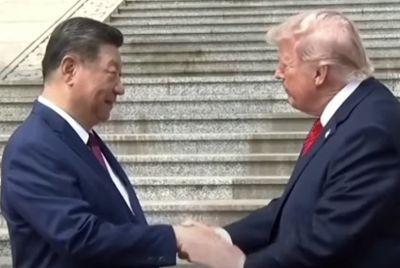
BEIJING — President Donald Trump arrived in Beijing Wednesday evening for a high-stakes two-day summit with Chinese President Xi Jinping, the first visit by a U.S. leader to China in nearly nine years, but one unfolding in a far more tense and constrained atmosphere than his 2017 trip.
Where Trump's November 2017 state visit was billed as a "state visit-plus" overflowing with pageantry — a private dinner and opera performance inside the Forbidden City, children waving flags along motorcade routes and the announcement of $250 billion in business deals — the 2026 gathering carries markedly lower ambitions and a sharper edge of rivalry.
Trump touched down at Beijing Capital International Airport as security locked down the capital and global attention fixed on the world's two largest economies navigating war in the Middle East, persistent trade frictions and technological competition. Meetings with Xi are scheduled for Thursday and Friday at the Great Hall of the People.
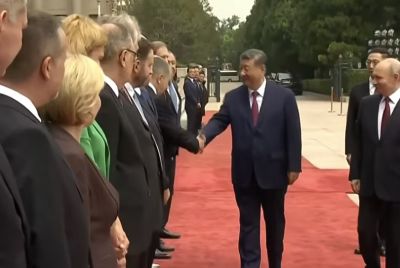
In 2017, the tone was celebratory. Xi rolled out the red carpet, escorting Trump and first lady Melania Trump through the Forbidden City's main halls for an afternoon tea and evening performance. A military band played, schoolchildren chanted welcomes and Trump praised Xi as a "very special man." The two leaders touted what appeared to be a budding personal rapport and a new era in bilateral ties. Chinese officials unveiled a raft of memorandums of understanding worth hundreds of billions of dollars in sectors from energy to agriculture, though many later failed to materialize fully.
Nine years later, the choreography remains formal but noticeably scaled back. No "state visit-plus" designation this time. Analysts say the grandeur serves a different purpose: signaling mutual respect while acknowledging deep distrust built over a decade of tariffs, technology restrictions, military posturing and the 2023 spy balloon incident.
The agenda has shifted dramatically. In 2017, North Korea dominated alongside trade. This week, the shadow of the U.S.-Israel conflict with Iran looms large. Trump has pressed China to use its influence to help reopen the Strait of Hormuz and ease oil price spikes that have fueled U.S. inflation. Beijing, for its part, seeks stability to protect its economy and wants progress on Taiwan and reduced U.S. tech export curbs.
Trade remains central but looks different. Trump's second-term tariffs — initially hiked sharply before partial rollbacks following the October 2025 Busan meeting with Xi — still hover around 26-34 percent on many Chinese goods after court rulings and negotiations. Chinese officials expect announcements of Boeing aircraft purchases, U.S. agricultural products and energy deals, but analysts doubt anything approaching 2017's headline-grabbing scale.
Critical minerals and rare earths also feature prominently. The two sides are discussing extensions of existing deals while wrestling over semiconductor restrictions. Artificial intelligence cooperation — or at least guardrails — is expected to surface, reflecting how technology has become a core battleground absent in 2017.
Power dynamics have flipped in subtle but important ways. In 2017, China's economy was far more dependent on the U.S. market; today the U.S. share of Chinese exports has fallen from about 19 percent to roughly 11 percent. Beijing has diversified trading partners, advanced its technological self-reliance and weathered previous tariff rounds. Xi enters talks from a position of greater confidence, even as China's growth faces domestic headwinds.
Trump, distracted by the Iran conflict and domestic economic pressures, is seeking tangible wins to bolster his image at home. White House officials speak of "stabilizing" the relationship rather than resetting it. Expectations are modest: possible new dialogue forums on trade and investment, symbolic purchases and commitments to future visits — Xi to Washington in the fall and Trump to the APEC summit in Shenzhen in November.
The personal chemistry between the two leaders has evolved too. They have met multiple times, most recently in Busan in late 2025. Xi has a clearer read on Trump's transactional style, while Trump has tempered some of the first-term bombast with pragmatic deal-making. Yet underlying suspicions remain. U.S. officials continue to view China as a strategic competitor; Beijing sees Washington as intent on containing its rise.
Security around the summit reflects the stakes. Beijing has imposed heavy restrictions, closing sites like the Temple of Heaven and tightening airspace. The visit occurs against a backdrop of military tensions in the Taiwan Strait and South China Sea that were far less acute in 2017.
Experts describe the gathering as a "risk-management summit." Both sides want to prevent escalation but harbor little hope for breakthroughs on structural issues such as industrial subsidies or market access. "The relationship is defined more by the absence of friction than by any affirmative agenda," one former U.S. official noted.
For Trump, a successful outcome might include photo opportunities, modest trade announcements and language committing both nations to dialogue on Iran and nuclear issues. For Xi, hosting the first U.S. presidential visit in nearly a decade allows China to project strength and global centrality even amid its own challenges.
Broader implications extend beyond the two days. The summit could set the tone for U.S.-China relations through the remainder of Trump's term. A smoother-than-expected meeting might open doors to cooperation on global issues; missteps or overly tough rhetoric could harden positions on Taiwan or technology.
As Trump and Xi sit down Thursday, the contrast with 2017 is stark. Then, the world's two largest economies appeared on the cusp of a golden partnership. Now, they meet as wary superpowers managing competition while the world watches — distracted by war, worried about supply chains and uncertain about artificial intelligence's next chapter.
The Forbidden City may not host a private dinner this time. The opera is off the schedule. Instead, closed-door talks in the Great Hall will focus on preventing confrontation rather than celebrating friendship. In that shift lies the story of how the U.S.-China relationship has matured — or hardened — over the past decade.
© Copyright 2026 IBTimes AU. All rights reserved.
- Recommended For You