Did Donald Trump Just Swear in His Truth Social Post? Donald Trump Uses Expletive in Easter Threatening Iran
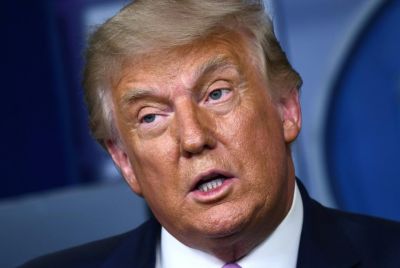
WASHINGTON — President Donald Trump posted an expletive-laden message on Truth Social on Easter Sunday, April 5, 2026, directing strong language at Iranian leaders while threatening military strikes on the country's power plants and bridges if the Strait of Hormuz remains closed.

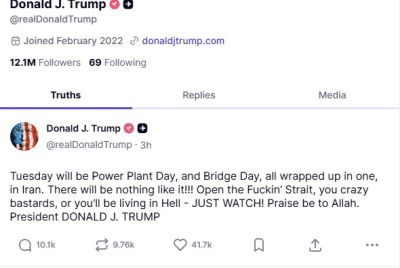
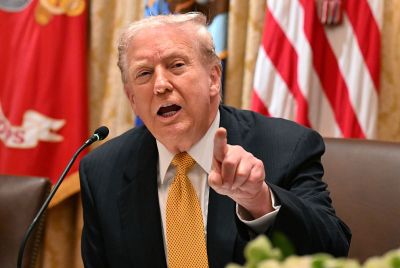
In the post, timestamped around midday, Trump wrote: "Tuesday will be Power Plant Day, and Bridge Day, all wrapped up in one, in Iran. There will be nothing like it!!! Open the Fuckin' Strait, you crazy bastards, or you'll be living in Hell - JUST WATCH! Praise be to Allah. President DONALD J. TRUMP." The message, which quickly amassed tens of thousands of reactions, escalated his ongoing ultimatum over the strategic waterway critical to global oil flows.
The use of the profanity "Fuckin'" marked a notably crude tone even by Trump's unfiltered social media standards, drawing immediate attention from news outlets across the political spectrum. Major media organizations including Reuters, The New York Times, USA TODAY, The Guardian and the BBC described the post as "expletive-laden" or "foul-mouthed," with some anchors issuing viewer advisories before reading excerpts aloud.
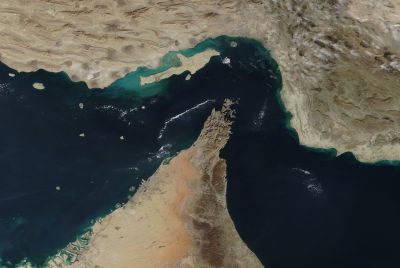
The post ties directly to the ongoing Middle East crisis that has seen Iran effectively restrict traffic through the Strait of Hormuz since U.S. and Israeli strikes began more than a month ago. Trump has repeatedly demanded the waterway's full reopening, issuing deadlines and warning of severe consequences. In Saturday posts, he referenced a 48-hour window, setting the stage for potential action as early as Tuesday.
White House officials declined immediate comment on the specific language or whether the message signals imminent military operations. The Pentagon referred questions to operational channels without confirming or denying any planned strikes on Iranian infrastructure.
Critics and some legal observers raised concerns that threats against power plants and bridges could implicate civilian infrastructure, potentially raising questions under international law. Supporters, however, viewed the blunt rhetoric as characteristic of Trump's "maximum pressure" style and a sign of resolve amid disruptions to global energy supplies.
The timing — Easter Sunday, a major Christian holiday — amplified reactions. Trump had shared separate messages earlier emphasizing faith and the resurrection, making the contrast with the profane Iran post particularly stark for some commentators. Social media users and pundits noted the juxtaposition, with some calling it "unhinged" and others praising it as tough diplomacy delivered directly to supporters.
The Strait of Hormuz disruption has already contributed to fuel shortages and price spikes worldwide, including diesel shortages affecting agriculture in places like Australia. Analysts estimate the near-halt in transits has removed significant daily oil and LNG volumes from markets, driving up costs and insurance premiums for shipping.
Trump's post continues a pattern of using Truth Social — the platform he launched after being banned from major sites following the Jan. 6, 2021, Capitol events — to communicate unvarnished views and bypass traditional media filters. He frequently employs all-caps emphasis, exclamation points and colorful phrasing to rally his base and pressure adversaries.
The closing phrase "Praise be to Allah" added another layer of surprise and debate, with observers speculating on its intent — possibly ironic, sarcastic or aimed at framing the message in terms familiar to the Iranian leadership.
Foreign policy experts offered mixed assessments. Some saw the language as risky escalation that could complicate diplomatic backchannels or provoke retaliation. Others argued it fits Trump's long-standing approach toward Iran, which included withdrawing from the 2015 nuclear deal during his first term and imposing heavy sanctions.
Iranian state media and officials had no immediate detailed response to the specific wording, though Tehran has consistently rejected ultimatums and portrayed its actions in the strait as defensive. Iranian leaders have warned that any attacks on their territory would trigger strong responses.
Congressional reactions split along partisan lines. Some Republican lawmakers defended the president's directness as necessary given the energy security stakes. Democratic voices and a few independents criticized both the profanity and the potential for broader conflict without clearer congressional involvement.
The incident highlights ongoing questions about presidential communication in the social media era. Trump's style energizes supporters who appreciate its authenticity while alarming critics who prefer more measured diplomatic language from the Oval Office.
As of Sunday afternoon, no additional details had emerged from the administration about specific Tuesday plans. Defense officials maintained standard refusals to discuss operational timelines.
The post also comes amid reports of U.S. military actions in the region, including the recent rescue of downed American airmen, which Trump highlighted in separate messages.
For global markets, any escalation rhetoric adds volatility to already sensitive energy trading. Oil futures reacted to the news, though analysts cautioned that actual strikes would carry far broader consequences for supply chains, inflation and regional stability.
Domestically, the colorful language dominated early Easter afternoon news cycles, with cable networks and online platforms dissecting both the substance of the threat and the choice of words on a religious holiday.
Trump has a history of strong language on social media and in rallies, but deploying an F-bomb in an official presidential communication directed at a foreign government remains rare even for him. Past instances have drawn rebukes from etiquette observers and parental groups concerned about children encountering the content.
The president's defenders point out that his base largely embraces the no-holds-barred approach, seeing it as refreshing compared to what they call scripted political correctness from previous administrations.
As Tuesday approaches — referenced explicitly in the post — international observers, shipping companies and energy traders monitor developments closely. Diplomatic efforts, including talks involving multiple nations, continue in parallel, though public statements from Washington and Tehran suggest hardened positions.
The Truth Social post, viewable directly on the platform under Trump's verified account, stands as a raw example of his communication strategy in a high-stakes geopolitical moment. Whether it serves as effective deterrence, complicates negotiations or simply reflects frustration over the ongoing blockade remains subject to intense debate.
In the broader context of U.S.-Iran relations, marked by decades of hostility, nuclear concerns, sanctions and proxy conflicts, Trump's latest message reinforces his commitment to a hard line. The coming days will reveal whether the rhetoric translates into action or functions primarily as public pressure.
For now, the expletive has ensured widespread coverage, turning a serious national security warning into one of the most discussed presidential social media moments in recent memory — all on a day traditionally focused on resurrection and hope.
© Copyright 2026 IBTimes AU. All rights reserved.
- Recommended For You