Trump Explains Deleting AI Jesus Image Post: 'People Were Confused' and Takes Jab at Riley Gaines
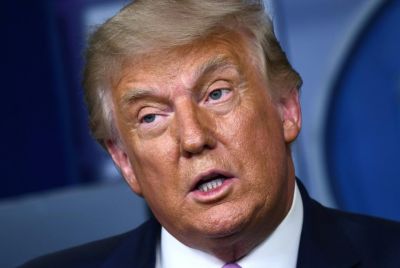
WASHINGTON — President Donald Trump said Monday he deleted an AI-generated image from his Truth Social account that many interpreted as depicting him as a Jesus-like figure because it caused "confusion" among viewers, while insisting the artwork simply showed him as a doctor healing the sick.

The post, which appeared late Sunday night shortly after Trump criticized Pope Leo XIV, featured the president in flowing white and red robes with a radiant light emanating from one hand as he touched the forehead of a man lying in a hospital bed. Doctors, military personnel, an American flag, bald eagles, the Statue of Liberty and fighter jets appeared in the background. The image was removed from Trump's account by Monday morning after drawing swift backlash, including from some of his evangelical and conservative supporters who called it blasphemous.
Speaking to reporters outside the Oval Office, Trump maintained he viewed the picture differently. "I thought it was me as a doctor and it had to do with the Red Cross," he said. "It's supposed to be me as a doctor making people better, and I do make people better. I make people a lot better." He added that medical professionals and Red Cross elements were clearly visible, framing the scene as a lighthearted portrayal of healing rather than religious imagery.
In a later interview with CBS News, Trump elaborated on his decision to take down the post. "Normally I don't like doing that, but I didn't want to have anybody be confused. People were confused," he said. He denied that criticism from conservative activist Riley Gaines or others influenced the removal, insisting only "fake news" would interpret the image as him portraying himself as Christ.
Gaines, a former collegiate swimmer and prominent voice against transgender athletes in women's sports, had publicly questioned the post on X early Monday. "Why? Seriously, I cannot understand why he'd post this," she wrote. "Is he looking for a response? Does he actually think this? Either way, two things are true. 1) a little humility would serve him well 2) God shall not be mocked."
Trump responded directly to Gaines during his CBS interview, saying, "I'm not a big fan of Riley, actually." He dismissed her comments as irrelevant to his actions and reiterated that the image was not meant to evoke Jesus. The exchange marked a rare public rift with a longtime supporter who has appeared with Trump at rallies and events.
The controversy erupted against the backdrop of Trump's ongoing feud with the new Pope Leo XIV, whom he accused Sunday of being "weak on crime" and overly influenced by liberal figures. The AI image followed that tirade, intensifying scrutiny from faith-based groups who saw it as crossing a line.
Evangelical leaders and Catholic commentators expressed discomfort, with some calling the depiction offensive or sacrilegious. Critics across the political spectrum noted the irony, given Trump's strong support among religious conservatives during his campaigns and presidency. The swift deletion fueled further debate about the president's use of artificial intelligence-generated content on his personal platform.
Trump has frequently shared AI-created images and videos on Truth Social, often featuring dramatic or flattering portrayals of himself and his policies. Supporters view them as creative expressions of his messaging, while detractors argue they blur lines between reality and fabrication in an already polarized information environment.
The president's explanation that the image represented him as a doctor aligned with his frequent claims of improving American lives through policy achievements in health care, the economy and national security. He has repeatedly said his administration has delivered better outcomes for citizens, framing himself as a fixer of national ills.
Yet the religious overtones — divine light, robes and a healing gesture reminiscent of biblical scenes — struck a nerve with portions of his base. Some online commentators and faith leaders warned against "mocking God," echoing Gaines' post. Others defended Trump, suggesting the backlash was overblown or driven by media exaggeration.
The incident highlights broader tensions around AI technology in politics. As generative tools become more accessible, leaders and candidates increasingly experiment with them for engagement, but the results can backfire when imagery touches sensitive cultural or religious themes.
Gaines, who rose to prominence advocating for women's sports and has positioned herself as a defender of conservative values, has generally aligned with Trump on cultural issues. Her public criticism, though measured, represented an unusual break and quickly amplified the story across conservative media.
Trump's jab at Gaines may reflect irritation with any perceived disloyalty, even from allies. The president has a history of responding sharply to critics, including those within his own political orbit, when he feels they undermine his narrative.
White House officials offered no additional comment on the deleted post beyond the president's own remarks. Press Secretary Karoline Leavitt did not address the matter directly in Monday's briefing.
The episode comes as Trump navigates multiple domestic and international challenges, including ongoing Middle East tensions and domestic policy debates. His feud with Pope Leo, sparked by the pontiff's comments on the Iran conflict, had already drawn attention before the AI image compounded the headlines.
For Trump's supporters, the controversy may fade quickly as attention shifts to other priorities. Many have dismissed the image as harmless fun or artistic expression, arguing that critics are too sensitive or politically motivated.
Opponents, however, seized on the moment to question Trump's judgment and humility, contrasting the post with traditional Christian teachings on modesty and reverence.
As artificial intelligence continues to reshape political communication, incidents like this one underscore the risks of rapid posting without thorough vetting. Trump's team has not indicated changes to his social media habits, and he remains one of the most active high-profile users of Truth Social.
In the end, Trump framed the entire episode as minor. He told CBS he believed most people understood the doctor interpretation and that only confusion prompted the deletion. His shot at Gaines suggested he remains unapologetic and focused on his own instincts rather than external feedback.
The deleted image, though gone from Truth Social, lives on through screenshots and media coverage, ensuring the debate over its meaning will persist for days. Whether it damages Trump's standing with religious voters or simply becomes another footnote in his unconventional communication style remains to be seen.
For now, the president has moved on, leaving the brief but intense firestorm over an AI-generated Jesus-like figure as another example of how quickly digital imagery can ignite cultural and political passions in 2026 America.
© Copyright 2026 IBTimes AU. All rights reserved.
- Recommended For You