

(VIDEO) Labrador Rescued From Ben Nevis, UK's Tallest Mountain, After Owner Feared Dog Would Die From Cannabis
Labrador's Mountain Rescue Highlights Hidden Dangers of Discarded Drugs on Hiking Trails
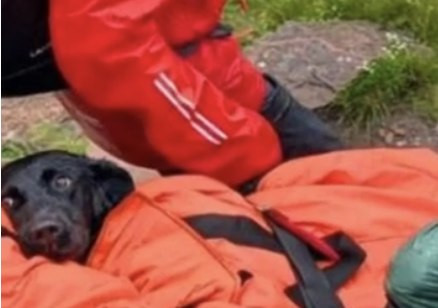
A black Labrador had to be stretchered off Ben Nevis, the United Kingdom's highest mountain, last weekend after falling critically ill from what vets believe was discarded cannabis ingested along the trail, leaving her owner fearing the worst before the dog made a full recovery.
Christina Bluhme, a dog trainer from Esher, Surrey, was halfway up the 4,413-foot peak in Scotland with her dog, Tokyo, when the labrador suddenly lost the use of her legs and began drifting in and out of consciousness, according to the BBC. Members of the Lochaber Mountain Rescue Team responded to the scene and stretchered the unconscious dog down the mountain to a local veterinary clinic in Fort William.
Bluhme described the ordeal as one of the most terrifying experiences of her life. "One of the most frightening days I've ever experienced," she said, adding, "I genuinely thought I was going to lose her." She credited the mountain rescue team with making the difference between a safe outcome and a far worse one. "Without the incredible Lochaber mountain rescue team, there is simply no way I could have got her safely off the mountain," Bluhme said. "Carrying a 25kg labrador down Ben Nevis was impossible on my own."
Vets believe Tokyo ingested cannabis that had been left on the trail, according to the BBC, and the dog made a full recovery the following day. Bluhme said she felt "incredibly lucky" that Tokyo had survived and offered thanks to both the rescue crew and the veterinary team who treated her dog. "You were there when we needed you most," she said, praising their "compassion and dedication."
Bluhme also used the experience to caution other dog owners about a hazard she said she had never anticipated encountering during an outdoor hike. "A little reminder to fellow dog owners — please be aware that discarded drugs and other toxic substances can sometimes be found even in the most beautiful outdoor places," she said. "It was something I never imagined we would encounter."
The Lochaber Mountain Rescue Team said it was relieved by Tokyo's full recovery and praised the veterinary team that treated her. A spokesperson for the team described the dog as an otherwise healthy, active animal whose sudden collapse pointed to something she had ingested rather than a preexisting condition. "It's now suspected that Tokyo, a usually very fit and active working dog, had ingested something that made her critically unwell," the spokesperson said. "Many thanks to Crown Vets for their support, and to Tokyo's owner for the update and photos."
Veterinary experts say dogs are particularly vulnerable to cannabis exposure compared with humans, owing to fundamental differences in brain chemistry. According to Vets Now, a UK veterinary emergency service, dogs' brains contain more cannabinoid receptors than human brains do, meaning marijuana tends to affect dogs more intensely than it would a person consuming a similar relative amount. When dogs ingest cannabis, symptoms typically appear within 30 to 90 minutes and can include loss of balance, stumbling, an inability to stand, dribbling urine, dilated pupils and glassy eyes, a symptom profile broadly consistent with what Bluhme described witnessing in Tokyo on the trail.
Tokyo's case is not the first of its kind reported in recent years. In a similar incident in Somerset in 2024, two dogs named Margot and Willow became unwell and were unable to stand after consuming human waste containing cannabis while walking in the Winscombe nature reserve, according to prior reporting. That earlier case, like Tokyo's, underscored how discarded drug residue in popular outdoor recreation areas can pose an unexpected hazard to pets even in locations that appear otherwise clean and well-maintained.
Ben Nevis, located near Fort William in the Scottish Highlands, is the highest mountain in the British Isles and one of the UK's most popular hiking destinations, drawing tens of thousands of walkers and climbers annually via its well-established Mountain Track route, sometimes referred to as the "Tourist Path." The mountain's popularity, combined with heavy foot traffic along its main trail, has occasionally led to littering concerns, though incidents involving pets falling seriously ill from ingesting discarded substances along the route remain relatively rare.
The Lochaber Mountain Rescue Team, based in Fort William, is a volunteer organization responsible for responding to emergencies across Ben Nevis and the surrounding Lochaber region, handling a range of incidents involving hikers, climbers and, less commonly, animals in distress. Rescue operations involving unconscious or immobile large dogs present a particular physical challenge given the weight involved and the often steep, uneven terrain found on sections of the mountain, a difficulty Bluhme acknowledged directly in describing why she could not have managed to carry Tokyo down on her own.
Veterinary professionals generally advise that pet owners who suspect their animal has ingested cannabis or another toxic substance seek immediate veterinary care, given how quickly symptoms can escalate and how difficult it can be for owners to determine the exact substance or quantity involved without professional evaluation. While cannabis toxicity in dogs is rarely fatal when treated promptly, it can cause significant and frightening symptoms in the short term, including the kind of severe neurological effects that led Bluhme to fear she was about to lose her dog on the mountainside.
Bluhme's account has drawn renewed attention to the broader issue of litter and discarded substances in popular outdoor spaces across the UK, with her warning to fellow dog owners framed as a call for greater awareness rather than blame directed at any specific individual or group. As hiking and outdoor recreation continue to grow in popularity across Scotland and the wider UK, veterinary experts and rescue organizations alike have continued to emphasize the importance of keeping dogs on leads or under close supervision in high-traffic areas, along with prompt veterinary attention any time a pet begins showing sudden, unexplained symptoms of distress while outdoors.
© Copyright 2026 IBTimes AU. All rights reserved.