

(PHOTO) Oakland Zoo Rescues Five Abandoned Tigers From Shuttered California Roadside Facility
Rescue highlights ongoing efforts to protect big cats from private ownership and commercial exploitation
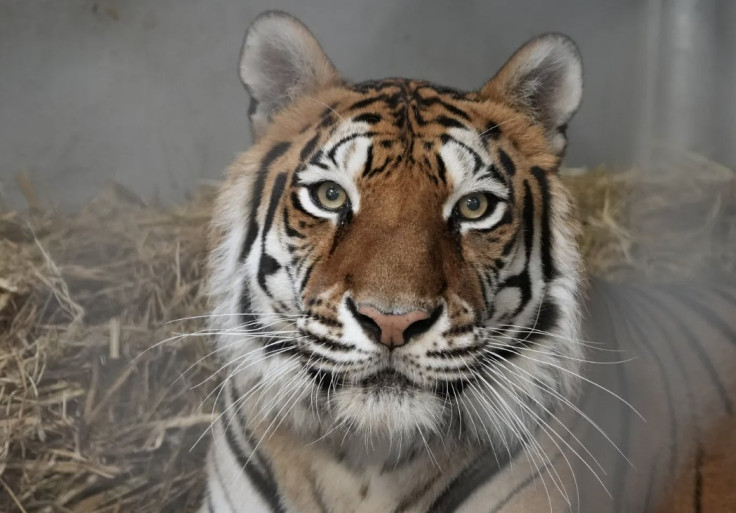
Five tigers abandoned at a shuttered private facility in Northern California have been rescued by big cat experts from the Oakland Zoo, with one of the animals set to remain permanently at the zoo as her new home, officials announced this week.
The rescue effort was carried out as part of the Oakland Zoo's ongoing work to provide expert care, rehabilitation and permanent placement for animals affected by private ownership and the commercial wildlife trade. "Oakland Zoo has successfully transferred these tigers after a private owner reached out to the Zoo for assistance in finding suitable placement, following their abandonment at his facility," zoo officials wrote in a statement.
The tigers had previously lived at a roadside facility in Oroville, California, that animal rights organization PETA has described as the "Worst Roadside Zoo in America." According to PETA, the tigers were bred by a series of dealers the organization characterized as disreputable and were prematurely separated from their mothers so they could be used in cub-petting photo sessions, a practice widely criticized by animal welfare advocates for the harm it causes to young big cats.
Among the five rescued tigers is Sitara, an estimated 13-year-old female whose name means "star" in Hindi. Sitara has become a permanent resident at the Oakland Zoo following her rescue. Zoo officials said she remains strong overall but is currently experiencing some lameness in her left hind leg, and the zoo's animal care and veterinary team is working closely with her to help her adjust to her new environment.
Because Sitara previously lived in more restrictive conditions, zoo staff are helping her gradually learn to navigate features of her new habitat that she has likely never encountered before, including pools, a waterfall, raised platforms and natural vegetation. "All things she hasn't had before," the zoo wrote in its statement, adding that staff are also launching a dedicated program aimed at helping Sitara rebuild trust and resilience following past experiences with previous caretakers.
The remaining tigers in the group were relocated to accredited sanctuaries through partnerships the Oakland Zoo maintains with other wildlife organizations. Three of the five tigers were placed at new facilities with the help of the Performing Animal Welfare Society, known as PAWS, based in California, and the Turpentine Creek Wildlife Refuge, located in Arkansas. Both organizations are accredited by the Global Federation of Animal Sanctuaries and hold membership in the Big Cat Sanctuary Alliance, industry groups that set standards for the humane, long-term care of captive big cats.
A 14-year-old female white tiger among the rescued group, who suffers from visual impairment linked to inbreeding, received intermediate care at the Oakland Zoo before being relocated to Turpentine Creek Wildlife Refuge for long-term placement. Zoo officials explained that white tigers result from a rare genetic mutation known as leucism, and that breeding programs aiming to produce white-coated offspring typically require pairing two tigers that both carry the recessive gene responsible for the trait. Because those breeding pairs are frequently closely related to one another, the resulting inbreeding can lead to a range of health complications, including blindness, according to the zoo.
Two additional tigers from the group, a male white-and-Bengal tiger mix and a male Siberian tiger mix, were relocated to PAWS, which zoo officials said specializes in providing expert, lifelong care for animals rescued from similar circumstances.
The fifth and final tiger in the group, roughly 16 years old, faced severe health challenges at the time of the rescue. According to the Oakland Zoo, the animal's condition ultimately left no viable path toward recovery or safe placement elsewhere. "Ultimately, the kindest option for this tiger was humane euthanasia," the zoo wrote in its statement, describing the decision as one made in the animal's best interest given the severity of its health problems.
Amy Phelps, the Oakland Zoo's zoological manager, said the rescue reflects the broader mission behind the zoo's work with animals coming out of private ownership and the exotic pet trade. "Projects like this remind us that animal welfare is profoundly personal, and one of the most meaningful things we can do is change the life of one individual," Phelps said. "These tigers have been given a future with greater stability, greater opportunity, and greater peace."
The rescue is far from an isolated case for the zoo. Since 2021, the Oakland Zoo has received more than 250 requests for assistance involving rescue operations tied to the wildlife pet trade, roadside zoos and other forms of exotic animal trafficking, according to zoo officials. The organization has previously taken part in high-profile rescues, including tigers connected to the "Tiger King" documentary series, which drew widespread public attention to the private ownership and breeding of big cats in the United States.
Zoo officials pointed to progress made since the passage of the Big Cat Public Safety Act, a federal law signed in 2022 that has curbed private ownership and commercial breeding of big cats nationwide, reduced the prevalence of cub-petting operations, and blocked new private owners from acquiring big cats going forward. Despite that legislative progress, officials said cases like the one involving Sitara and the four other rescued tigers demonstrate that further work remains necessary to fully protect the animals and educate the public.
"Sitara and the other recently transferred tigers serve as reminders that more can be done to protect big cats and to educate visitors and supporters about responsible choices," zoo officials wrote. "The core issue in the tiger crisis is the breeding of big cats to supply the cub-petting industry, including pay-to-pose photo opportunities."
The Oakland Zoo said it will continue working with partner sanctuaries and welfare organizations to respond to future cases involving abandoned or mistreated big cats, as the broader effort to phase out unregulated private ownership of exotic animals continues across the country.
© Copyright 2026 IBTimes AU. All rights reserved.