

China's Tianwen-2 Probe Reaches Earth's Quasi-Moon Kamo'oalewa, Sends Back First Close-Up Images Ever
Tianwen-2's mission reshapes understanding of Kamo'oalewa, offering insights into the solar system's early history.
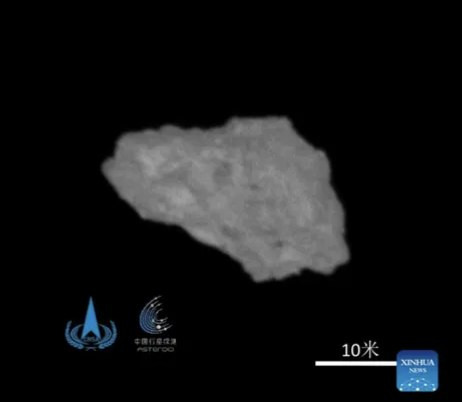
China's Tianwen-2 spacecraft has successfully rendezvoused with Kamo'oalewa, a small asteroid that trails Earth in a stable quasi-satellite orbit, capturing the first-ever close-up images of the object after a journey spanning roughly 620 million miles over 400 days in deep space.
The China National Space Administration announced the spacecraft's arrival on July 6, revealing that Tianwen-2 had captured its initial images from a distance of about 20 kilometers on July 2. The mission first optically detected Kamo'oalewa on June 6, followed by a capture maneuver on June 7 that brought the probe to within roughly 30,000 kilometers of the asteroid. By June 19, the spacecraft had closed the distance to about 2,000 kilometers before settling into its current station-keeping position closer to the surface.
Tianwen-2 launched May 29, 2025, from the Xichang Satellite Launch Center aboard a Long March 3B rocket, marking the first time that particular vehicle has delivered a payload directly onto an Earth-escape trajectory. The mission represents China's second interplanetary spacecraft, following Tianwen-1's successful landing of a rover on Mars in 2021, and its first attempt at collecting and returning a sample from a near-Earth asteroid.
The early images have already reshaped scientific understanding of the object itself. Ground-based observations had previously estimated Kamo'oalewa's diameter at somewhere between 40 and 100 meters, but Tianwen-2's close-up imagery suggests the asteroid is considerably smaller, at roughly 20 meters across, or a little over 66 feet, a size comparable to a school bus. That figure closely matches an estimate of 18 meters, plus or minus 2 meters, published in a preprint by University of Arizona researcher Benjamin Sharkey and colleagues, based on thermal emission modeling using the James Webb Space Telescope.
The revised size estimate carries scientific weight beyond simple measurement, because it directly affects calculations of the asteroid's albedo, or how much sunlight it reflects. A smaller object producing the same observed brightness implies a much higher surface reflectivity than previously assumed. Mikael Granvik, an astronomer at the University of Helsinki and Luleå University of Technology in Sweden, told SpaceNews that the first Tianwen-2 image "basically confirms" the high geometric albedo suggested by the Sharkey team's analysis, a finding not compatible with the low-to-moderate albedo typically associated with lunar material.
That detail has reignited debate over one of the central scientific questions surrounding Kamo'oalewa: whether the asteroid is a fragment blasted off the moon by an ancient impact, or a piece of an ordinary silicate asteroid that migrated into Earth's orbital neighborhood from elsewhere in the solar system. Since 2021, researchers had generally favored the lunar-origin hypothesis, based on reflected-light spectra that closely resembled space-weathered lunar regolith collected during NASA's Apollo missions, with a 2024 study proposing the asteroid could have been ejected by the same impact that formed the moon's Giordano Bruno crater between 1 million and 10 million years ago.
More recent evidence has complicated that picture. New JWST observations from earlier this year, along with follow-up data collected using the Large Binocular Telescope in April, showed Kamo'oalewa's infrared color signature to be notably less reddened than the 2021 ground-based measurements, aligning more closely with ordinary silicate asteroids than with lunar material. Separately, an international research team that included scientists from the Chinese Academy of Sciences published a paper in May proposing that Kamo'oalewa's spectral characteristics more closely match LL chondrite meteorites, a class of stony meteorite with relatively low iron and metal content. Laboratory experiments simulating space weathering on LL chondrite powder produced results closely matching observational data of the asteroid, leading researchers to suggest Kamo'oalewa may have originated from the Flora family, a cluster of bodies located in the main asteroid belt rather than on the moon.
Han Siyuan, deputy director of the Lunar and Space Exploration Engineering Center and spokesperson for the Tianwen-2 mission, said the asteroid's material could offer rare insight into the earliest period of the solar system's history. "It is highly likely to contain primordial information from the early days of the solar system's formation, and it holds great scientific value for studying early material composition, formation processes, and evolutionary history," Han said.
Outside researchers have also expressed enthusiasm about the mission's technical achievement. Sara Russell of the London Museum of Natural History called the rendezvous a remarkable feat of navigation and engineering. "It seems an amazing achievement to observe and reach such a small object," Russell said. "I am excited about the mission, as it is a sample-return, bringing a fragment to Earth."
Tianwen-2 now faces its most difficult phase: physically landing on the asteroid and collecting a surface sample. Kamo'oalewa rotates rapidly, completing a full rotation roughly every 27 to 30 minutes, and its small size leaves little margin for error during any contact maneuver. The spacecraft carries 11 scientific instruments, including multiple cameras of varying focal lengths, spectrometers, a magnetometer, sounding radar and particle analyzers, along with a detachable camera reserved specifically for documenting the sample-collection process. Mission planners have equipped the probe with three different sampling techniques, including hovering above the surface to gather loose particles, a brief touch-and-go maneuver using a gas-driven collection head, and anchoring directly to the surface for harder terrain, giving the mission flexibility depending on what its instruments reveal about the asteroid's composition and structure in the coming months.
If successful, Tianwen-2 aims to collect between 20 and 100 milligrams of material from Kamo'oalewa's surface, which it will carry through a full solar orbit before releasing a return capsule during a flyby of Earth, with a landing currently expected around late 2027. Should the mission succeed, it would mark China's first asteroid sample-return effort, following earlier successful missions by Japan's Hayabusa and Hayabusa2 spacecraft and NASA's OSIRIS-REx mission, both of which previously returned material from other near-Earth asteroids.
After completing its work at Kamo'oalewa, expected to take roughly two and a half years in total, Tianwen-2 is slated to continue on to a second target: comet 311P/PANSTARRS, a body located in the main asteroid belt beyond Mars, with arrival anticipated around 2035. If that leg of the mission is also completed successfully, Tianwen-2 would become the first spacecraft to visit and study both a near-Earth asteroid and a main-belt comet during a single mission.
© Copyright 2026 IBTimes AU. All rights reserved.