5 Biggest Competitors Challenging SpaceX's Dominance of the Space Industry in 2026
Despite SpaceX's dominance, competitors like Blue Origin and Rocket Lab are making strides in the space launch market.
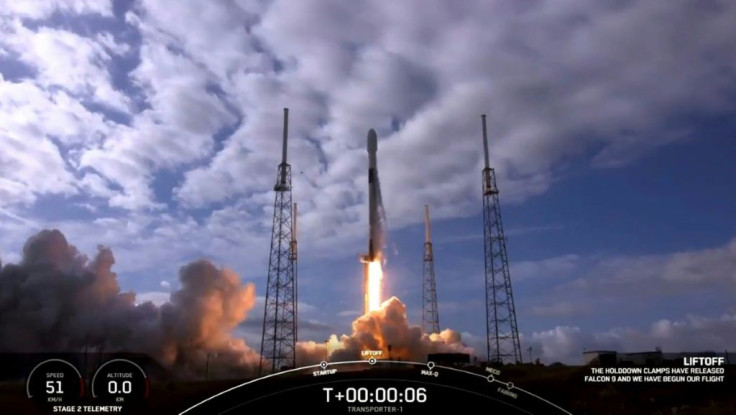
Despite controlling roughly 87% of global orbital launch mass and commanding a market valuation exceeding $2.5 trillion following its June IPO, SpaceX faces a growing field of rivals working to chip away at its lead across launch services, satellite connectivity, and emerging orbital infrastructure. Here are the five competitors generating the most serious attention.
1. Blue Origin
Jeff Bezos's space company remains SpaceX's most direct and closely watched rival, having made genuine technical progress even while trailing significantly in operational scale. Jeff Bezos-backed Blue Origin's New Glenn flew its first commercial missions in early 2026 and picked up a NASA lunar cargo contract worth up to $468 million. It has heavy-lift capacity well above Falcon 9's but a fraction of the flight history.
That heavy-lift advantage is genuine on paper. On payload, Blue Origin's New Glenn actually beats Falcon 9, though it hasn't flown nearly often enough to prove that capacity translates into reliable, repeatable service. New Glenn can lift 45 metric tons to low Earth orbit, with launch costs estimated at $67 million per flight.
The company suffered a significant setback recently that has widened the operational gap further. Blue Origin is currently grounded following a launchpad explosion on May 28, 2026, an incident that has further widened the gap with SpaceX, given that Blue Origin's launch cadence before the explosion was already very low compared to SpaceX's pace of multiple Falcon 9 launches per week.
2. Rocket Lab
Among publicly traded competitors, Rocket Lab has emerged as one of the premier opportunities for investors seeking exposure to the broader space economy. Founded in 2006, Rocket Lab is the developer of the Electron rocket, which was the second most-frequently launched U.S. launch vehicle, successfully completing 21 launches in 2025 — a record year for the company.
Rocket Lab's ambitions extend well beyond its existing small-satellite niche. The Neutron medium-lift rocket, targeting a 2026 maiden flight, will compete directly with Falcon 9 for constellation deployment and medium-payload missions. Rocket Lab spokesperson Murielle Baker highlighted the underserved market the company is targeting: "There is a practical monopoly in the medium-lift launch market right now, with really only one operational vehicle." The company entered the year with a $1.85 billion backlog, and it plans to recognize 37% of that backlog by 2027.
Even Rocket Lab's own leadership acknowledges the scale of SpaceX's continued advantage. Rocket Lab CEO Peter Beck put the competitive dynamic bluntly: "There's nobody else that's demonstrating launch cadence and reliability other than SpaceX and us."
3. Amazon, Through Project Kuiper
E-commerce and cloud computing giant Amazon represents a different kind of competitive threat, aimed less at SpaceX's launch business and more directly at its lucrative Starlink satellite internet operation. Amazon's Project Kuiper plans to take on SpaceX's Starlink. As of early 2026, Starlink reportedly had more than 10,000 active satellites providing internet and mobile phone services to more than 10 million global subscribers.
Project Kuiper faces a genuinely paradoxical competitive position, however. Kuiper is the most significant competitive threat to Starlink, but it faces a paradoxical situation: Kuiper must launch on competitors' rockets — including ULA's Vulcan, Blue Origin's New Glenn, and even SpaceX's own Falcon 9 — effectively funding its rival while attempting to compete. Kuiper's 3,236-satellite constellation is fully licensed, but an FCC mandate requiring 50% deployment by July 2026 is a deadline likely to be missed, creating regulatory risk for the project.
4. China's State-Backed Launch Programs
Beyond American competitors, China's rapidly advancing space program represents what analysts describe as the most structural shift in the global competitive landscape. China's progress is the most structural shift: Zhuque-3 and Long March 12A are reusable, methane-fueled rockets explicitly built to match Falcon 9 on cost per kilogram, and the country flew a record 83 orbital missions in 2025, with state-backed megaconstellations guaranteeing launch demand for years to come.
Despite that rapid progress, SpaceX maintains a substantial lead specifically in proven reusability. On reuse, SpaceX still leads by a wide margin: it had roughly 400 orbital booster recoveries by April 2026, dwarfing China's combined total of a few dozen and Blue Origin's single-digit count. SpaceX's S-1 prospectus disclosed that the company launched 2,213 metric tons to orbit in 2025, more than 80% of total global mass-to-orbit for the year — compared to China's CASC, the second-largest launch provider globally by orbital launches, which carried an estimated fraction of SpaceX's total.
5. United Launch Alliance
The joint venture between Boeing and Lockheed Martin remains one of SpaceX's most established competitors, particularly within U.S. government and national security launch contracts. United Launch Alliance has a track record of 150 consecutive successful launches, and it aims to achieve unprecedented results with its new Vulcan rocket family. After completing just six launches in 2025, ULA said in February that it plans to accelerate activity in 2026 and complete 20 to 25 launches this year.
ULA's central challenge remains cost, given that the company has not achieved the kind of reusability that defines SpaceX's pricing advantage. ULA's Vulcan Centaur costs $100-120 million per launch with zero recovery, making it 60-80 times more expensive per kilogram than a high-cadence Falcon 9.
Honorable Mention: Firefly Aerospace
Among emerging public companies, Firefly Aerospace has also drawn growing attention as a launch services and lunar specialist combined into one. The company's rocket made the first and only completely successful private moon landing mission, when its Blue Ghost lander touched down upright, remained healthy, and completed all scheduled surface operations. Firefly reported revenue of $160 million in 2025, representing year-over-year growth of 163%, with management forecasting 2026 revenue between $420 million and $450 million.
A Market With Room for Multiple Winners
Despite SpaceX's continued dominance across nearly every measurable metric, analysts note that the broader commercial launch market's rapid expansion is creating genuine space for multiple competitors to succeed without directly unseating the industry leader. The satellite launch market grew 15.1% from $10.34 billion in 2024 to $11.9 billion in 2025, with projections estimating the market could reach $22.18 billion by 2029.
What's driving that growth across all competitors is the same underlying demand: satellite megaconstellations that need thousands of repeat launches over their lifetime, not a single mission. That kind of recurring demand is what turns a one-time technology lead into a market large enough to support several winners at once.
With SpaceX continuing to push toward full operational status for its next-generation Starship vehicle, and with rivals like Blue Origin, Rocket Lab, and China's state-backed programs all racing to bring their own reusable hardware online, the competitive landscape over the remainder of 2026 will likely hinge on which companies can convert promising technology into the kind of proven, repeatable flight cadence that has defined SpaceX's enduring advantage. As aerospace engineer Chris Combs of the University of Texas at San Antonio put it, "More players in the market is good for competition... I think for the foreseeable future it will still be hard to compete with SpaceX on price."
© Copyright 2026 IBTimes AU. All rights reserved.
- Recommended For You