

(VIDEO) Yellowstone Bull Bison Tosses Tourist 8 Feet Into Air in Terrifying Video, Leaving Man Hospitalized
Unexpected Bison Charge Leaves Tourist Hospitalised at Yellowstone
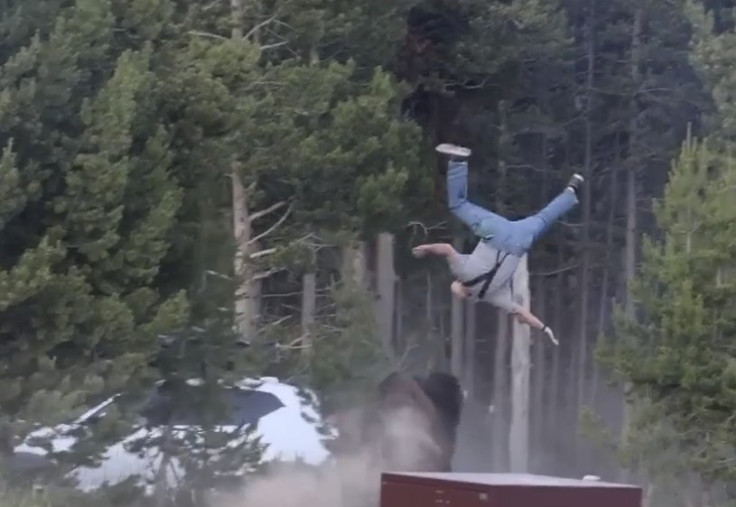
A tourist was seriously injured Friday evening after an agitated bull bison charged and launched him roughly eight feet into the air at Yellowstone National Park, in an encounter captured on video by a professional photographer camping nearby.
The incident occurred at the Bridge Bay Campground, located south of Fishing Bridge inside the park, according to Mike MacLeod, a professional photographer from Bozeman, Montana, who witnessed and recorded the attack. MacLeod said the victim, an older man, was walking with his young grandson when the bison, already visibly agitated, made the pair the target of its aggression.
A tourist was seriously injured after a bison tossed them about 8 feet into the air in Yellowstone National Park. The attack was captured on video by photographer Mike Macleod. pic.twitter.com/ZtGTb32Gee
— Breaking911 (@Breaking911) July 12, 2026
MacLeod, who was camping at Bridge Bay when his wife first spotted the bull bison entering the area, said he grabbed his camera and began filming from what he believed was a safe distance. "I was just trying to get some dramatic footage of that bison having a fit," MacLeod told Cowboy State Daily. "It's changed my idea of what to expect from these guys at this time of year, because I would not have predicted that happening."
According to MacLeod's account, the bison initially charged a group of children who were photographing it from a distance on their cellphones, though the children were able to safely scatter. The animal then turned its attention toward a sapling before ultimately chasing after the victim and his grandson as they attempted to move away behind nearby trees. The bison hooked the man with its left horn on his hip and tossed him into the air, sending him into what MacLeod described as a full flip before he landed on his side. "The bison was at least 6 feet tall, and he was several feet above him," MacLeod said.
MacLeod said the man and his grandson had been standing at what would generally be considered a safe distance from the animal, estimated at roughly 100 yards, when the bison suddenly charged. The National Park Service requires visitors to remain at least 25 yards, or 75 feet, away from bison at all times, given the animals' unpredictable behavior and physical power. Bison can weigh close to a ton and run at speeds up to roughly 30 miles per hour, more than three times faster than the average human.
After the man hit the ground, MacLeod said the bison stood over him briefly, shaking its head in apparent agitation, raising fears among bystanders that the animal might continue its attack. MacLeod said he made the decision to intervene despite the risk. "I had to get the bison's attention," MacLeod said. "I was really afraid he was going to gore the guy on the ground, so I stopped videotaping and ran at the bison, yelled loud, and was trying to be as big and intimidating as possible." Other bystanders followed MacLeod's lead, shouting and approaching the animal until it ultimately ran off, allowing people nearby to rush to the injured man's aid.
MacLeod, who said he previously worked as a combat photographer in the Army, credited his past experience with helping him stay composed during the incident. "I used to be a combat photographer in the Army," MacLeod said. "I could see this thing coming."
Yellowstone's Emergency Medical Services responded to the scene and provided initial treatment to the victim, who was reported to be in significant pain, particularly in his hips and the leg on which he landed. The man sustained serious injuries, including a broken hip, and remained hospitalized as of Saturday. His name has not been publicly released by park authorities or his family. The man's grandson, who escaped the encounter unharmed, later told MacLeod that his grandfather was "not out of the woods yet" and continued to experience considerable pain following the attack.
MacLeod said he found it difficult to understand why the bison singled out the victim and his grandson specifically, given that other visitors were positioned closer to the animal at the time. "I've been around bison for a while, but this was really weird," MacLeod said. "Why did it pick those two? There were so many people around, and most of them were closer to and behind the bison. It was really weird." MacLeod added that, unlike many similar incidents in the park, no one involved appeared to have acted carelessly around the animal. "I didn't see anybody getting close," he said. "People were yelling, 'Careful, there's a bison coming through,' and they kept their distance. They were very respectful."
The National Park Service had not issued a formal statement addressing the specific incident as of Saturday. Park officials and wildlife experts consistently caution that bison, despite their sometimes docile appearance, are wild animals capable of sudden and unpredictable aggression, particularly during their annual rutting season, which typically runs from June through September and can heighten agitation among bulls.
Friday's incident marked the second confirmed human-bison encounter reported in Yellowstone so far this year. The first occurred June 26, when a 12-year-old was injured near Mud Volcano, an area located north of Fishing Bridge. Yellowstone has recorded a string of similar bison-related injuries in recent years, part of a broader pattern of wildlife encounters that park officials and safety advocates say underscores the ongoing risks tourists face when approaching or unexpectedly encountering large animals inside the park.
Bison remain one of Yellowstone's most iconic and heavily visited attractions, drawing visitors from around the world hoping to observe the animals in their natural habitat. Wildlife researchers have noted that bison also play a significant ecological role within the park, with their grazing patterns credited with helping sustain the nutritional quality of Yellowstone's grasslands. Despite that ecological importance, park officials continue to stress that visitors must maintain safe distances at all times, noting that even individuals who believe they are following recommended guidelines can still find themselves targeted by an animal that becomes suddenly agitated, as appeared to be the case in Friday's incident.
As of Saturday, the extent of the victim's ongoing medical treatment and prognosis had not been publicly detailed, and it remained unclear whether the National Park Service planned to release further information about the circumstances surrounding the attack in the days ahead.
© Copyright 2026 IBTimes AU. All rights reserved.