KOSPI Extends Historic Two-Day Plunge as SK Hynix Earnings Miss Deepens Global AI Chip Stock Sell-Off
KOSPI Index Experiences Record Two-Day Decline Due to AI Sector Uncertainty

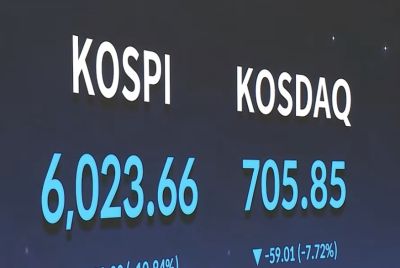
South Korea's benchmark stock index tumbled nearly 6% on Wednesday, extending a historic two-day rout that has wiped out more than a tenth of the market's value as investors dumped shares of chipmakers over mounting doubts about the sustainability of the artificial intelligence spending boom.
The KOSPI closed down 360.42 points, or 5.98%, at 5,663.24, according to Korea Exchange data. The decline followed an even steeper drop of nearly 11% on Tuesday, marking the index's worst two-day stretch on record, with combined losses exceeding 12.6%. The benchmark, which had topped 9,000 points as recently as its 52-week high, is now down more than 39% from that peak.
The session began on an optimistic note, with the KOSPI opening 1.09% higher at 6,089.11 and briefly extending gains to as much as 3.4%. But the rally reversed sharply around mid-morning, and by early afternoon the index had plunged as much as 12.63% intraday before paring some of those losses into the close.
The renewed selling was triggered by earnings from SK Hynix, one of the two chipmakers that together account for more than half of the KOSPI's total market weighting. The company reported that its operating profit soared sixfold from a year earlier to a record 60.5 trillion won, or roughly $41.2 billion, but the figure still fell short of analysts' forecasts. Investors, already nervous about stretched valuations across the AI hardware sector, treated the miss as a signal that explosive earnings growth tied to artificial intelligence infrastructure may be starting to moderate. SK Hynix shares fell more than 9% on the day, after sinking even further during intraday trading. Samsung Electronics, the KOSPI's other dominant weight, dropped more than 5%.
Because Samsung and SK Hynix together make up such a large share of the index, analysts say the KOSPI has effectively become a direct proxy for global sentiment toward AI hardware spending, stripping South Korean equities of the diversification benefits international investors once sought in the market. That concentration has amplified the swings in both directions over the past year, but it left the index especially exposed once cracks began to show in the AI trade this week.
The rout triggered market circuit breakers and sell-order sidecars on both the KOSPI and the smaller KOSDAQ index for a second consecutive session, the first time on record that both mechanisms have been activated on back-to-back trading days, according to the Korea Exchange. A sidecar temporarily halts program sell orders, while a circuit breaker suspends trading entirely for 20 minutes once an index falls 8% or more and holds at that level for a full minute.
The KOSDAQ, which tracks smaller and more growth-oriented companies, fell 6.12% to close at 662.68, after slumping as much as 10.6% during the session. Losses were broad-based across sectors, with electrical and electronics stocks down more than 8%, non-metallic minerals down over 7.5%, and metals, general services, medical equipment, construction, finance and manufacturing shares all falling more than 6%.
Foreign investors and institutions were modest net buyers during the session, purchasing a combined 483 billion won worth of shares, while individual investors were net sellers of roughly 480 billion won, suggesting retail traders bore the brunt of the panic selling even as larger players moved to pick up shares at lower prices.
Analysts pointed to several forces compounding the sell-off beyond SK Hynix's results. Growing skepticism about whether AI infrastructure spending has peaked has combined with intensifying competition from Chinese memory chip manufacturers, who have made rapid technological gains. The successful stock listing of Chinese memory maker CXMT and reports that Chinese firms have developed advanced deep ultraviolet lithography equipment further rattled investors already worried about South Korea's chip industry losing its competitive edge. Elevated retail participation in leveraged exchange-traded funds tracking semiconductor stocks has also amplified volatility in both directions.
The sell-off in Seoul mirrored steep losses across U.S. chip stocks overnight, where the Philadelphia Semiconductor Index fell for a fourth consecutive session. Micron Technology dropped nearly 9%, Advanced Micro Devices fell more than 8%, Intel slid almost 6%, and Qualcomm and Western Digital both posted losses of more than 4%. SK Hynix's U.S.-listed depositary receipts fell nearly 9% as the sell-off extended into a third straight session on Wall Street.
Other major Asian markets also weakened Wednesday, with technology-heavy indexes in Japan and China trading lower as the semiconductor rout spread across the region. Markets in Australia and Hong Kong were notable exceptions, outperforming the broader regional trend as investors rotated into sectors seen as less exposed to the AI hardware slowdown, including banks, miners and healthcare stocks.
Adding to investor unease, the U.S. military said Wednesday it had intercepted a surprise Iranian attack targeting American troops stationed across the Middle East, reigniting regional geopolitical tensions and pushing oil prices higher. The development added a fresh layer of uncertainty to markets already grappling with the fallout from the chip sector's earnings disappointment.
Market analysts widely expect that any meaningful rebound in South Korean equities will take time to materialize, given the scale of the losses and the depth of investor skepticism now surrounding the AI spending narrative that had driven the KOSPI to record highs earlier this year. The index remains down more than 34% over the past month, even as it stays well above levels from a year ago.
© Copyright 2026 IBTimes AU. All rights reserved.
- Recommended For You