(VIDEO) Secretary Rubio Hosts Austrian Foreign Minister at State Department for Key Partnership Talks
High-level talks focus on security, economic cooperation, and regional conflicts
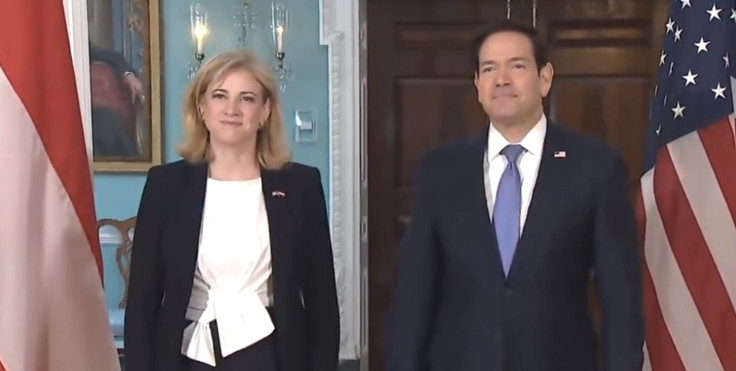
WASHINGTON — U.S. Secretary of State Marco Rubio met with Austrian Foreign Minister Beate Meinl-Reisinger at the State Department on Tuesday, continuing a series of high-level discussions aimed at strengthening bilateral ties amid ongoing global challenges.
The meeting took place in the Treaty Room, where the two diplomats arrived together for talks focused on shared interests in security, economic cooperation and responses to regional conflicts. Meinl-Reisinger posted earlier in the day that she was back in Washington at Rubio's invitation, noting the need for Europe and the United States to remain closely engaged as the world faces growing disorder and geopolitical uncertainty. She expressed interest in discussing common interests and ways to further strengthen the transatlantic partnership.
U.S. Secretary of State Marco Rubio met with Austrian Foreign Minister Beate Meinl-Reisinger at the State Department. pic.twitter.com/tupU8VJROG
— Breaking911 (@Breaking911) August 11, 2026
This encounter builds on previous engagements between the two officials. In July 2025, Rubio and Meinl-Reisinger met in Washington to discuss efforts to protect sensitive research and technologies, as well as steps to address conflict in the Middle East. Rubio welcomed significant investments from Austrian companies in the United States at that time. A separate call earlier that year covered democratic values and security in Europe, Austrian investment opportunities, dual-use industrial cooperation, increased European defense spending, stability in Bosnia and Herzegovina, and the need for a ceasefire in Ukraine.
Austria and the United States maintain a strategic partnership dating to 2019. Nearly 1,000 Austrian companies operate in the United States, employing more than 60,000 people. Firms such as Red Bull and Borealis are among those with substantial U.S. presence. Austrian officials have previously emphasized the importance of planning security for these investments, particularly in light of broader transatlantic trade discussions.
Meinl-Reisinger has underscored the United States' role as a key strategic partner for Austria during challenging geopolitical periods. In past statements, she highlighted shared efforts to pursue peace in Ukraine and the Middle East alongside strong economic relations. On the Middle East, she has called for an immediate ceasefire, the release of hostages, and unrestricted humanitarian access, describing the United States as indispensable as a mediator.
The latest meeting occurs against a backdrop of continued focus on European security architecture and the need for greater European contributions to collective defense. U.S. officials have repeatedly encouraged European nations to increase defense spending and assume a larger share of responsibility for regional stability. Discussions also typically touch on protecting critical technologies and research from potential security risks, an area of growing importance given advances in dual-use fields.
Austria's foreign policy under Meinl-Reisinger, who assumed office as minister for European and international affairs in March 2025, has included early outreach to partners in Brussels, Kyiv and Jerusalem. She has reaffirmed support for Ukraine and engaged on Middle East issues. The United States, under the current administration, has prioritized diplomacy aimed at resolving conflicts while reinforcing alliances.
Bilateral economic ties remain a consistent theme. Austria maintains a trade surplus with the United States in goods while facing a deficit in services. Officials on both sides have pointed to opportunities for expanded direct investment and cooperation in industrial sectors. Protecting sensitive research and technology transfers has emerged as a priority, reflecting broader concerns about safeguarding innovation and national security interests.
The presence of Austrian companies in the American market illustrates the depth of commercial links. These investments contribute to jobs and economic activity across multiple states. Diplomatic engagements such as the one on Tuesday provide a venue for addressing any regulatory or trade-related concerns that could affect that activity while exploring new areas of collaboration.
Regional stability in Europe continues to feature in U.S.-Austrian conversations. Mentions of Bosnia and Herzegovina in prior readouts reflect ongoing attention to Western Balkan security. On Ukraine, both sides have previously noted the importance of achieving a ceasefire as part of broader efforts to end the conflict.
Middle East dynamics also remain relevant. Previous discussions covered efforts to address conflicts there, with emphasis on humanitarian considerations and the role of mediation. The United States has positioned itself as a central actor in seeking de-escalation and lasting arrangements.
Rubio's tenure as secretary of state has included a series of meetings with European counterparts focused on shared security challenges, economic resilience and the need for partners to invest more in their own defense capabilities. Engagements with Austrian leaders fit within that pattern of reinforcing transatlantic bonds while encouraging greater European agency.
Meinl-Reisinger's visit underscores Austria's interest in maintaining close coordination with Washington even as European capitals navigate complex internal and external pressures. The strategic partnership provides a framework for practical cooperation on issues ranging from technology protection to conflict resolution.
As the talks concluded, no immediate detailed joint statement was issued beyond the confirmation of the meeting and the broader context provided by officials and the foreign minister's public remarks. The session itself forms part of routine yet substantive diplomacy intended to keep lines of communication open and identify concrete areas for progress.
U.S.-Austrian relations rest on a foundation of democratic values, economic interdependence and mutual interest in a stable international order. Meetings between the secretary of state and the Austrian foreign minister serve to review that foundation, address emerging challenges and look for opportunities to expand practical collaboration. Tuesday's discussion in the State Department's Treaty Room continued that process at a time when geopolitical uncertainty has heightened the value of established partnerships.
Further details on specific outcomes or follow-up steps may emerge in subsequent statements from either government. For now, the meeting itself signals ongoing commitment on both sides to active engagement on the issues that define the current transatlantic agenda.
© Copyright 2026 IBTimes AU. All rights reserved.
- Recommended For You