Victorian Teachers Reject 28% Pay Rise, Reigniting Strike Threat Months Before State Election
Teachers in Victoria reject a 28% pay rise offer, pushing for strikes and renegotiations as state election nears.
MELBOURNE, Australia — Victorian Labor MPs will be banned from visiting public schools and 24-hour strikes are back on the table just five months out from the state election, after teachers delivered a shock rejection of the Allan government's 28% pay rise offer.
Education Minister Ben Carroll criticized the leadership of the Australian Education Union — with whom he had reached an in-principle agreement just last month — calling them out of touch and warning that the state does not have an unlimited pot of money to draw from.
A Decisive Rejection
The scale of the rejection caught state officials off guard. Up to 60,000 Australian Education Union members voted 57.7% against the proposed agreement, which Premier Jacinta Allan had promoted as making Victorian teachers the best paid in the country. Just 42.3% of members voted in favor of the deal.
The union's governing council had given in-principle support for the agreement, which involved pay rises of between 28% and 32% over four years. That offer fell significantly short of the 35% pay rise over three years that educators had originally demanded, and some teachers are now pushing for 24-hour strikes within the next three months in an effort to secure better terms.
Union Leadership Calls for Return to Negotiations
AEU Victorian branch president Justin Mullaly said the union's council, made up of 120 elected teachers, education support staff, and principals, met Friday and agreed to call on the government to return to the negotiating table, restart industrial action, and ask members directly what they want included in a revised offer.
"The Victorian community knows that when an employer offers a minimum 28 per cent pay rise, it's something you should seriously consider, but this is more than just about ... the pay rise," Mullaly said.
"This is the fact that we have got members, teachers, [education support staff] and school leaders who are under immediate and critical pressure when it comes to things like workload, and we know there is more that this government needs to do in a future offer in terms of addressing those concerns, and that is abundantly clear given the decision of the members to reject the offer."
What Was on the Table
Under the government's proposed agreement, an experienced teacher's pay would have increased from $118,063 to $151,419 a year by 2029, including a $15,000 boost this year designed to put Victorian teachers ahead of their counterparts in New South Wales.
Despite the substantial dollar figures involved, the union's broader membership remains frustrated over the legacy of a previous wage deal struck four years ago that locked in just 2% annual increases — a rate that left teachers' wages well below the pace of subsequent inflation.
Members Say the Offer Doesn't Make Up Lost Ground
AEU council member Lucy Honan, who opposed the deal, argued that the government's latest offer failed to restore the real value of teachers' wages following the post-COVID inflation spike.
"We took a big cut in the last EBA and in this agreement over four years it's not putting us above where we were in 2020," she said. "We're really concerned that a lot of the increase is offered in allowances rather than base salary changes."
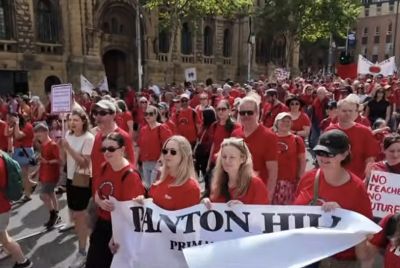
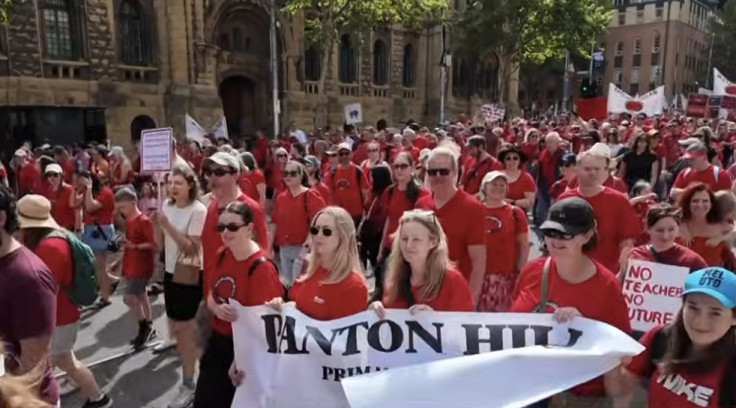
Honan said she plans to bring a motion before the council calling for a 24-hour strike during term three, though she cautioned that even without formal council backing, strikes could still occur at specific individual schools or districts. The union has a recent precedent for large-scale action: in March, 35,000 teachers walked off the job for the first time in more than a decade and marched through the streets of Melbourne.
"It [the EBA rejection] doesn't mean just going back to negotiating — it means organising industrial action," Honan said. "I'm talking about 24-hour strikes — whatever we need to do to end the crisis in our schools."
Honan added that members are specifically seeking a hard cap on class sizes at 25 students per class, rather than the aspirational targets currently in place, as well as fewer mandatory meetings in order to reduce what teachers describe as excessive workload pressures.
A Costly Offer Amid State Budget Pressure
The government's rejected offer would have cost an estimated $4.6 billion, adding further pressure to a state budget already under significant strain, with Victoria's net debt forecast to reach $199.3 billion within four years. Carroll said the state has a responsibility to all taxpayers to remain financially disciplined in its approach to public sector wage negotiations.
"The Victorian taxpayer and the public purse do not have unlimited funds, and it's really important that the AEU leadership get back to talking to their members," Carroll said.
He framed the rejection as evidence of a broader disconnect within the union's leadership structure. "What this is showing today is a real disconnect between the AEU leadership ... and that that is something the AEU leadership need to answer today," Carroll said. "This was the largest public sector agreement. This was significant, and we will always take our financial responsibility seriously, and I will not be rushing back to the negotiating table."
A Missed Opportunity on Federal School Funding
Beyond the immediate pay dispute, the rejected deal also carried broader implications for how Victoria's schools are funded at the federal level. Had teachers accepted the pay offer, it would have allowed Carroll to sign a long-awaited agreement with the federal government aimed at eventually bringing the state's schools up to the minimum funding standard — an outcome that now remains unresolved as the dispute drags on.
Political Stakes Rise Ahead of the November Election
The renewed threat of school shutdowns arrives at a particularly sensitive moment for the state's governing party. The prospect of looming disruptions in the lead-up to the November 28 state election threatens further political pain for an already unpopular Labor government, whose primary vote has plummeted into the low- to mid-20s in recent published polling.
Opposition education spokesman Brad Rowswell seized on the rejection to call for swifter government action, arguing that teachers deserve higher pay. "Jacinta Allan must now step in and give an immediate assurance that she will do everything she possibly can to get back to the negotiation table and deal with this matter urgently," Rowswell said.
What Comes Next
With the union's council now formally calling for a return to negotiations alongside renewed industrial action, and with the state election just five months away, the standoff between the Allan government and Victoria's teachers appears poised to escalate rather than resolve quickly. Whether that escalation takes the form of coordinated 24-hour strikes, more localized school-level disruptions, or a swift return to the bargaining table will likely depend heavily on how both sides respond to the union council's demands in the coming weeks — with the added complication of a state budget already straining under mounting debt, and a government eager to avoid further political damage ahead of voters heading to the polls in late November.
© Copyright 2026 IBTimes AU. All rights reserved.
- Recommended For You