

India's Education Minister Resigns After Weeks of Nationwide 'Cockroach' Youth-Led Protests Over Exam Leaks
Dharmendra Pradhan steps down following nationwide protests demanding accountability for leaked medical school entrance exams.
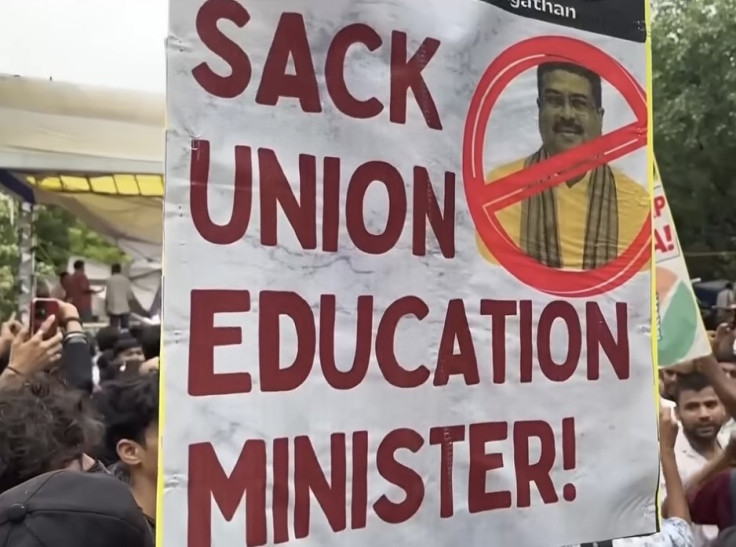
NEW DELHI — India's education minister resigned Saturday, handing a significant victory to a youth-led protest movement that had spent more than a month demanding accountability over allegations that entrance exams to the country's most competitive medical schools were leaked and sold.
Dharmendra Pradhan announced his resignation following talks with organizers of the Cockroach Janta Party, or CJP, a youth movement that emerged in May and quickly grew into one of the most significant challenges Prime Minister Narendra Modi's government has faced in recent years. The party called off its nationwide protests immediately after the announcement, saying the government had agreed to its core demands.
A scandal that disrupted millions of students
The controversy at the center of the protests traces back to May, when leaked questions disrupted the National Eligibility cum Entrance Test, commonly known as NEET, India's fiercely competitive undergraduate gateway exam for medical schools. The leak forced authorities to cancel results and schedule a retest, affecting more than two million students nationwide. For many families, the scandal represented not just a logistical setback but a symbol of deeper dysfunction in a system where a single test can determine a young person's entire career trajectory.
According to Indian media reports, several students died by suicide after learning their exam results would be scrapped, a detail that transformed public anger over the leak into a broader movement demanding systemic reform and accountability from government officials.
From online joke to national movement
The Cockroach Janta Party traces its origins to a comment made by India's chief justice that was widely interpreted as comparing unemployed young people to "cockroaches." The remark, which struck a nerve in a country grappling with persistently high youth unemployment, was seized upon by Abhijeet Dipke, a Boston University graduate, who transformed the moment into a rallying cry. What began as a social media post 36 days before Pradhan's resignation evolved into a sustained protest campaign that drew tens of thousands of students and supporters to New Delhi's Jantar Mantar protest site, with demonstrations also spreading to Mumbai, Hyderabad, Bengaluru and Ahmedabad.
When news of Pradhan's resignation reached the crowd gathered at Jantar Mantar on Saturday, Dipke addressed supporters directly from the stage. "We have done it, we have done it," Dipke said, prompting loud cheers from the thousands who had camped at the protest site for more than a month. He went on to read the names of students who had died by suicide amid the exam scandal, dedicating the movement's victory to them.
Escalating tension with police
The protests intensified significantly in the days leading up to Pradhan's resignation. Demonstrators clashed with police earlier in the week after officers used baton charges and tear gas to disperse crowds marching toward parliament, injuring dozens of students. Rather than dampening the movement, the crackdown appears to have galvanized broader public support, drawing students, professionals and families into a demonstration that organizers say reflected frustrations extending well beyond the exam scandal itself, touching on job scarcity, corruption and government accountability more broadly.
One protester at the demonstrations, Tluanga Ralte, described the moment in personal terms while marching with a copy of the Indian constitution. "Young generation is here. This is win for the constitution," Ralte said, capturing the sense among demonstrators that the movement extended beyond a single resignation.
Modi's government responds
Modi addressed the growing unrest directly in a video message posted to Instagram earlier in the week, acknowledging the seriousness of the situation in Hindi. "Friends, I understand that paper leak is no ordinary subject," Modi said, adding that authorities had identified and jailed those responsible for the leak. That message prompted student leaders to meet briefly with a government representative, though they ultimately renewed their demand for Pradhan's resignation and warned of nationwide marches if their demands went unmet by the weekend.
Following Pradhan's resignation, government ministers JP Nadda and Jitendra Singh held a press conference confirming that police cases against protesters would be dropped and that the government would provide compensation to the families of students who died amid the scandal. Officials also announced the creation of fast-track courts to prosecute future cases involving examination paper leaks, alongside a commitment to review the CJP's broader five-point reform plan for India's exam system.
A resignation framed as principled, not forced
In his own resignation statement posted to social media platform X, Pradhan struck a conciliatory tone, emphasizing his respect for the concerns raised by young protesters. "I hold deep respect for the aspirations, sentiments, and rightful expectations of the youth" of the country, Pradhan wrote, describing the realization of young Indians' dreams as central to his political values.
Nitin Nabin, national president of Modi's ruling Bharatiya Janata Party and a close aide to the prime minister, characterized Pradhan's decision in similarly positive terms, describing his choice to step down as one that "reflects the highest standards of integrity and selfless service in public life," while affirming the party's continued support for Pradhan going forward. As of Saturday, Modi had not yet publicly accepted Pradhan's resignation.
A rare political victory, with questions ahead
Pradhan's resignation marks one of the more significant political concessions Modi's government has made in response to grassroots protest in recent years, particularly given the movement's youthful, largely leaderless origins on social media. Whether the government's broader promises — including exam system reforms, compensation for affected families and a review of the CJP's reform proposals — will be fully implemented remains to be seen, and organizers have signaled they intend to monitor the government's follow-through closely.
For now, though, Saturday's announcement was treated as a clear victory by the movement's supporters, who filled New Delhi's streets in celebration after more than a month of sustained demonstrations that forced one of the most closely watched political reckonings India has seen in recent memory.
© Copyright 2026 IBTimes AU. All rights reserved.