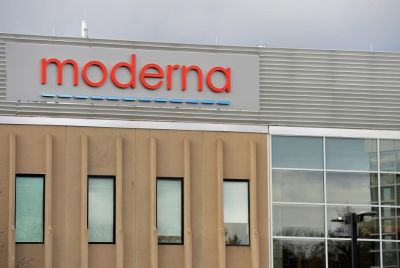
Moderna Stock Jumps More Than 11% After Science Day Showcases Expanding mRNA Pipeline Beyond Vaccines
Moderna's strategic shift towards a diversified biotechnology company excites investors with new mRNA therapies.

Shares of Moderna jumped sharply Friday morning, climbing more than 11% as investors responded to the biotechnology company's annual Science Day presentation, which detailed a broadening pipeline of mRNA-based therapies extending well beyond the vaccines that built the company's name.
The stock was trading at $66.38, up $6.63, as of 10:33 a.m. EDT, continuing a rally that began the previous afternoon when Moderna laid out its research roadmap for investors.
What sparked the rally
The catalyst behind the move was Moderna's Science Day, an investor event held Thursday in Cambridge, Massachusetts, where the company outlined how its core messenger RNA platform is being applied across a widening range of disease areas. Moderna announced research and early development updates at the event, held June 25, 2026.
The presentation went beyond infectious disease vaccines, the segment most closely associated with Moderna since its COVID-19 shot drove the company to prominence during the pandemic. The company used Science Day to outline how its mRNA platform supports three commercial franchises and a broad early-stage pipeline, with updates covering oncology and multiple sclerosis programs, validation of a T-cell engager modality, and a new in vivo CAR-T program for autoimmune diseases.
A company in transition
Moderna's leadership framed the update as part of a broader strategic shift toward becoming a more diversified biotechnology company, rather than one defined primarily by vaccines. "As we execute our strategic plan to become a diversified, multi-modality biotechnology company, we are preparing to manage three commercial franchises, Infectious Disease Vaccines, Intismeran, and Rare Disease Therapeutics, while advancing a broad mRNA pipeline and continuing to invest in research and development," said Stéphane Bancel, CEO of Moderna.
Bancel also emphasized how the company's underlying platform allows it to pursue multiple disease areas using the same core technology. "Working across three strategic horizons, we are applying our mRNA platform expertise to validate, scale and expand our modalities, with new modalities in the clinic, including T-cell engagers, and new modalities soon to be in the clinic, like in vivo CAR-T. At the same time, we are driving innovation by using data, AI and machine learning, and robotics to accelerate discovery and continuously improve how we execute for near-term growth while fueling the next generation of mRNA medicines."
A three-horizon framework
Moderna organized its presentation around what it described as three strategic horizons of development. The company uses Horizon 1 for approved and late-stage products, Horizon 2 for emerging modalities, and Horizon 3 for future modalities, a structure the company says leverages its mRNA platform, an AI-enabled Scientific Intelligence Engine, and its early pipeline to balance near-term commercial growth with long-term innovation.
Investors appeared particularly encouraged by the progress disclosed within the Horizon 2 category, which includes more advanced experimental programs moving closer to the clinic.
Cancer and autoimmune programs draw attention
Among the most closely watched updates was data validating a treatment approach for blood cancer. The company highlighted validation of its T-cell engager modality with mRNA-2808 in multiple myeloma, supporting rapid advancement of a second T-cell engager, mRNA-2151, in ovarian cancer.
Moderna also introduced a new experimental approach targeting autoimmune disease using a technology known as in vivo CAR-T. The company introduced an in vivo CAR-T modality with mRNA-6007, moving into early development for autoimmune diseases. The mechanism behind the new program centers on reprogramming a patient's own immune cells inside the body. The program is designed to enable deep B-cell depletion for autoimmune conditions using a multiplexed mRNA approach with targeted lipid nanoparticles, aiming to deliver mRNA into immune cells in vivo, enabling transient CAR expression and potential immune reset, with an initial clinical focus on systemic lupus erythematosus and other B cell-mediated autoimmune diseases.
Progress on a multiple sclerosis candidate
Moderna also provided an update on a program targeting multiple sclerosis tied to a common virus. The company's mRNA-1195 program is designed to address Epstein-Barr virus-associated conditions including multiple sclerosis, with Phase 1 part B data expected in the second half of 2026. The company also said its Phase 2 study in multiple sclerosis is ongoing, with its sentinel cohort fully enrolled and the data safety monitoring board recommending the trial proceed with dose escalation.
How the market is responding
Friday's rally builds on momentum that had already been building for Moderna shares heading into the event. As of Friday morning trading, Moderna's percentage change stood at 7.31%, with one market summary attributing the move to the company's Science Day outlook on its mRNA platform and growth horizons, which the summary said sparked a roughly 10% surge.
Analyst sentiment on the stock remains mixed even as shares climb, reflecting a broader debate over how much of Moderna's early-stage pipeline will eventually translate into approved, revenue-generating products. Piper Sandler raised its price target on Moderna to $77 from $69 while maintaining an Overweight rating on the shares. Other analysts have taken a more cautious stance. Citi analyst Geoff Meacham maintained a Hold rating on Moderna and kept his price target at $41.00, while Bank of America Securities analyst Alec Stranahan maintained a Sell rating with a $34.00 price target despite what he described as scientific momentum.
Looking ahead
The Science Day presentation comes as Moderna continues working to diversify its revenue base following a steep decline in COVID-19 vaccine sales since the height of the pandemic. The company has been pushing to advance new vaccine candidates, including an experimental seasonal flu shot, alongside its growing oncology and rare disease portfolios. Moderna's next quarterly earnings report is scheduled for July 30, 2026, which will give investors another opportunity to assess how the pipeline updates detailed at Science Day are translating into the company's broader financial outlook.
© Copyright 2026 IBTimes AU. All rights reserved.
- Recommended For You