KOSPI Falls for a Third Consecutive Day as Even Samsung's Record Earnings Fail to Halt the Selloff Today
Investor Anxiety Over AI Spending and Semiconductor Valuations Drives Market Volatility
South Korea's benchmark KOSPI index fell for a third straight session Thursday, extending one of the steepest market corrections in the country's history even as Samsung Electronics reported record quarterly earnings, underscoring how deeply investor anxiety over artificial intelligence spending and semiconductor valuations has come to dominate trading in Seoul.
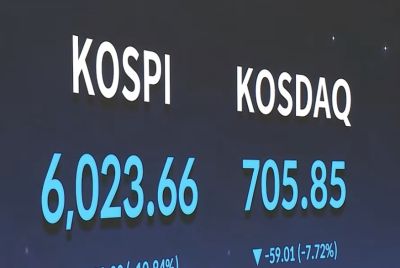
The KOSPI closed at 5,593.56, down 69.68 points, or 1.23%, after briefly attempting to reclaim the 6,000-point threshold earlier in the session. The index opened higher, up 18.53 points, or 0.33%, at 5,681.77, and at one point in the morning posted gains of more than 5%, before that momentum reversed and losses deepened through the afternoon. The KOSPI has now dropped 1,162.19 points, or 17%, over the past three trading sessions alone.
The tech-heavy KOSDAQ index fared even worse Thursday, closing at 644.78, down 17.90 points, or 2.70%, marking its own third consecutive daily decline. Trading throughout the day showed extreme intraday volatility across both indexes, reflecting continued uncertainty about the semiconductor sector even as some investors moved to buy shares they viewed as oversold following the market's historic recent selloff.
The session's central paradox centered on Samsung Electronics, which reported record second-quarter earnings but still could not lift the broader index. Samsung's semiconductor division posted operating income of 89.2 trillion won, or roughly $62 billion, more than 250 times higher than the prior year and modestly ahead of analyst estimates, driven by surging demand for high-bandwidth memory chips used in artificial intelligence hardware. Samsung shares themselves rose 1.44% on the news. But SK Hynix, the country's other dominant chipmaker, told a starkly different story, falling 9.6% even after also reporting record profits, as investors focused instead on the company's earnings falling short of the loftier expectations that had built up around AI-related chip demand. Both chipmakers together account for roughly half of the KOSPI's total market capitalization, meaning SK Hynix's decline weighed heavily on the broader index even as Samsung posted gains.
By sector, the session showed a notable split between more defensive, domestically focused industries and technology-linked stocks. Pharmaceuticals rose 3.51%, chemicals gained 2.56%, metals climbed 2.49%, transportation equipment and parts advanced 2.19%, and insurance stocks added 1.96%. On the other side of the ledger, electrical and electronic stocks fell 3.08%, medical precision instruments dropped 2.10%, and manufacturing declined 1.83%, reflecting continued pressure specifically within technology and chip-adjacent sectors even as other parts of the Korean economy showed relative resilience.
Investor flows offered a somewhat more encouraging signal beneath the headline index decline. Foreign investors were net buyers of Korean shares Thursday, purchasing a net 1.3329 trillion won worth of stock, marking the first session in four trading days that foreign investors posted net buying on the main exchange. Institutional investors also bought a net 66.6 billion won in shares. Individual retail investors, by contrast, were net sellers, offloading a net 1.4199 trillion won worth of stock, suggesting that larger institutional players may have viewed the recent sharp declines as an opportunity to accumulate positions even as retail sentiment remained more cautious.
Thursday's session capped a month of extraordinary volatility for Korean equity markets more broadly. The KOSPI dropped below 8,000 points on July 2, triggering an automatic sell-side sidecar that briefly suspended program trading on KOSPI-listed shares within minutes of that day's opening bell, part of a pattern of trading halts that has already made 2026 a record year for market volatility in South Korea, surpassing even the sidecar and circuit breaker activity recorded during the 2008 global financial crisis.
Regulators have moved to address the volatility directly. Beginning July 31, the basic deposit requirement for single-stock leverage products will rise to 30 million won from the previous 10 million won, a change market participants will be watching closely to see whether it succeeds in reducing the intraday volatility that has repeatedly gripped large-cap semiconductor stocks and the broader KOSPI throughout the year.
The broader selloff in Korean chip stocks has tracked similar turbulence in U.S. markets, where the Nasdaq Composite slid 0.66% in the session preceding Thursday's Korean trading, and the VanEck Semiconductor ETF lost 5.4%, with U.S. memory chipmakers Micron Technology and Sandisk each falling more than 10% amid renewed concerns about memory chip pricing and oversupply. That transpacific link between American and Korean chip stock performance has become increasingly pronounced this year, as global investors reassess the sustainability of the capital spending surge tied to artificial intelligence infrastructure.
With the KOSPI now trading at its lowest level since early April, according to data from Trading Economics, and both Samsung and SK Hynix having posted record earnings without providing a durable lift to the broader index, market watchers said the coming days are likely to remain volatile as investors continue weighing genuinely strong underlying chip industry profitability against mounting concerns about whether current valuations across the sector have run too far ahead of what near-term demand can sustainably support.
© Copyright 2026 IBTimes AU. All rights reserved.
- Recommended For You