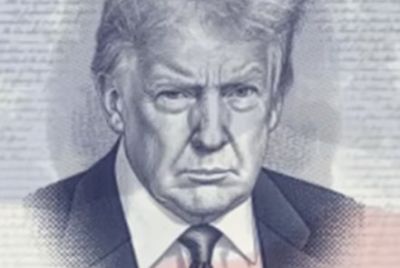
(VIDEO) Trump Visibly Winces at Loud Military Flyover During Historic Tarmac Welcome for Xi Jinping
The unusual airport welcome came as Washington and Beijing extended a temporary trade truce and tensions over artificial intelligence remained high.

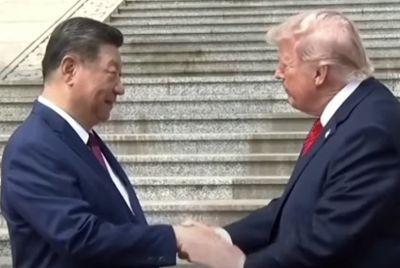
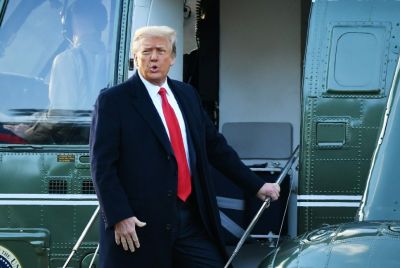
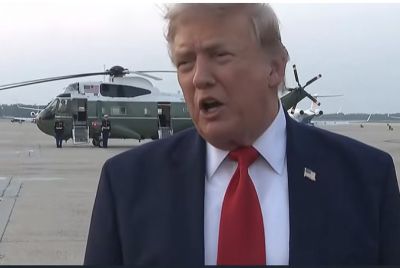
WASHINGTON — President Donald Trump personally greeted Chinese President Xi Jinping on the tarmac at Joint Base Andrews Wednesday evening, taking the unusual step of welcoming a foreign leader at the Maryland military base rather than the White House, in a ceremony that briefly went off script when Trump visibly winced at the sound of a low-flying military jet overhead.
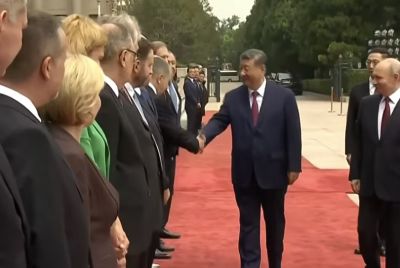
Trump, joined by first lady Melania Trump, greeted Xi and his wife, Peng Liyuan, as they arrived to begin Xi's state visit to the United States. The two leaders and their spouses walked along a 100-foot red carpet flanked by U.S. service members, with American and Chinese flags on display. The ceremony featured the national anthems of both countries performed by the U.S. Air Force band, a 21-gun salute, a guard of honor, a display of six F-16 and six F-22 fighter jets, and a flyover by two B-1 Lancer bombers.
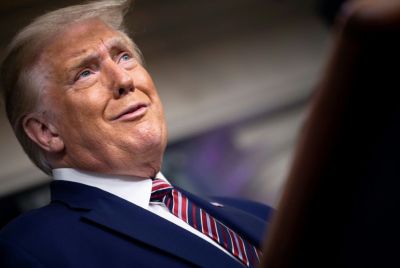
It was during that flyover, coming near the end of the U.S. national anthem, that the ceremony's most talked-about moment occurred. As the B-1 bombers roared overhead, Trump, who was saluting at the time, visibly recoiled at the noise, ducking, gritting his teeth, turning his head toward the aircraft and lowering his salute in front of assembled reporters and photographers. Xi, standing beside him, remained composed and showed no visible reaction to the flyover, as did both Melania Trump and Peng Liyuan.
The moment was captured on a White House livestream of the ceremony but was not included in the edited highlight footage of the event that Trump's aides released afterward, according to reporting on the ceremony.
Trump's decision to personally welcome Xi at Joint Base Andrews marked a significant departure from typical diplomatic protocol, under which U.S. presidents generally receive visiting foreign leaders at the White House rather than traveling to greet them upon arrival. According to historical records, the last time an American president greeted a world leader personally at Joint Base Andrews was in 1962, when President John F. Kennedy met British Prime Minister Harold Macmillan. Notably, Xi did not extend the same gesture to Trump when the American president traveled to Beijing for his own state visit to China in May.
The elaborate welcome drew a range of reactions online, much of it focused on Trump's visible reaction to the flyover. Journalist Aaron Rupar noted the apparent contrast between the mild weather and Trump's attire, writing, "it is 64 degrees at Joint Base Andrews right now and yet Trump is wearing gloves as he greets President Xi." Twitch streamer Hasan Piker, who broadcast footage of the arrival ceremony to his viewers, joked about Trump's reaction to the flyover, asking, "Trump -- it's YOUR airshow. How do you get scared?"
Beyond the social media reaction to the flyover moment, the lavish nature of the welcome itself drew more substantive criticism from at least one member of Trump's own party. Mississippi Sen. Roger Wicker addressed the ceremony directly in remarks delivered on the Senate floor, expressing reservations about the scale of the welcome extended to Xi. "Had the White House asked me for advice, I would have suggested the president not invite Xi Jinping to Washington for such a lavish welcome here in the United States, based on all of the troubling issues we have with President Xi and the Chinese Communist Party," Wicker said. He urged Trump to remain mindful of Xi's record throughout the visit, describing the Chinese leader in blunt terms. Wicker said Trump should remember "during every minute of dialogue" that "his guest is a brutal, unelected and oppressive dictator who seeks to dominate his neighbors and whose massive military arsenal is aimed directly at the United States of America." Wicker's public criticism was described as a rarity on Capitol Hill, where Republican pushback against Trump's foreign policy decisions has remained uncommon even as some GOP lawmakers have grown more willing to break with the president publicly in recent weeks.
The high-profile diplomatic gesture unfolded alongside a substantive economic announcement the same day. U.S. Treasury Secretary Scott Bessent said Wednesday that the United States and China had agreed to extend the so-called "Busan agreement," a temporary trade truce between the world's two largest economies, providing at least a measure of near-term stability to the broader U.S.-China economic relationship even as tensions over technology, security and regional influence continue to shape the overall dynamic between the two countries.
Artificial intelligence has emerged as a particularly significant point of friction shaping the broader Trump-Xi meeting, reflecting deep and persistent distrust between Washington and Beijing over the technology's military and economic implications, according to analysts tracking the visit.
With Xi's state visit continuing in the days ahead, Wednesday's arrival ceremony, and Trump's visible reaction to the military flyover in particular, is likely to remain a widely discussed moment from the trip, even as the substantive discussions between the two leaders on trade, technology and broader bilateral relations continue to unfold over the course of the visit.
© Copyright 2026 IBTimes AU. All rights reserved.
- Recommended For You