Oscar-Winning Irish Actress Brenda Fricker, Beloved Star of My Left Foot and Home Alone 2, Dies at 81
Celebrating the Life and Legacy of Brenda Fricker, a Trailblazer in Film and Television

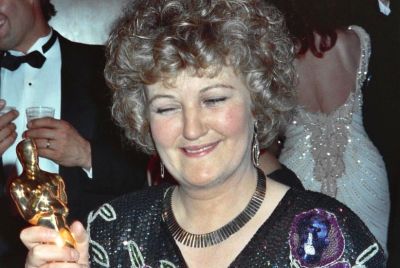
Brenda Fricker, the Irish actress who became the first Irish woman to win an Academy Award and endeared herself to generations of moviegoers with roles in "My Left Foot" and "Home Alone 2: Lost in New York," has died at the age of 81.
Fricker won the Oscar for best supporting actress in 1990 for her portrayal of the on-screen mother of Christy Brown, a real-life Irish man born with cerebral palsy who could control only his left foot, in the film "My Left Foot." The role was played by Daniel Day-Lewis, who also won an Academy Award for his lead performance that year. Fricker's win made history, marking the first time an Irish actress had claimed an Academy Award, defeating a field of Hollywood stars that included Julia Roberts and Anjelica Huston.
Fricker's agent, Phil Belfield, confirmed her death in a statement. "We will never see her like again and the world is lesser for the lack of her," Belfield said, adding that he had been honored to know, love and work with her, and that she would always hold a place in his heart and in the hearts of film and television fans around the world.
Born in Dublin, Fricker built a decades-long career that spanned television, theater and film, beginning with early roles including a part in Ireland's first soap opera, "Tolka Row," in the 1960s, followed by a stint on the British soap "Coronation Street" in 1977 and an appearance in "Licking Hitler," a television drama written by David Hare, in 1978.
Fricker gained wide recognition through her role as nurse Megan Roach on the long-running BBC medical drama "Casualty," appearing in the show's very first episode when it launched in 1986 and remaining a regular fixture until 1990, with occasional returns to the role in subsequent years through her final appearance in 2010.
Two years after her Oscar win, Fricker took on one of her most widely beloved roles, playing the homeless "pigeon lady" who befriends Macaulay Culkin's character Kevin McCallister in New York's Central Park in the 1992 holiday comedy "Home Alone 2: Lost in New York." The role introduced her to an entirely new generation of audiences beyond those familiar with her earlier dramatic work.
Fricker's additional film credits included the 1993 comedy "So I Married an Axe Murderer," the 1994 family film "Angels in the Outfield," the 1996 legal drama "A Time to Kill," and the 2003 biographical film "Veronica Guerin," in which she played the mother of the murdered Irish journalist at the center of the story.
Despite her landmark Oscar win, Fricker later reflected that the honor may have ultimately worked against her career rather than propelling it forward. "What did happen was the old curse of the Oscars, as they call it," she told The Times in 2024, explaining that the accolade led to her being typecast and passed over for a number of roles, including in theater. She was characteristically wry about the financial realities of the honor as well, joking, "So there's a lot that's not great about an Oscar. And you don't get any money. They could give you a few bob with it, at least."
Tributes to Fricker poured in from Irish political and cultural figures following news of her death. Ireland's Tánaiste, or deputy prime minister, Simon Harris, said he was deeply saddened by the loss of what he called a national treasure. He described her as a consummate performer who brought depth and humanity to every role she undertook, calling her one of the greatest exports Ireland has ever produced and an ambassador for Irish talent on the world stage, adding that the country would never see her like again.
The United States ambassador to Ireland, Edward Walsh, also paid tribute to Fricker, describing her as a giant of Irish film and praising her unforgettable performance in "My Left Foot." Writing on the social media platform X, Walsh said her work carried Ireland's stories to audiences around the world and inspired generations on both sides of the Atlantic, extending his condolences to her family, friends and all who loved her.
Earlier this year, Dublin's Lord Mayor, Councillor Ray McAdam, had proposed that Fricker receive the freedom of the city, describing her as one of Dublin's most distinguished cultural figures. He said her work was marked by honesty, depth and a rare ability to bring warmth and toughness in the same breath, adding that her performances had helped tell Irish stories and become part of family life across generations.
In a memoir published last year, Fricker offered a candid account of a difficult upbringing, describing an unstable childhood in which she experienced abuse at home and was groomed at age eight by a man who gave her elocution lessons. She also wrote about being seriously injured in a bicycle accident at age 14 that left her hospitalized for two years, and about surviving sexual assault as a teenager and again later in her career. Despite those hardships, she recalled holding onto some fond memories of her youth, saying that in the era she grew up in, young people could be wild, and that she looked back on those days with a kind of gratitude. Reflecting on the broader arc of her life and career to The Times, she said the path she had taken was never something she had calculated or planned, describing it instead as the product of luck and happy accidents along the way.
Fricker's death adds to a string of recent losses in the entertainment industry, following closely on the heels of tributes paid to other notable performers in recent weeks. Her legacy, built across nearly five decades of work spanning Irish theater, British television and Hollywood film, is expected to be remembered both for her groundbreaking Oscar win and for the warmth she brought to some of the most memorable supporting roles in modern cinema.
© Copyright 2026 IBTimes AU. All rights reserved.
- Recommended For You