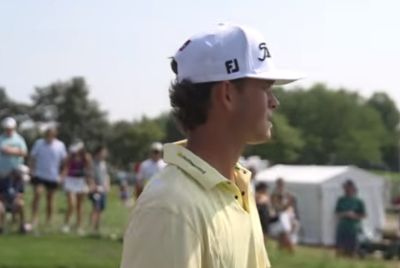
(VIDEO) Wyndham Clark Seizes Four-Shot U.S. Open Lead as Fog and Fading Wind Reshape Shinnecock
Clark capitalises on calmer conditions to lead U.S. Open, as fog delay reshapes the course dynamics.
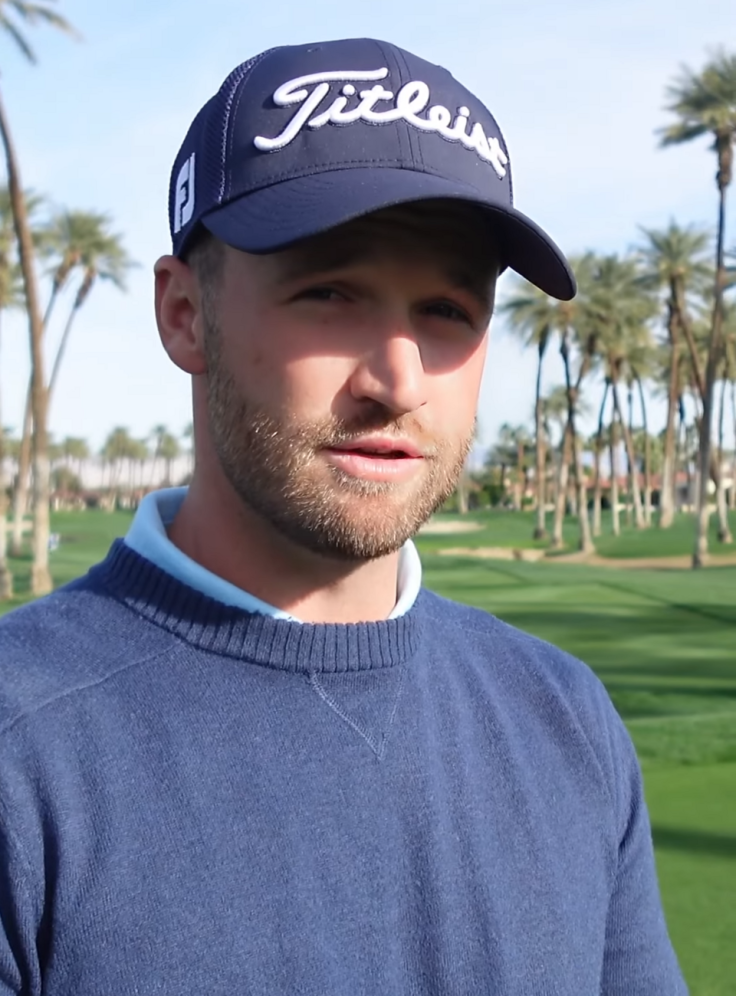
SOUTHAMPTON, N.Y. — The USGA built a different golf course at Shinnecock Hills to keep it playable in strong wind. And when the wind finally subsided late Thursday afternoon, Wyndham Clark looked like he was playing an entirely different U.S. Open than the one that had punished the morning wave for hours.
Clark seized on a more gentle course — slightly calmer and still soft with receptive greens — by pulling away late to reach 6 under par through 16 holes, leaving him in darkness with a four-shot lead over seven players when play was suspended for the night. Among those chasing him were 21-year-old University of Oklahoma senior-to-be Ryder Cowan and the surprisingly resurgent Dustin Johnson.
Shinnecock was still a brute of a test, but the red numbers populating the white scoreboard were an unfamiliar sight for a course that has historically punished even the world's best players. When play was suspended by darkness, 17 players were under par. The 50 golfers who have yet to finish their opening rounds will resume play at 6:35 a.m. ET Friday.
A Fog Delay That Changed Everything
The decisive factor in Clark's round may have occurred hours before he even teed off. Thirty minutes after the round began, play was stopped because of fog so dense it was difficult to see the fairway and the green on the par-3 11th hole. The two-hour delay pushed back tee times across the board — and, crucially for Clark, pushed his afternoon tee time into a window when the day's punishing wind had begun to ease.
"I would say when I got my tee times on Tuesday, I was like, 'Oh, could be a tough draw,'" Clark said. "That two-hour fog delay was very helpful, and it was really nice [the wind] laid down. So it definitely helped those last six, seven holes we played."
The forecast had called for the strongest wind of the week during the brightest part of Thursday, and for the morning wave, that forecast proved brutally accurate. The afternoon wave, benefiting from both the delay and a natural lull in conditions, ultimately played at least a stroke easier than the early starters who faced relentless wind throughout their rounds.
Clark's Round Takes Shape
Clark started his round on the back nine at No. 10 and opened with two quick birdies, going out in 32 to plant his name atop the leaderboard early. After missing an 8-foot birdie putt on No. 1 and failing to save par from a bunker on the long par-3 second, his round took off in earnest.
He hit a wedge to 5 feet on No. 3 for birdie, made a 20-foot birdie putt on the next hole, and then, from 207 yards with some wind at his back, struck his second shot on the par-5 fifth to within 3 feet for eagle. "Everything was kind of clicking," Clark said. "We were definitely fortunate with the wind laying down. Overall, a good round."
Clark, who won the U.S. Open in Los Angeles three years ago, still has two holes remaining when first-round play resumes Friday morning. He will return to complete his opening round before heading back out for the second round, with wind expected to be calmer than it was for Thursday's brutal midday stretch.
Dustin Johnson's Late Collapse
For a stretch of Thursday afternoon, it appeared Clark might have company at the top of the leaderboard. Dustin Johnson, playing in his final year of exemption from the U.S. Open he won at Oakmont in 2016, ran off four straight birdies and was tied with Clark after 13 holes.
But Johnson's round unraveled quickly in the closing stretch. He failed to get up and down for birdie on the easy par-5 fifth, where Clark had made eagle, and then three-putted from short range for a double bogey on the sixth hole, falling four shots behind his playing partner in the span of just a few holes.
A Star-Studded Amateur Makes History
Ryder Cowan, the 21-year-old Oklahoma senior-to-be, delivered one of the day's most compelling storylines. Cowan birdied his last hole for a 68 to join former Sooner Max McGreevy and former Oklahoma State player Sam Stevens on the leaderboard. Cowan briefly held the lead outright in his first career major championship appearance, and his round matched the lowest score ever posted by an amateur at Shinnecock Hills.
"Through nine, I looked up and I was 3-under par," said Cowan, who earned his spot in the field by surviving a three-man playoff for two available spots at a qualifier in Palm Beach Gardens, Florida. "I definitely looked at that leaderboard, and I saw it up there. ... I hit it good all day, put myself in good positions throughout the day."
Scheffler Grinds, McIlroy Survives
Scottie Scheffler, who needs a U.S. Open title to complete the career Grand Slam, battled all day and relied heavily on his short game to salvage a 72 — his 10th consecutive U.S. Open round without breaking par. Despite the labored performance, the score left him only four shots out of the lead heading into Friday.
Rory McIlroy, meanwhile, navigated the worst of the morning conditions to post a 69 in gusts that topped 30 mph during the middle of the day, when the scoring average ballooned to well above 74. It was a result that allowed him to avoid the kind of disaster that has befallen previous fields at Shinnecock Hills.
Jon Rahm, who had a chance in the final hour at the PGA Championship, was the only player in the field to play bogey-free golf on Thursday, reaching 2 under by sinking a 60-foot birdie putt on the par-3 17th hole. He was joined at that mark by three other U.S. Open champions — Matt Fitzpatrick (2022), Gary Woodland (2019), and Johnson himself — all of whom still have holes remaining to complete their opening rounds.
A Brutal Test, Even With Calmer Conditions
For half of the opening round, the USGA appeared to have engineered the ideal test. Coming off two previous U.S. Opens at Shinnecock when the course got out of control, officials slowed the greens to 10½ on the Stimpmeter — a notably slow speed for any major championship, let alone the U.S. Open — and kept additional water on the putting surfaces to soften them.
It was all in service of managing the wind, which did not disappoint organizers in its ferocity. Sustained wind approached 25 mph, with gusts even stronger, and conditions worsened when the wind shifted directions in the middle of the day. The severity was such that it took Scheffler's group nearly three hours to complete just nine holes, and only 27 of the 77 players in the afternoon wave managed to finish their opening rounds — with Jason Day among those who didn't, withdrawing because of a back injury.
"It was tough around here without wind, and then it was blowing pretty hard — really hard," Keegan Bradley said after carding a 70. "The USGA did a great job setting the course up because if the greens were any faster or firmer, we might not be playing right now."
Sam Stevens, who shot 68 despite a double bogey to start his round — a hole that alone took him over two hours to play because of the fog delay — offered a similarly favorable assessment of the course setup. "The greens haven't been too firm, the fairways haven't been too firm, so I've really felt like it's pretty scorable," said Stevens, who recorded only his second sub-70 round in four U.S. Open appearances. "Obviously, it's difficult, but overall, it's an awesome place. I think the setup is great right now."
With dozens of players still needing to complete their opening rounds Friday morning before the second round even begins, the leaderboard at Shinnecock Hills remains far from settled — but for now, Clark's late surge through the calm has given him a commanding head start in pursuit of his second U.S. Open title.
© Copyright 2026 IBTimes AU. All rights reserved.
- Recommended For You