Twenty One Capital Shares Rise 7% as Bitcoin Treasury Firm Rebuilds Under New CEO's Strategy
Bitcoin treasury company sees stock rise as new CEO outlines fresh strategy

Twenty One Capital climbed Friday, trading up 6.89%, or 30 cents, to $4.66, as the Tether-backed bitcoin treasury company continued to show signs of stabilization following a turbulent stretch that saw its stock plunge to fresh lows after an abrupt leadership change last month.
The gain marks a modest but notable rebound for a stock that has fallen dramatically since its public debut, trading within a 52-week range spanning from a low of $4.15 to a high of $31.20, a decline of more than 85% from the stock's earlier highs that has left most shareholders who bought after its market debut underwater.
A Company Built Around Accumulating Bitcoin
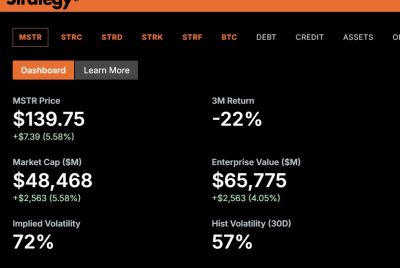
Twenty One Capital, based in Austin, Texas, operates as a bitcoin-native public company designed to give investors exposure to the cryptocurrency through traditional equity markets, rather than requiring them to hold and secure bitcoin directly. The company went public in December through a SPAC merger with Cantor Equity Partners, positioning itself as a bitcoin-accumulation vehicle intended to compete with Michael Saylor's Strategy, the corporate pioneer of holding bitcoin as a primary treasury asset. Twenty One currently holds approximately 43,514 bitcoin, according to tracking service BitcoinTreasuries, making it one of the largest corporate bitcoin holders in the world, with those holdings valued at roughly $2.8 billion as of early August.
A Rocky Start From Day One
The stock's struggles began almost immediately after its public debut. Twenty One Capital shares fell 20% on their first day of trading in December, closing at $11.42 despite bitcoin itself rising 3% that same day, as investors reacted skeptically even as the company touted plans to build revenue-generating businesses in brokerage, credit and lending beyond simply accumulating bitcoin. The company had raised $850 million through a combination of convertible notes and equity sales ahead of its debut, backed by stablecoin issuer Tether, along with SoftBank Group and Bitfinex.
A Collapsed Merger and a Sudden CEO Exit
Twenty One's troubles deepened significantly in July, when co-founder and CEO Jack Mallers abruptly resigned, citing a strategic disagreement with the company's board over its long-term direction. The announcement sent shares tumbling nearly 18% in a single session, falling to around $4.37 as investors digested both the leadership change and the collapse of a broader expansion strategy Tether had unveiled earlier in the year.
That original strategy had called for combining Twenty One Capital with Strike, the bitcoin payments company also founded by Mallers, and Elektron Energy, a bitcoin mining infrastructure firm, into a single publicly traded company spanning bitcoin treasury management, payments and mining operations. Under the plan, Twenty One would have contributed its bitcoin treasury, Strike its payments and lending business, and Elektron its large-scale mining infrastructure, together forming what backers described as one of the largest bitcoin-focused public companies spanning the industry. That vision collapsed in July when Strike withdrew from the proposed combination and will instead remain an independent company, with Mallers departing Twenty One to refocus on Strike directly. Twenty One and Elektron have continued discussions on a potential two-way combination, though no deal has been finalized.
A New CEO With a Different Vision
Following Mallers' departure, Twenty One named Raphael Zagury as its new chief executive. Zagury has since laid out a distinct strategic vision for the company, describing an approach modeled loosely on Berkshire Hathaway's operating structure rather than a pure bitcoin treasury model. Speaking at the Mining Disrupt 2026 conference in Miami in late July, Zagury outlined plans to use bitcoin mining as a cash-flow engine that could fund investments in additional cash-flow-positive operating businesses, while allowing local management teams at those businesses operational autonomy. The strategy is explicitly aimed at generating better risk-adjusted returns than simply holding bitcoin alone, through what Zagury described as disciplined capital allocation, diversification and risk management, with shareholder value ultimately measured in bitcoin terms rather than traditional fiat currency returns.
Trading Below the Value of Its Own Bitcoin Holdings
One factor that has drawn attention to Twenty One's stock in recent weeks is its valuation relative to the bitcoin it actually holds. According to data from BitcoinTreasuries, the company's market capitalization of approximately $1.5 billion sits well below the roughly $2.8 billion value of its bitcoin holdings, implying the stock trades at a significant discount to its underlying net asset value, a dynamic some investors and analysts have pointed to as a potential opportunity, arguing that buying the stock effectively provides bitcoin exposure at less than the cost of buying bitcoin directly on the open market.
A Pattern Familiar to Bitcoin Treasury Stocks
Twenty One's volatility mirrors a broader pattern seen across the small cohort of publicly traded companies that have built their business models primarily around accumulating and holding bitcoin, a group that includes Strategy, American Bitcoin Corp and Strive Inc. These stocks have generally shown far greater volatility than bitcoin itself, often trading at either significant premiums or discounts to the value of their underlying bitcoin holdings depending on shifting investor sentiment toward both the broader cryptocurrency market and the specific companies' operational execution.
Institutional Backing Remains Intact Despite the Turmoil
Despite the leadership upheaval and steep stock price decline, Twenty One's core institutional backing has remained largely in place. Tether International serves as the company's controlling shareholder, having acquired SoftBank Group's stake in the company in May, a transaction that further consolidated Tether's control over Twenty One's shareholder base and strategic direction. As part of that transaction, SoftBank's representatives on Twenty One's board stepped down in accordance with the company's shareholder agreement, even as SoftBank had played a significant early role in the company's formation.
With a new chief executive now working to implement a revised strategy centered on cash-generating businesses rather than pure bitcoin accumulation, and ongoing discussions continuing around a potential combination with Elektron Energy, Twenty One Capital's near-term trajectory remains closely tied to both the execution of Zagury's operating vision and the broader direction of bitcoin prices. For now, Friday's gain offers at least a modest signal of stabilization for a stock that has spent much of the past several weeks working to recover from one of the more turbulent stretches in its short history as a publicly traded company.
© Copyright 2026 IBTimes AU. All rights reserved.
- Recommended For You