

(VIDEO) McDonald's CEO Addresses Viral Big Arch Backlash: 'I Eat Here 3-4 Times a Week'
OAK BROOK, Ill. — McDonald's Corp. CEO Chris Kempczinski has responded directly to widespread online mockery over a promotional video in which he took a notably small bite of the chain's new Big Arch burger, insisting he regularly enjoys the company's food and remains committed to menu innovation despite the social media firestorm.
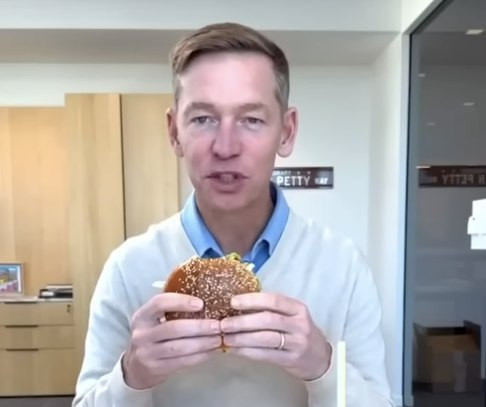
In an exclusive interview with The Wall Street Journal published Monday, April 6, 2026, Kempczinski addressed the viral clip that sparked memes, competitor jabs and questions about his authenticity as the leader of the world's largest fast-food chain. He also demonstrated his willingness to engage by taking an on-camera bite of a french fry and chicken nugget — his first such appearance since the original controversy erupted in early March.
The original video, posted to Kempczinski's Instagram account in late February, showed the CEO in a bright office setting holding the oversized Big Arch burger. He described it as a "product" with a "unique" bun before taking a cautious, modest bite and declaring it "so good." The clip quickly went viral on TikTok, X and Instagram, with users mocking the small portion, his facial expression and corporate language.
Critics called the moment inauthentic, with comments ranging from "He doesn't even eat his own food" to "Most unnatural thing I've ever seen." Competitor brands piled on: Burger King, Wendy's and others posted cheeky responses in the comments or on their own channels, turning the gaffe into a brief social media marketing battle.
The Big Arch, a limited-time offering featuring two quarter-pound beef patties, special tangy sauce and an oversized arched bun, launched in the U.S. in early March priced between $6.89 and $10.19 depending on location and customizations. The 1,020-calorie item had already performed well as a permanent menu fixture in the U.K. and Ireland.
Kempczinski told the Journal he was simply being himself on camera during what was intended as a casual, fun moment. He pushed back against suggestions that his reaction indicated dislike for the burger or McDonald's menu overall.
"Yes, I eat McDonald's three or four times a week," he said in a follow-up response to an Instagram question that resurfaced in the interview context. "I love our food, and I'm proud of what our teams create every day. The video was a fun, casual moment — I was just being myself."
The CEO used the platform to discuss broader challenges facing the company, including consumer affordability concerns and cautious spending habits amid economic pressures. He highlighted McDonald's efforts to balance value menus with premium limited-time offerings like the Big Arch while navigating inflation, labor costs and shifting diner preferences.
Industry analysts noted that the backlash, while intense for a few days in March, has not appeared to materially hurt sales of the Big Arch. Early reports from franchisees indicated solid demand for the item, which was designed as a bigger, bolder take on classic McDonald's flavors to appeal to customers seeking indulgence without leaving the Golden Arches.
The incident underscored the risks and rewards of corporate leaders engaging directly on social media. Kempczinski has increasingly used platforms like Instagram to humanize the brand, but the viral moment highlighted how quickly polished marketing can be dissected and memed in today's online culture.
In the WSJ interview, Kempczinski acknowledged the power — and pitfalls — of social media. He said he learned from the experience and remains open to future on-camera appearances, even joking about his children alerting him that the original video had blown up online.
McDonald's has leaned heavily into limited-time offerings and value initiatives in recent years to combat slowing traffic and competition from rivals like Wendy's, Burger King and emerging fast-casual players. The Big Arch was positioned as a hero item to drive excitement and incremental sales.
Franchise operators have generally supported the innovation push, though some have privately expressed concerns about menu complexity and the need for consistent value perception. The company has responded with aggressive national value promotions, including its popular $5 Meal Deal, to reassure budget-conscious customers.
Public reaction to Kempczinski's response has been mixed. Some social media users appreciated the direct address and his willingness to engage again on camera, while others continued to circulate memes from the original clip. The CEO's claim of eating at McDonald's multiple times weekly drew both support and skepticism in comment sections.
The episode has sparked broader conversations about authenticity in corporate marketing. Experts say consumers increasingly demand genuine enthusiasm from brand leaders, particularly for a company like McDonald's that built its empire on approachable, craveable food.
Kempczinski, who became CEO in 2019, has guided McDonald's through the COVID-19 pandemic, supply chain disruptions and evolving labor dynamics. Under his leadership, the company has accelerated digital ordering, expanded delivery partnerships and invested in menu refresh efforts.
The Big Arch launch came as part of a strategy to refresh core categories and give customers reasons to visit more frequently. McDonald's has also focused on breakfast, chicken and beverage innovations to maintain relevance.
As the company prepares for its next earnings report, executives will likely face questions about same-store sales trends and the effectiveness of recent promotions. Wall Street has watched McDonald's closely for signs of recovery in U.S. traffic amid a value-focused consumer environment.
In the interview, Kempczinski emphasized that the company listens to feedback — both positive and critical — and uses it to improve. He reiterated commitment to delivering quality, affordable food that lives up to the brand's promise.
For now, the viral moment appears to have evolved from pure backlash into a case study in crisis communication and social media navigation. McDonald's continues to promote the Big Arch through traditional advertising and in-restaurant displays while monitoring online sentiment.
Franchisees and operators have been encouraged to lean into the item's novelty, with some locations reporting strong initial sales driven by curiosity following the online buzz — even if some of that attention was negative.
The CEO's latest appearance, where he confidently ate fries and nuggets on camera, seemed designed to close the loop on the controversy while reinforcing his personal connection to the brand.
Whether the response fully quiets the memes remains to be seen, but it demonstrates McDonald's willingness to address criticism head-on rather than ignore it.
As fast-food competition intensifies and consumers scrutinize every corporate move through a social media lens, leaders like Kempczinski face heightened expectations for transparency and relatability.
McDonald's, with more than 40,000 locations worldwide, continues to adapt to changing tastes while defending its position as a cultural and culinary staple. The Big Arch episode, awkward as it was for the CEO, ultimately provided a very public reminder that even the biggest brands must navigate the internet's unforgiving spotlight.
For customers, the real test will remain in the restaurants: Does the Big Arch deliver on taste, value and satisfaction? Early indications suggest many are giving it a try, regardless of the online drama surrounding its promotional rollout.
Kempczinski's response may not convert every skeptic, but it signals a leadership style comfortable with vulnerability and direct engagement — traits increasingly valued in the age of always-on social media.
As April progresses, attention will shift back to menu performance, value perception and the chain's ability to deliver consistent experiences across its vast network. The viral Big Arch backlash, while memorable, appears unlikely to derail broader strategic efforts.
In the end, as Kempczinski himself might say, it's about the food — and ensuring millions of customers continue to find reasons to say "I'm lovin' it" every day.
© Copyright 2026 IBTimes AU. All rights reserved.