

Meteorite That Crashed Through New Jersey Roof Contains Rare Extraterrestrial Amino Acids, Study Finds
Hillsborough meteorite provides unique insights into the chemical makeup of primitive asteroids
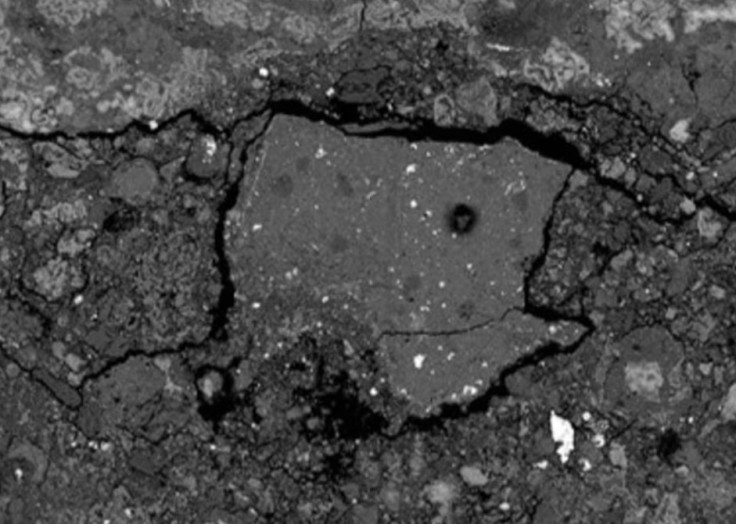
A meteorite that punched through the roof of a New Jersey home two years ago has revealed a rich chemical record of the early solar system, including a diverse suite of amino acids that scientists say are almost entirely foreign to life on Earth.
The 2-pound space rock, now known as the Hillsborough meteorite, streaked across the daytime sky on July 16, 2024, drawing reports from observers across New York, New Jersey, Connecticut, Rhode Island and Pennsylvania. As it passed just south of the Statue of Liberty, the object produced a sonic boom felt by residents throughout New York City and New Jersey. Traveling at roughly 32,000 miles per hour, the meteor was estimated to be about the size of a heavy airline bag before it began breaking apart approximately 22 miles above the ground.
Doppler weather radar at Newark Liberty International Airport picked up a cloud of fragments raining down from the sky between Staten Island and New Jersey, but only one piece was ever recovered. That fragment crashed through the ceiling of a master bedroom in a home in Hillsborough, New Jersey, causing no injuries. The homeowners, who have asked to remain anonymous, acted quickly to preserve the fallen material, using disposable gloves, aluminum foil and glass jars to collect the black fragments and dust scattered across their bed and carpet.
Peter Jenniskens, a senior research scientist at the SETI Institute and NASA's Ames Research Center, is the lead author of a study detailing the analysis of the meteorite, published Wednesday in the journal Science Advances. Jenniskens said the homeowners' quick action extended beyond simply collecting the debris. Recognizing that the fragile, porous rock could absorb moisture from the air, the homeowners patched their roof before rain fell that same evening, a step Jenniskens said proved crucial to protecting the sample from contamination.
That preservation effort allowed researchers to study the meteorite in an unusually pristine state. Analysis showed it to be a rare, primitive type of space rock known as a CM-type carbonaceous chondrite, classified more specifically as an intermediate CM½ variety that exists between two established subtypes distinguished by how much water altered their composition while still attached to a larger parent asteroid. According to Jenniskens, the sample marks only the second time a CM½ meteorite has ever been observed falling to Earth, and the first time researchers have been able to study one in such well-preserved condition. A similar meteorite that fell in Indonesia in 2020 landed in mud, compromising much of its scientific value.
Jenniskens said the sample offers researchers an unusually direct look at the physical structure of its parent body, noting in written comments that it is the first CM-type meteorite found to contain fragments of rock that preserved the subsurface characteristics of the original asteroid. He said the Hillsborough meteorite likely broke away from a larger asteroid within the inner asteroid belt between Mars and Jupiter, following a chain of cosmic events he described in detail: a major collision formed a broader asteroid family at some point in the past, a smaller collision roughly 6 million years ago destroyed one of those asteroids, and the resulting fragment eventually settled into a near-Earth orbit before heat and cold cycling caused it to break apart again about 200,000 years ago, ultimately setting it on a path toward Earth.
Chemical analysis of the recovered fragments turned up high concentrations of sodium, a signature researchers believe originated from icy brines once present within the meteorite's parent asteroid. As that water evaporated over time, it left behind concentrated salt minerals capable of forming molecules considered essential building blocks for life. Alongside those salts, researchers also detected organic carbon and a complex array of amino acids within the sample.
Study co-author Danny Glavin, a senior scientist in the Sample Return in the Solar System Exploration Division at NASA's Goddard Space Flight Center, said the detected amino acids were largely unlike anything found in Earth-based biology. "We detected a complex suite of amino acids, the fundamental building blocks of proteins, in water extracts of the Hillsborough meteorite," Glavin said. "Most of the amino acids detected in Hillsborough are rare or nonexistent in life on Earth, so they are truly extraterrestrial in origin." Glavin added that the diversity of amino acids identified in the sample exceeded what researchers found in pristine material returned from the carbon-rich asteroids Bennu and Ryugu, sampled respectively by NASA's OSIRIS-REx mission in 2020 and Japan's Hayabusa2 mission in 2019.
Researchers are now working to compare the salt minerals identified in the Hillsborough meteorite with those previously catalogued in the Bennu and Ryugu samples, aiming to better understand how water shaped the chemistry of primitive asteroids across the solar system. Fragments of the meteorite are currently being curated at the American Museum of Natural History in New York City.
Outside researchers say the discovery adds meaningfully to scientists' understanding of how life's chemical precursors may have first reached Earth. Peter Brown, a professor in the department of physics and astronomy at Western University in Ontario who was not involved in the study, said the presence of brine within the meteorite offers a particularly strong window into how water once moved through and reacted with organic material inside a primitive asteroid. Brown said meteorites like the Hillsborough sample retain the chemical fingerprint of the early solar system precisely because, while altered by water, they never experienced the intense heating that many other space rocks endure, leaving them with a texture closer to crumbling soil or clay than solid stone.
Brown credited the homeowners' fast, informed response with making the scientific analysis possible in the first place, noting that rainfall likely destroyed any additional fragments that landed outside before they could be collected. The homeowners connected shortly after the fall with Mike Hankey of the American Meteor Society, who guided them through the process of preserving the sample and minimizing contamination.
Reflecting on the experience, the homeowners said they understood almost immediately how rare the event was. "We knew almost immediately that what happened to us was incredibly rare and we felt a responsibility to preserve the meteorite for the scientific community," they said in written comments. "It's still surreal to think that this meteorite traveled through space for millions of years before ending its journey in our home. The entire experience has been incredible, and we're honored to have played a small part in advancing scientific understanding through its study."
© Copyright 2026 IBTimes AU. All rights reserved.