

(VIDEO) Gus the T. Rex Could Fetch $30 Million at Sotheby's, Sparking Scientific Debate Over Fossil Ownership
Sotheby's to Auction One of the Most Complete T. rex Fossils, Sparking Debate Over Private Sales
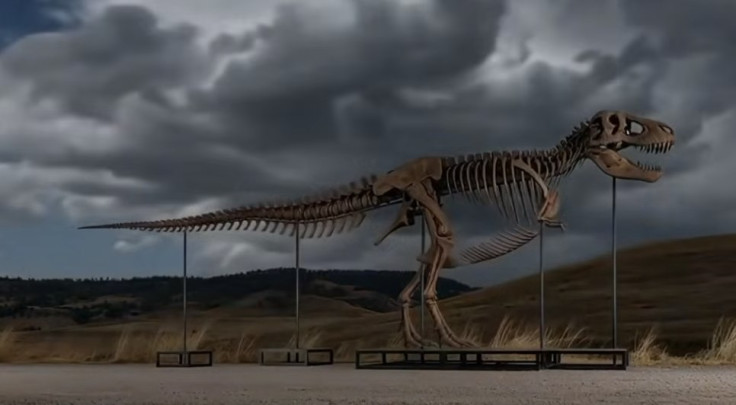
A Tyrannosaurus rex skeleton nicknamed Gus goes up for auction Tuesday at Sotheby's in New York City, with the auction house estimating the fossil could fetch between $20 million and $30 million, the highest presale estimate ever placed on a dinosaur skeleton, even as paleontologists warn the sale could push one of the most complete T. rex specimens ever found permanently out of scientific reach.
Gus was discovered in 2021 on a 6,500-acre cattle ranch in Harding County, South Dakota, owned by Gary "Gus" Licking, after whom the dinosaur is named. The skeleton measures roughly 38 feet from nose to tail and stands more than 12 feet tall, and is composed of 183 individual bone elements, representing about 61% of the dinosaur's possible bone count and 75% to 80% of its original bone mass by weight, according to Sotheby's. The skull alone measures 54 inches and retains roughly 82% of its possible bones. Marks across the skeleton, including healed fractures and what appear to be bite wounds to the skull, suggest Gus survived violent encounters with other predators during its lifetime roughly 67 million years ago, during the late Cretaceous period.
The excavation and preparation of Gus took nearly five years in total. Licking had spent years walking his property and noticing small bone fragments and teeth scattered across the land, eventually growing convinced something significant lay beneath the surface. He was proven right when paleontologists with Theropoda Expeditions, a Texas-based commercial excavation firm, found the fossil on the exact parcel of land Licking had pointed them toward. The team spent three years carefully extracting the skeleton from the ground, followed by another two years cleaning, cataloging and assembling the bones into their current mounted, predatory pose. Licking died roughly a year into the excavation, though his widow, Dana, continued following the project's progress.
Thomas Heitkamp, president of Theropoda Expeditions, described the painstaking nature of the reconstruction process. "It really does feel like tackling the world's hardest puzzle, except we have to find all the pieces first," Heitkamp said. "All those bones separated for 67 million years that we can now, almost magically, fit back together. There's something deeply satisfying about that."
Cassandra Hatton, Sotheby's global head of science and natural history, said the combination of factors that make Gus stand out is difficult to overstate. "The completeness, the quality, the size, and the preservation" set the specimen apart, Hatton told Reuters, emphasizing that finished fossils require significant expertise to properly identify and assemble. "What I think is really important for people to understand, when we talk about dinosaur fossils, is that they don't come out of the ground complete," Hatton said. "It takes highly specialized, careful, diligent, skilled people to recognize what they're looking at, to tell the difference between a piece of rock and a piece of this animal."
Gus's opening bid is set at $19 million, according to Sotheby's online registry. If the fossil sells within its estimated range, it would fall short of the current auction record for a dinosaur fossil, set in 2024 when Apex, a Stegosaurus skeleton, sold for $44.6 million to billionaire investor Ken Griffin, who has since loaned the specimen to the American Museum of Natural History in New York. Notably, Gus's estimate could prove conservative, given that Apex itself carried a presale estimate of only up to $6 million before ultimately selling for nearly eight times that figure.
The auction continues a lineage of high-profile dinosaur sales dating back nearly three decades. Sotheby's held the first-ever dinosaur auction in 1997, when Sue, a T. rex discovered in 1990 near the same South Dakota region where Gus was found, sold for $8.4 million to a group of institutions purchasing on behalf of Chicago's Field Museum, where the specimen remains on display today. Sue, at 90% of its possible bone mass, remains the largest and most complete T. rex skeleton ever discovered, edging out Gus on completeness even as Gus approaches similar scale. Another nearby T. rex, known as Stan, sold at auction in 2020 for $31.8 million, a record at the time for a dinosaur fossil.
Gus's discovery site sits within the Hell Creek Formation, a geological region spanning parts of South Dakota, Montana, North Dakota and Wyoming that has produced some of the most significant T. rex finds in paleontological history, including one of the first T. rex skeletons ever unearthed in 1902, the fossil discovery that gave the species its name.
The impending sale has reignited longstanding tension within the scientific community over the private auctioning of scientifically significant fossils. Some paleontologists argue that skyrocketing auction prices for specimens like Gus effectively price public museums and academic research institutions out of acquiring fossils that could otherwise contribute meaningfully to scientific study. University of Edinburgh paleontologist Steve Brusatte has noted that with price tags reaching $30 million or more, no public museum or research institution can realistically compete in these auctions. Susannah Maidment, a senior researcher at London's Natural History Museum, pointed to an even larger concern lurking beneath public auctions. "I've heard of private sales of T. rex specimens that have achieved more than $50 million," Maidment said, adding that such a sum "would absolutely revolutionize the collections, facilities and galleries of any museum or university across the UK."
Other researchers have pushed back on the notion that commercial excavation is the only path to recovering significant fossils, arguing that public institutions could pursue similar finds if landowners chose to work with museums rather than commercial paleontology firms from the outset. Some in the field have also questioned commercial excavators' framing of their work as preserving fossils for the public good. Kristi Curry Rogers, a professor of biology and geology at Macalester College, has argued the broader debate is less about legal ownership and more fundamentally about scientific stewardship of specimens that offer unique insight into prehistoric life.
Sotheby's has pushed back against the notion that private sales necessarily remove fossils from public view, pointing to arrangements such as Ken Griffin's decision to loan Apex to a major New York museum following his 2024 purchase. Hatton has also described a broadening buyer base for major fossil sales in recent years. "The dinosaur market today is broader than most people realize — and widening," Hatton said. "Interest now comes not only from U.S.-based museums and private collectors, but also major international museums, foundations, and individuals creating destinations of their own. What unites them isn't a single profile but a shared respect and curiosity for objects."
Whether Gus ultimately ends up displayed publicly, tucked away in a private collection, or somewhere in between will not be known until Tuesday's auction concludes, when bidders at Sotheby's New York office, and potentially online, determine just how far the market is willing to push the price for one of the largest and most complete Tyrannosaurus rex skeletons ever pulled from the ground.
© Copyright 2026 IBTimes AU. All rights reserved.