

(VIDEO) NASA Confirms Daytime Fireball Over Philly: Meteor Blazed at 30,000 MPH Across Northeast
PHILADELPHIA — A brilliant daytime fireball streaked across the skies over the Philadelphia region and parts of five states Tuesday afternoon, prompting hundreds of eyewitness reports and drawing swift analysis from NASA's Meteoroid Environments Office, which released detailed trajectory data confirming the event as a meteor burning up high in Earth's atmosphere.
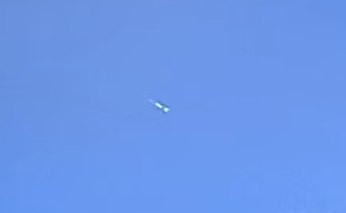
The fireball first became visible around 2:34 p.m. EDT on April 7, 2026, at an altitude of about 48 miles above the Atlantic Ocean off the coast of Mastic Beach on Long Island, New York. Traveling southwest at roughly 30,000 miles per hour, the meteor covered more than 117 miles through the upper atmosphere before disintegrating approximately 27 miles above Galloway Township in southern New Jersey, just north of Atlantic City, according to NASA's preliminary report.
Hundreds of residents across Pennsylvania, New Jersey, Delaware, New York and Connecticut contacted local news outlets and the American Meteor Society after spotting the bright flash against the clear blue sky. Some described a vivid green hue with silver or white fragments trailing behind, while others reported a brief sonic-like boom or rumble. The American Meteor Society logged at least 186 reports, including 28 from New Jersey alone, making it one of the more widely observed daytime fireballs in the Northeast in recent years.
NASA's Meteoroid Environments Office, which tracks bright meteors or "fireballs" using a network of cameras, weather radar and public reports, quickly mapped the object's path. The agency noted the meteoroid — likely a small asteroid fragment no larger than a few feet across — entered the atmosphere at a relatively shallow angle, allowing it to travel a long distance before fully ablating. No meteorites are expected to have reached the ground, as the object completely disintegrated at high altitude, NASA officials indicated in their analysis released late Tuesday.
Witnesses from Philadelphia to the Jersey Shore shared videos and photos showing a bright streak lasting several seconds. One driver on Route 70 in Medford, New Jersey, captured clear footage of the meteor against the afternoon sky, while social media filled with accounts from startled residents who initially mistook it for an aircraft in distress or even a flare. "It was like a green shooting star in broad daylight — lasted maybe three or four seconds and then poof," said one Philadelphia resident who contacted Action News.
The event occurred during what NASA describes as peak "fireball season" in the Northern Hemisphere, spanning February through April. During these months, the rate of bright meteors can increase by 10% to 30%, particularly around the March equinox, due to Earth's orbital position relative to streams of meteoroidal material. Tuesday's sighting adds to a notable uptick in large fireball reports in early 2026, with the American Meteor Society documenting a surge in widely witnessed events traced to the Anthelion sporadic source — the region of the sky opposite the Sun.
Experts emphasize that fireballs differ from typical meteors by their exceptional brightness, often rivaling or exceeding that of Venus or even the full Moon. They result when larger meteoroids — typically pebble- to boulder-sized — slam into the atmosphere at high speeds, compressing air and generating intense heat that causes the object to glow and vaporize. In this case, the 30,000 mph velocity produced enough energy to create a visible plasma trail and possible fragmentation, explaining the colorful descriptions from witnesses.
Tuesday's fireball follows a string of notable events in recent weeks, including a daytime bolide over Ohio in March that produced sonic booms and possible meteorite fragments, and others across Texas, Michigan and parts of Europe. While scientists say the apparent increase partly reflects greater public awareness and reporting via smartphone apps and social media, some analysts have noted an uptick in large events from the Anthelion region that "warrants serious investigation," according to American Meteor Society data.
No injuries or property damage were reported from the Philadelphia-area event. Unlike the rare cases where meteorites survive to the surface — such as the Texas house-piercing fragment in March — most fireballs pose no threat to people on the ground. NASA estimates that thousands of tons of meteoroidal material enter Earth's atmosphere daily, with the vast majority burning up harmlessly. Large fireballs like Tuesday's occur several times per year somewhere on the planet but are less common during daylight hours when they must outshine the Sun to be noticed.
Local authorities, including the National Weather Service offices in Mount Holly, New Jersey, and State College, Pennsylvania, received inquiries but confirmed no aviation incidents or other anomalies. Radar data showed no unusual returns, consistent with a high-altitude atmospheric event rather than a low-flying object.
For astronomers and citizen scientists, public reports play a crucial role in refining trajectory models. The American Meteor Society encourages witnesses to submit detailed accounts, including exact time, location, direction of travel and duration. Such data helps reconstruct the meteoroid's orbit and potential origin within the solar system, whether from the asteroid belt or a comet stream.
The Philly-region fireball generated widespread social media buzz, with hashtags like #PhillyFireball and #NJ Meteor trending locally. Videos captured from dashcams and security cameras provided additional angles for NASA's analysis. Some observers noted a possible sonic boom or pressure wave, though reports were inconsistent given the high altitude of disintegration.
NASA's quick release of preliminary findings reflects improved coordination between federal agencies, public reporting networks and meteor cameras. The agency's Fireball Network and partnerships with the American Meteor Society allow for near-real-time confirmation of significant events, helping distinguish meteors from other phenomena such as aircraft, drones or reentering space debris.
As details emerge, scientists continue monitoring for any potential meteorite recovery, though expectations remain low. Fragments from such events, if they exist, would be small and scattered over a wide area, often blending with terrestrial rocks. In rare witnessed falls, hunters use magnetic tools and systematic grid searches guided by trajectory data.
The sighting served as a reminder of Earth's constant interaction with space debris. While dramatic, these events offer valuable scientific opportunities to study atmospheric entry physics, material composition and the population of near-Earth objects. For the average observer, they provide a rare celestial spectacle in the middle of an ordinary workday.
Residents who missed the show can take comfort in the knowledge that fireball season continues for several more weeks. Clear skies and patience may reward sky-watchers with additional bright meteors, though none are guaranteed to match Tuesday's visibility in a populated daytime setting.
NASA plans to publish a more comprehensive report in the coming days, incorporating additional camera data and refined calculations. In the meantime, the agency and the American Meteor Society continue to collect witness accounts to improve future models.
For many in the tri-state area, the brief but unforgettable streak of light became the highlight of an otherwise routine Tuesday. It sparked conversations about astronomy, space safety and the wonders visible right overhead — proof that even in a bustling metropolitan region, the universe occasionally puts on a show.
© Copyright 2026 IBTimes AU. All rights reserved.