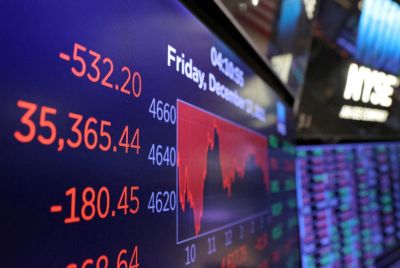
Dow Jones Climbs to Fresh Record Above 54,400 as Wall Street Rally Continues Into Wednesday This Week
Record-setting sessions on Wall Street driven by falling oil prices, strong earnings, and optimism over Strait of Hormuz diplomacy.

NEW YORK — The Dow Jones Industrial Average opened Wednesday at 54,467.23, extending a remarkable run of record-setting sessions on Wall Street as falling oil prices, strong corporate earnings and growing optimism over a potential resolution to the Strait of Hormuz crisis continued to fuel investor enthusiasm.
The blue-chip index's early Wednesday level built directly on Tuesday's historic close, when the Dow surged 907.47 points, or 1.71%, to finish at 54,085.88, marking the index's first close above the 54,000 threshold in its history. Wednesday's opening level of 54,467.23 represented a further gain of roughly 381 points, or about 0.7%, from that record close, suggesting the rally that has defined trading over the past several sessions was carrying fresh momentum into the new trading day.
A Historic Week for Major Indexes
Tuesday's session saw all three major U.S. stock benchmarks close at record highs simultaneously. The S&P 500 surged 1.79% to close at 7,736.52, its first record close in two months and a level that surpassed its previous closing peak set in early June. The tech-heavy Nasdaq Composite climbed 2.59% to finish at 26,584.99, powered in part by a 29% rally in Palantir Technologies shares, though the index itself remained roughly 2% below its own record high set in early June as it continued recovering from a summer slump.
The Dow's advance Tuesday marked its second consecutive all-time high, following a close above 53,000 points for just the second time ever on Monday. That back-to-back run of records came as Amazon briefly eclipsed a $3 trillion market capitalization for the first time on Monday, before pulling back roughly 2% Tuesday after founder Jeff Bezos filed to sell approximately $4 billion worth of shares.
Oil Prices and Iran Diplomacy Drive Sentiment
A significant portion of this week's rally has been attributed to continued declines in oil prices, driven by growing hopes that diplomatic talks involving the United States, Iran and Oman could soon lead to the reopening of the Strait of Hormuz to commercial shipping traffic. Brent crude fell to $79.11 a barrel as of early Wednesday, marking a roughly 13% decline from the prior week, as officials from the three countries reported progress in negotiations aimed at resuming oil shipments through the critical waterway.
President Donald Trump reinforced that sense of momentum, saying the strait would reopen "very soon" or Iran would be "hit very hard," according to comments reported by CNN. The optimistic tone from Washington was complicated somewhat by Iranian state media, which reported Wednesday that any potential agreement between Iran and Oman regarding the waterway's future had "no connection" to reopening the strait itself, illustrating the continued uncertainty underlying the diplomatic process even as markets have broadly priced in an optimistic outcome. Separately, tensions in the region remained elevated after an Indian-flagged vessel was struck and sunk by a projectile off the coast of Yemen, according to Indian authorities, though no group had been identified as responsible for the attack.
Strong Earnings Lift Individual Stocks
Beyond the macro backdrop, Tuesday's rally was also propelled by a wave of strong corporate earnings reports. Caterpillar led gains among Dow components, surging more than 5% and surpassing its intraday record set the previous month. Cisco Systems and IBM also posted notable gains of 5.11% and 3.91%, respectively, contributing meaningfully to the index's advance. Beyond the Dow's 30 components, the broader technology sector jumped roughly 4% during Tuesday's session, with chipmakers and AI-linked companies among the standout performers as sentiment toward the sector continued to rebound from earlier summer weakness.
That sector rotation has been a defining feature of markets in recent months. Through June and July, healthcare and financial stocks, sectors in which the Dow carries significant exposure, had outperformed technology shares, helping keep the blue-chip index near record territory even as the tech-heavy Nasdaq struggled with a summer slowdown. In August, however, technology shares have staged a notable comeback, rising nearly 7% for the month even as broader debate continues among investors over which companies stand to be the ultimate winners and losers from the ongoing artificial intelligence investment boom.
A Busy Day for Earnings Ahead
Wednesday's session arrived with investor attention split between the continued momentum in oil prices and Middle East diplomacy on one hand, and a fresh slate of high-profile corporate earnings on the other. Disney, Shopify and Kimberly-Clark were among the major companies scheduled to report quarterly results Wednesday, adding to an already earnings-heavy stretch of the summer reporting season that has helped drive much of the market's recent momentum.
That earnings-driven momentum followed a similarly eventful Tuesday, when SpaceX delivered its first results as a newly public company alongside a strong quarterly report from AMD, both of which drew significant investor attention given their ties to the broader AI infrastructure buildout that has dominated market narratives for much of the year.
Caution Amid the Rally
Despite the historic run of record closes, some market strategists have cautioned that the pace of recent gains raises questions about how sustainable the rally can be in the near term, with attention turning to whether fewer individual stocks participating in new highs could signal underlying fragility even as headline indexes continue climbing. Options market positioning has generally remained bullish, according to recent market commentary, though analysts have noted that narrowing market breadth during a rally can sometimes precede periods of consolidation or pullback.
With Wednesday's session already building on Tuesday's historic close, investors are likely to continue closely tracking developments in the Strait of Hormuz negotiations, given how directly oil price movements have been tied to this week's broader market sentiment. The continued flow of second-quarter corporate earnings, alongside any further updates on U.S.-Iran diplomacy, is expected to remain the dominant driver of trading in the sessions ahead as Wall Street works to determine whether the current record-setting run can be sustained into the latter half of the summer.
© Copyright 2026 IBTimes AU. All rights reserved.
- Recommended For You