

Wildfire Smoke Blankets American Midwest to East Coast as Milwaukee Records Worst Air Quality in History
Air quality plummets across the Midwest and Northeast as Canadian wildfires send smoke southward.
Heavy, pungent wildfire smoke darkened skies across a wide stretch of the United States on Thursday, from the Great Lakes to parts of the East Coast, reducing visibility in major cities and prompting warnings that breathing the outside air could pose a serious health risk to millions of people.
The smoke, drifting south from hundreds of active wildfires burning across Canada, triggered air quality alerts in at least 18 states stretching from Minnesota to New Hampshire and as far south as Virginia. According to the Canadian Wildland Fire Information System, roughly 858 wildfires were burning across Canada as of Thursday, the majority concentrated in the province of Ontario, where 113 fires remained classified as out of control. Some of that smoke traveled more than a thousand miles to reach cities in the United States, including New York City, despite Toronto itself sitting more than 1,100 miles from where many of the largest fires were burning in sparsely populated parts of Ontario.
Milwaukee bore some of the worst conditions recorded anywhere in the country. City officials said the Wisconsin city recorded its worst air quality on record Thursday, with an Air Quality Index reading of 644, more than double the city's previous record of 300, which had stood since 1987. Readings at that level fall far outside the standard 0-to-500 scale typically used to describe air pollution, reflecting just how severe the smoke concentration became in parts of the Upper Midwest.
Milwaukee was far from alone. According to rankings compiled by the air-quality monitoring service IQAir, Chicago, Cleveland, Detroit, Minneapolis, New York, Philadelphia, Pittsburgh and Washington, D.C., were among the cities most heavily affected by the smoke, with several registering conditions officially classified as hazardous, the most severe category on the U.S. Air Quality Index. Parts of New York City recorded AQI readings exceeding 200 Thursday evening, a level considered "very unhealthy," while officials in several cities warned that readings above 150 posed a danger to the general public, not just to individuals in traditionally sensitive groups such as children, older adults or people with existing respiratory conditions.
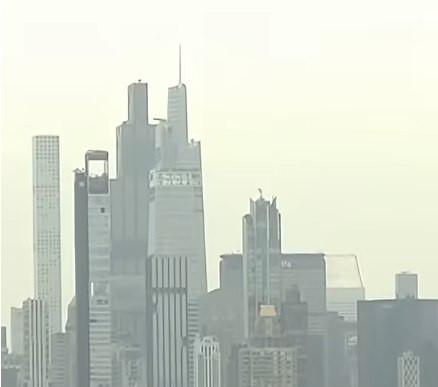
All of New York State, including New York City, along with parts of New Jersey, was placed under an air quality advisory Thursday because of the smoke. Images from around the city showed the sun shrouded behind a thick haze as it set behind Manhattan's Hudson Yards development, while in Chicago, residents sought relief along the Lake Michigan shoreline even as smoke settled over the lakefront. In Minneapolis, Mayor Jacob Frey urged residents to monitor the latest health guidance from the city as conditions continued to shift, saying officials would continue tracking the situation and sharing updates as needed.
Forecasters said the smoke was expected to remain a significant problem through the end of the week and into the weekend. According to meteorologists, the latest wave of smoke settled unusually close to the ground because of a shift in the region's weather pattern, in contrast to an earlier smoke plume earlier in the week that largely remained higher in the atmosphere and caused comparatively less severe surface-level pollution. As a result, air quality deteriorated sharply across the Northeast, Great Lakes and Midwest, with forecasters warning that poor conditions were likely to persist through Saturday as additional plumes of smoke continued arriving from the north.
Health officials have said the extreme smoke was expected to linger through Thursday evening across the Upper Midwest, including northern Wisconsin and northern Michigan, before continuing to affect the New York City area and other parts of the Northeast. Broader estimates from meteorologists tracking the smoke's reach suggested that unhealthy air quality was affecting more than 120 million people across the Midwest and Northeast as of Thursday, underscoring the scale of the event compared with more localized smoke episodes in past summers.
Wildfire smoke of this kind carries fine particulate pollution known as PM2.5, tiny airborne particles capable of traveling deep into the lungs and, in some cases, entering the bloodstream when inhaled. Exposure to elevated PM2.5 levels has been linked to a range of health effects, including irritated eyes and airways, coughing, difficulty breathing, and worsened symptoms for people with asthma or other chronic respiratory or cardiovascular conditions. Health officials have urged residents in affected areas to limit time spent outdoors, avoid strenuous physical activity outside, keep windows closed, and run air conditioning or air purification systems on recirculating settings where possible to reduce the amount of smoke-laden outside air entering homes.
This week's smoke event adds to what has already been a difficult wildfire season across parts of North America. Wildfires within the United States, mostly concentrated across the western half of the country, have burned more than 3.6 million acres so far this year, contributing to smoke and air quality concerns that had already affected parts of the West, the Plains and the Midwest earlier in the summer, independent of the thicker Canadian smoke now moving over the Great Lakes and Northeast.
Photographs and video captured across affected cities Thursday showed the extent of the smoke's visual impact, including images of the Statue of Liberty in New York Harbor photographed from the Staten Island Ferry against a hazy, smoke-filled sky, and children continuing outdoor activities such as playing football in New York parks despite the deteriorating air quality around them. Similar scenes played out in Toronto, where a plane was photographed landing at Billy Bishop Toronto City Airport amid smoke that had settled over the city a day earlier.
With hundreds of wildfires continuing to burn across Ontario and other parts of Canada, and forecasters warning that additional smoke plumes remained likely to drift south in the coming days, officials across the affected U.S. states said they would continue monitoring air quality conditions closely and issuing updated guidance as the smoke's movement and intensity continued to shift through the remainder of the week and into the weekend.
© Copyright 2026 IBTimes AU. All rights reserved.