

Mitsubishi's Fifth-Generation Pajero Returns As Rugged Off-Road SUV After Five-Year Hiatus, Debuts In Tokyo
The fifth-generation Pajero marks a return to body-on-frame construction, offering serious off-road capabilities.
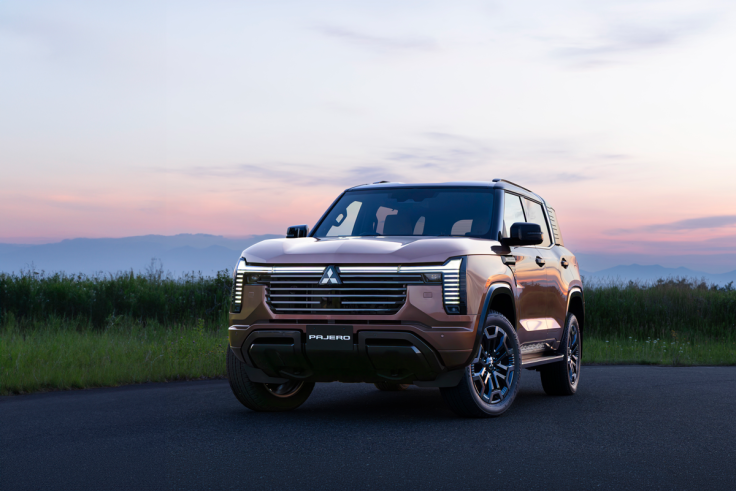
TOKYO — Mitsubishi has officially revived the Pajero nameplate, unveiling a fifth-generation version of its legendary off-roader that abandons the increasingly road-focused direction of its predecessor in favor of serious, body-on-frame off-road credentials.
The new Pajero debuted Wednesday, roughly 20 years after Mitsubishi unveiled the most recent prior redesign of the fourth-generation model in 2006. That earlier generation was discontinued globally in 2021 after nearly 15 years of continuous production, leaving Mitsubishi without a flagship off-road SUV in most markets during the intervening years.
Rather than continuing the fourth generation's shift toward a more unibody, road-oriented design, Mitsubishi took the fifth-generation Pajero in a distinctly different direction. The new SUV rides on a ladder-frame chassis derived from the underpinnings of Mitsubishi's Triton, known as the L200 in some markets, marking the first time in two generations the Pajero has returned to a true body-on-frame construction after the third generation had shifted to a unibody design with an integrated frame for added rigidity.
Built in Thailand alongside the Triton pickup to which it is closely related, the new Pajero shares its underlying platform with the sixth-generation Triton launched in early 2024. The SUV features a live rear axle, four-wheel drive with low-range gearing, a rear differential lock, and Mitsubishi's Super Select 4WD-II system, which offers four selectable drivetrain modes: rear-wheel drive in high ratio, four-wheel drive in high ratio, four-wheel drive high ratio with a locked center differential, and four-wheel drive low range with a locked center differential. The system is paired with Mitsubishi's Super All-Wheel Control technology, including Active Yaw Control and seven distinct drive modes covering Normal, Eco, Gravel, Snow, Mud, Sand and Rock conditions.
Power comes from a 2.4-liter turbocharged diesel engine, an intentional departure from the electrified and increasingly monocoque direction many rivals in the large SUV segment have taken in recent years. Mitsubishi is positioning the new Pajero as a genuine alternative to established off-road-focused competitors such as the Toyota Land Cruiser Prado, the Ford Everest and the Nissan Patrol, all of which have themselves received significant redesigns in recent years.
Visually, the new Pajero adopts a considerably boxier, more upright design language than its immediate predecessor, drawing inspiration from Mitsubishi's newer regional models such as the Destinator and Xforce while incorporating design cues meant to evoke earlier Pajero generations. The SUV features T-shaped headlights and taillights, a full-width light bar, and strong horizontal lines at the front, along with C-pillars styled to recall the cab-mounted roll bar found on the original first-generation Pajero. A hexagonal motif at the rear of the vehicle references the door-mounted spare tire that was a signature feature of earlier Pajero generations, though the new model relocates its spare tire to an underfloor mounting position beneath a conventional top-hinged tailgate, doing away with the swing-out rear door that longtime Pajero owners would recognize from past generations.
The new Pajero measures 193.7 inches, or 4,920 millimeters, in overall length, with a width of 75.8 inches, or 1,925 millimeters, and a height of 75.2 inches, or 1,910 millimeters. Its wheelbase spans 113 inches, or 2,870 millimeters, with both front and rear axles sharing a 64.2-inch, or 1,630-millimeter, track width. The SUV also offers 230 millimeters of ground clearance, a figure consistent with the demands of serious off-road driving. Depending on trim level, the Pajero rides on either Toyo Open Country H/T or Bridgestone Dueler H/T tires, both sized at 255/55 R20.
Mitsubishi designed the new Pajero in Japan under an internal design theme called "Grand Charisma," which the company said was intended to showcase premium craftsmanship befitting the nameplate's flagship status within Mitsubishi's broader lineup.
Effectively, the new Pajero also serves as a replacement for the Pajero Sport, a related model built alongside the previous-generation Triton that Mitsubishi discontinued in 2025. That positioning reflects a broader restructuring within Mitsubishi's SUV lineup, consolidating what had previously been separate nameplates into a single, more premium flagship model built on shared underpinnings with the Triton pickup truck.
Mitsubishi plans a staggered global rollout for the new Pajero, with Thailand set to be the first market to receive the SUV, followed by Japan and then Australia, where first deliveries are expected by the end of March 2027. The company has said the Pajero will eventually reach approximately 100 countries as part of a broader rollout beginning in Mitsubishi's 2027 fiscal year, which could bring the SUV to additional markets across the Middle East, Southeast Asia and beyond, though specific timelines and powertrain configurations for many of those markets remain unconfirmed. Diesel power is expected to be central to the Pajero's appeal in markets such as Thailand and Australia, where demand for diesel-powered SUVs and pickups remains strong, while predominantly gasoline-driven markets such as the United Arab Emirates and other Gulf nations may eventually receive a petrol-powered variant instead.
Industry analysts covering the reveal noted that Mitsubishi's decision to embrace a truck-based, body-on-frame approach for the new Pajero, rather than pursuing a softer, more unibody-oriented redesign, arrives at a moment when several rival Japanese automakers have similarly doubled down on genuine off-road capability for their flagship SUVs. Toyota's redesigned Land Cruiser and Land Cruiser Prado, along with Nissan's newest Patrol, sold in some markets as the Armada, have each taken comparable approaches in recent years, suggesting a broader industry shift back toward traditional off-road engineering even as many other SUV segments continue moving toward electrified, unibody platforms.
The Pajero name itself carries a complicated linguistic history outside Japan. Mitsubishi has historically marketed the SUV under alternate names in several regions, including Montero in North America, Spain and most of Latin America, and Shogun in the United Kingdom, due to the term "pajero" carrying a vulgar connotation in Spanish. Mitsubishi discontinued Pajero and Montero sales in North America back in 2006, and the brand has not indicated any plans to reintroduce the nameplate to the U.S. or Canadian markets as part of this fifth-generation relaunch.
As Mitsubishi moves toward production and eventual market launches over the coming months, further details regarding full pricing, complete trim-level specifications, and confirmed availability timelines for markets outside Thailand, Japan and Australia are expected to be announced in the lead-up to each region's respective on-sale date.
© Copyright 2026 IBTimes AU. All rights reserved.