

(VIDEO) Five Reasons Shoppers May Pick Apple's New iPhone Duo Over Samsung's Galaxy Z Fold 8 in 2026
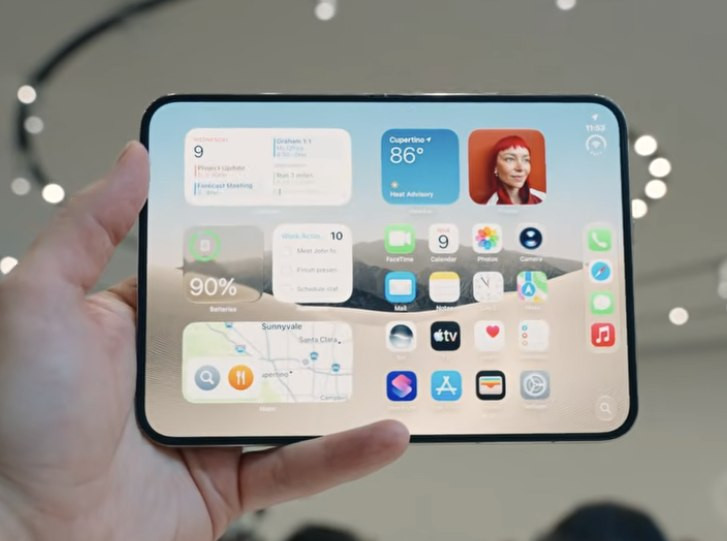
CUPERTINO, Calif. — Apple's first foldable, the iPhone Duo, arrived on Sept. 9 at a starting price of $1,999, $100 above Samsung's Galaxy Z Fold 8. That is not an obvious bargain. It is a bet that a tighter seal, a newer chip and the iPhone software stack outweigh a phone that is already on sale, 53 grams lighter and $100 cheaper in the United States.
Both devices are wide, passport-style books: a cover screen near 5.4 to 5.5 inches and a 7.6-inch inner panel at 120 Hz with peak brightness listed at 3,000 nits. Samsung unveiled the Fold 8 on July 22 and put it on sale Aug. 7. Apple set U.S. preorders for Oct. 16. The comparison below is about announced specifications and company claims, not a week of independent battery tests. Five differences are why some buyers will still write the larger check.
First is the rating that foldable owners actually live with: dust. Apple lists the Duo at IP68 for dust and water. Samsung lists the Fold 8 at IP48. The second digit is similar immersion language. The first digit is not. IP48 is protection against objects 1 millimeter and larger. IP68 is dust-tight. Fine grit in a hinge is how early foldables died in pockets. Digital Trends and others have called the seal the Duo's clearest hardware win. Samsung's years of hinge work produced a 201-gram body 4.5 millimeters thick unfolded. Apple's Duo is 254 grams and 5.2 millimeters unfolded, 11.3 millimeters folded versus 9.7. Buyers who want the lightest book still go to Seoul. Buyers who commute on dusty trains may pay for the 6.
Second is silicon. The Duo uses Apple's A20 Pro on a 2-nanometer process and a vapor chamber Apple says is meant to keep the larger panel from throttling. The Fold 8 uses Qualcomm's Snapdragon 8 Elite Gen 5 for Galaxy on 3 nanometers. Last year's Snapdragon was close to the A19 Pro in many tests. A process-node jump is the kind of claim Apple has used to sell every Pro iPhone; independent benchmarks on the Duo are not public yet. Storage goes to 2 TB on the Duo and 1 TB on the Fold 8. Base RAM is 12 GB on both; Samsung offers 16 GB on the 1 TB Fold. The software argument is older than the chip: iOS 27 split-view and apps rebuilt for the inner 4:3 panel before launch, versus Android 17 and One UI 9, which have had years of foldable windows and still fight tablet-stretched layouts. Both companies advertise about seven years of OS updates. The Duo's edge is not the calendar. It is whether Messages, FaceTime and the App Store feel finished on day one.
Third is how the phone charges and how long Apple says video lasts. Apple claims up to 31 hours of video playback on the inner display. Samsung's comparable claim for the Fold 8 is 26 hours. Test methods differ; treat both as marketing until a lab runs them. The Fold 8 battery is listed at 4,800 milliamp-hours, the Duo around 4,700. Wired charging is 45 watts on Samsung and in the 40-to-60-watt range in Apple's published figures, depending on the outlet. Wireless is where Apple leaned in: MagSafe-style magnets and about 25 to 30 watts, versus 20 watts Qi2-ready charging on the Fold 8 without built-in magnets. Alignment without a case is a small daily habit. Over two years it is the reason some people do not buy a third-party puck.
Fourth is the inner glass as a work surface. Apple added Apple Pencil support and a nano-texture finish it says cuts reflections more than a standard anti-reflective coat. Samsung dropped S Pen support on this wide Fold 8; the stylus remains a story on other Galaxy tablets and older Folds. A foldable that takes a pencil is closer to a pocket iPad than to a tall phone that opens. The Duo's inner resolution is listed around 2,670 by 1,878, a bit sharper than the Fold 8's 2,448 by 1,848. Neither has a dedicated telephoto. Cameras are dual wide systems: 48-megapixel main and ultrawide on Apple, 50-megapixel main and ultrawide on Samsung, plus a 12-megapixel Center Stage and under-display FaceTime camera on the Duo versus 10-megapixel selfies on the Fold. Samsung can record 8K30; Apple lists 4K120. Photographers who wanted a periscope zoom are shopping the Fold 8 Ultra at $2,100 and up, not this pair.
Fifth is the rest of the Apple house. A Duo buyer keeps Watch, AirPods, iCloud photos and a phone number that already lives in iMessage. That is not a spec sheet line. It is why people overpay for iPhones in every other category. The Fold 8 answers with Gemini, DeX-style desktop modes, more colorways — graphite, cream, lavender, pistachio — and a body you notice at the end of a day because it is not there. In the United Kingdom the Duo's £1,999 against the Fold 8's £1,699 is a £300 argument. In India the gap is far wider. In the United States it is $100 and a religion.
None of this makes the Duo the better foldable for everyone. Samsung shipped first, cut weight, and priced the wide book under $1,900. Apple shipped later, sealed the hinge tighter on paper, put a 2-nanometer chip and a pencil on a $2,000 slab, and asked the iPhone base to switch form factors without leaving the store. Preorders in October will show whether IP68 and iOS are enough to tax a category Samsung spent eight years teaching people to trust. Until hands-on battery numbers land, the five reasons above are the ones Apple put on the table — and the ones Samsung left open.
© Copyright 2026 IBTimes AU. All rights reserved.