KOSPI Falls More Than 5% as Investors Lock In Profits After Friday's Record-Breaking Rally Across Seoul
South Korea's KOSPI index experiences significant volatility following a record-breaking rally, highlighting market instability.
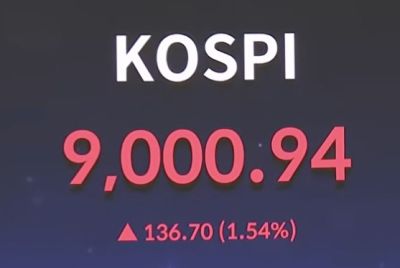
South Korea's benchmark KOSPI index fell 5.36% on Monday, dropping 353.68 points to trade at 6,241.77, as investors locked in profits following the index's historic single-day surge just two trading sessions earlier.
The index opened sharply lower Monday, initially falling 3.6% before extending losses to as much as 4.25%, dropping 280.05 points to 6,315.4 shortly after 9:15 a.m. local time, according to the Korea JoongAng Daily. The pullback continued through the morning session, pushing the decline past 5% by early afternoon.
Monday's retreat came directly on the heels of Friday's record-breaking rally, when the KOSPI surged 17.91% in a single session, the largest one-day percentage gain in the index's history, following blockbuster earnings from Microsoft, Amazon and Meta Platforms that had eased broader concerns about the sustainability of artificial intelligence infrastructure spending. That Friday rally itself followed a brutal three-session stretch in which the KOSPI had plummeted more than 17%, at one point falling roughly 40% from its June peak.
Notably, Monday's decline came even as Wall Street posted a positive session heading into the new trading week, with robust earnings from Amazon continuing to fuel investor optimism toward the broader artificial intelligence sector. That divergence between a positive US session and a sharply negative Korean one underscored how much of Friday's historic rally had been driven by profit-taking and short-covering dynamics specific to the Korean market, rather than a durable, fundamentals-driven shift in sentiment toward Korean chip stocks.
The current bout of extreme volatility fits a broader pattern that has defined South Korean equity markets throughout 2026. The Korea Exchange has repeatedly triggered trading halts, including both sell-side sidecars, which temporarily suspend program sell orders, and circuit breakers, which pause all trading entirely, on numerous occasions this year. By late June, the exchange had already logged close to 30 sidecar activations and five circuit breakers for the year, a pace that had already surpassed the KOSPI's prior annual record of 26 sidecar halts, set during the 2008 global financial crisis.
Much of the extreme volatility has been driven by the outsized weighting of Samsung Electronics and SK Hynix within the index. The two chipmakers together account for roughly half of the KOSPI's total market capitalization, meaning sharp swings in either stock, in either direction, tend to translate directly into equally dramatic swings for the headline index. Both companies have repeatedly whipsawed between steep declines and sharp rebounds in recent weeks, tracking a broader global reassessment of artificial intelligence-related chip demand and valuations that has played out across markets in the United States and Asia alike.
Frank Benzimra, head of Asia equity strategy at Societe Generale in Hong Kong, pointed to the concentrated nature of the recent selling pressure when South Korean markets first began plunging in late July. "If you look at what is falling in the market, it has been the stocks in which you have the most leverage," Benzimra said, according to Al Jazeera, highlighting how heavily leveraged positions tied to chip and technology stocks have amplified the scale of the market's swings in both directions.
The scale of the recent turbulence has been extraordinary even by the standards of a market that had posted extraordinary gains over the prior 18 months. South Korean equities surged roughly 75% during 2025, driven substantially by the global boom in artificial intelligence and semiconductor demand, before extending those gains with another roughly 50% climb earlier in 2026 as global capital continued flowing into the country's technology sector. That backdrop of extraordinary prior gains has left the index unusually vulnerable to sharp reversals whenever sentiment toward AI-related chip demand shifts, given how significantly valuations across the sector had climbed during the preceding rally.
South Korean regulators have moved to address the underlying volatility directly in recent days. New cash-deposit requirements for investors using leveraged exchange-traded funds took effect July 31, a change specifically designed to reduce the kind of mechanically amplified trading swings that have repeatedly gripped both the KOSPI and the smaller KOSDAQ index throughout the year.
With the KOSPI now retreating sharply from Friday's historic gain, market analysts continue to caution against reading too much into any single day's move given the scale of the index's recent whipsaw trading. Investors are likely to remain focused in the coming sessions on further earnings reports from major global technology companies, along with any additional developments involving Samsung and SK Hynix specifically, as key factors determining whether South Korean equity markets can find a more stable footing following one of the most volatile stretches in the exchange's history.
© Copyright 2026 IBTimes AU. All rights reserved.
- Recommended For You