NASA's Webb Telescope Captures Stunning New Images Of The Lion Nebula's Glowing Cosmic Mane
New images from NASA's James Webb Space Telescope offer unprecedented insights into the Lion Nebula's structure and evolution.
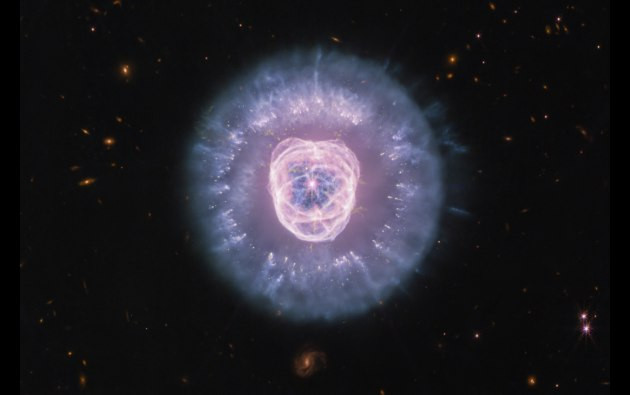
NASA's James Webb Space Telescope has captured striking new images of a dying star's remains, revealing unprecedented detail in a cosmic structure nicknamed the Lion Nebula for its uncanny resemblance to a lion's face framed by a glowing mane.
The images, released August 10, show planetary nebula NGC 2392, located roughly 6,500 light-years from Earth. Webb captured the target using two of its science instruments, the Near Infrared Camera, known as NIRCam, and the Mid-Infrared Instrument, known as MIRI, producing both a composite near- and mid-infrared view and a standalone thermal map that scientists say offers new insight into how dust from dying stars eventually seeds the formation of future stars and planets.
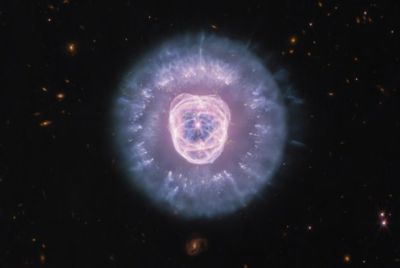
At the center of the nebula sits a white dwarf, the hot, compact remnant of a star that has shed its outer layers at the end of its life. In the image, that stellar core appears as a bright, button-like feature resembling the lion's nose. The dying star's intense radiation has carved out a bubble of ionized hydrogen gas around itself, forming the lion's "face," a structure marked by cavernous shells and expanding rings that continue destroying nearby dust as they push outward.
Surrounding that central bubble is the nebula's namesake "mane," a shell of dust illuminated from within by the central star's radiation and rendered in cyan in Webb's composite imagery. Toward the mane's outer edges, purple, cometary-shaped clumps of dust are visible, structures that have managed to survive the dying star's radiation rather than being destroyed outright.
Webb's MIRI thermal data revealed, for the first time, why certain dust knots are able to survive that radiation while surrounding material is obliterated. According to NASA, the surviving clumps are dense enough to effectively shadow the material directly behind them, shielding it from the star's radiation and allowing that dust to persist. Scientists say the finding carries broader significance beyond NGC 2392 itself: dust that survives this process may eventually reach the interstellar medium intact, carrying carbon, nitrogen and oxygen that can later become part of the raw material from which future stars and planetary systems form.
NASA's official caption accompanying the standalone MIRI image put the dynamic plainly, noting that "some dust is being destroyed by the dying central star's radiation, while some dust filaments manage to survive." Researchers have observed similar self-shielding dust structures, known as cometary knots, in other planetary nebulae studied by Webb, including the Helix Nebula, images of which NASA released in January. In that earlier case, NASA described the origins of the knots' formation as "not initially predicted" and said their underlying causes "are still not well understood," underscoring that NGC 2392's new images add another data point to an ongoing scientific puzzle rather than resolving it outright.
NGC 2392 is not a newcomer to space telescope imaging. NASA's Hubble Space Telescope previously observed the nebula in visible light back in 2000, capturing the lion-face structure and its hazy, comet-shaped features using an earlier generation of imaging technology. Webb's infrared instruments have now produced a considerably more detailed view of the same target, with NASA noting that while the overall structure looks broadly similar to Hubble's earlier image at first glance, Webb's infrared vision highlights fine features, including compact dust clumps and the diffuse haze of ionized gas, that were far less distinct in the earlier visible-light observations.
Scientists estimate that the structure captured in Webb's new images represents a relatively brief snapshot in the nebula's ongoing evolution. It has taken several thousand years for the gas and dust to reach their current configuration, and researchers expect the nebula will continue changing as the central white dwarf's radiation keeps reshaping the surrounding material. NASA has said the lion-shaped structure is expected to fully disperse in approximately 10,000 years, a relatively short span by astronomical standards.
Planetary nebulae like NGC 2392 form when stars with relatively modest masses, similar in scale to the sun, reach the end of their lives. Unlike far more massive stars, which end their lives in dramatic supernova explosions, lower-mass stars shed their outer layers more gradually, exposing a hot stellar core that ionizes and illuminates the surrounding expelled material, producing the colorful, structured nebulae that have become some of Webb's most visually striking targets since the telescope began science operations.
The new Lion Nebula images were processed by Alyssa Pagan of the Space Telescope Science Institute, using data collected under proposal 9548, led by principal investigator M. Garcia Marin. Webb, launched in December 2021, operates as an international collaboration led by NASA in partnership with the European Space Agency and the Canadian Space Agency, and has continued producing detailed observations of nebulae, distant galaxies and other cosmic phenomena throughout its ongoing mission.
With the new NGC 2392 data now available to researchers, scientists say the detailed thermal mapping of surviving dust structures could inform future studies of similar planetary nebulae, helping refine understanding of exactly how much stellar material ultimately survives a dying star's radiation to seed the next generation of stars and planetary systems across the galaxy.
© Copyright 2026 IBTimes AU. All rights reserved.
- Recommended For You