

(VIDEO) Golden Eagle Attacks Police Officer At World Nomad Games In Kyrgyzstan, Tears Off Vest In Incident
Unexpected Eagle Attack Highlights Cultural Traditions at Kyrgyzstan's World Nomad Games
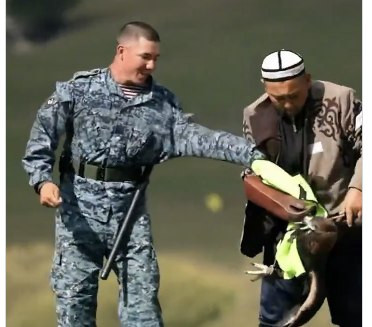
KYRCHIN GORGE, Kyrgyzstan — A trained hunting golden eagle attacked a police officer during this year's World Nomad Games in Kyrgyzstan, tearing off the officer's reflective vest in a startling incident that unfolded as the bird apparently mistook the man for prey.
The attack occurred Thursday in the Kyrchin Gorge, one of the primary competition venues for the biennial international sporting event, according to Kyrgyz news outlet Open.kg. The officer had been stationed at the site to help maintain public order during the ongoing games when the golden eagle suddenly swooped down and struck him.
At the World Nomad Games in Kyrgyzstan, a hunting golden eagle attacked a police officer after apparently mistaking him for prey. pic.twitter.com/KKqsDdVQLd
— Breaking911 (@Breaking911) September 4, 2026
According to the report, the bird tore off the officer's reflective safety vest during the attack. Witnesses described the eagle unexpectedly diving toward the man, who attempted to defend himself as the bird continued its assault. The situation was quickly brought under control after a falconer, one of the event's trained eagle handlers, rushed to the scene and intervened to stop the bird.
The officer did not sustain serious injuries or damage as a result of the encounter, according to the report.
The incident occurred amid the World Nomad Games' Salbuurun discipline, a traditional Central Asian hunting competition that combines events involving trained birds of prey, including golden eagles and falcons, alongside specially bred hunting dogs known as taigans. The practice of eagle hunting on command, in which trained birds respond to a handler's calls and pursue designated targets, traces its origins back to the Mongol conquests of the 12th and 13th centuries and remains a significant cultural tradition across parts of Central Asia today.
Within the Salbuurun competition, golden eagles are typically tested on their ability to respond to their handler's calls from a distance and to successfully catch a model fox or hare being pulled behind a horseman, with judges evaluating both the speed and accuracy of the bird's hunting instincts during the exercise. It remains unclear from available reporting whether the eagle involved in Thursday's attack on the police officer was actively participating in a competition event at the time, or whether the bird had simply become disoriented or overstimulated by the surrounding activity and mistook the officer, dressed in his reflective safety vest, for a legitimate hunting target.
The 2026 edition of the World Nomad Games is being held in Kyrgyzstan from Aug. 31 through Sept. 6, with competitions taking place across venues in the Kyrchin Gorge and along the shores of Lake Issyk-Kul, roughly 300 kilometers from the capital, Bishkek. This year's event marks a return of the games to their birthplace in Kyrgyzstan, where the competition first launched in 2014 as a platform to showcase traditional sports and cultural practices from Central Asia's nomadic peoples.
What began in 2014 as a relatively modest competition featuring 20 countries and 10 traditional sporting disciplines has grown substantially over the past decade, now drawing athletes from approximately 100 countries competing across 43 distinct events, according to reporting from ABC News Australia. The games feature a wide range of traditional nomadic sports, including kok-boru, a horseback team competition sometimes described as a Central Asian equivalent to rugby played with a goat carcass rather than a ball, alongside horseback wrestling, traditional archery, and various forms of belt wrestling native to different Turkic cultures across the region.
Ahmed Kharat, captain of the Australian team competing in archery events at this year's games, offered a comparison intended to help international audiences understand the cultural significance of some of the competition's more unfamiliar sports.
"It's like AFL and the NRL here in Australia, but on horseback," Kharat said, referring to kok-boru specifically.
This year's games have adopted the snow leopard as their official emblem, a symbol the International Secretariat of the World Nomad Games has described as representing strength, clarity and endurance, qualities organizers say reflect both the rugged terrain surrounding the competition venues and the broader spirit of the event itself. The snow leopard has increasingly served as a national symbol for Kyrgyzstan in recent years and has played a central role in the country's broader conservation diplomacy efforts, including its involvement in establishing Oct. 23 as International Snow Leopard Day.
Eagle hunting competitions have remained one of the more visually striking and internationally recognized elements of the World Nomad Games since the event's inception, drawing significant media attention given the relative rarity of the practice outside Central Asia. Traditional eagle hunters, known locally as berkutchi, train golden eagles over extended periods to respond precisely to vocal and physical commands from their handlers, a skill passed down through generations in parts of Kyrgyzstan, Kazakhstan and neighboring countries.
Despite Thursday's unusual attack on the police officer, there was no indication in available reporting that the incident had disrupted the broader schedule of Salbuurun competitions or other events taking place as part of this year's games. The World Nomad Games have continued operating with the same competitive schedule and venue arrangements that have characterized the event since its founding, with organizers not indicating any changes to safety protocols surrounding the eagle hunting competitions specifically in the immediate aftermath of the incident.
The World Nomad Games are scheduled to conclude Sunday, marking the close of this year's edition of the biennial event before the competition is expected to move to a new host location for its subsequent installment, consistent with the rotating hosting pattern the games have followed since expanding beyond Kyrgyzstan for the first time in 2022, when the fourth edition of the competition was held in Iznik, Turkey.
© Copyright 2026 IBTimes AU. All rights reserved.