

Argentine Official's Claim That China Caused Nepal Flood Sparks Diplomatic Row With Beijing Amid Fierce Anger
Argentine Government Distances Itself from Official's Claims Amidst Diplomatic Fallout
BUENOS AIRES — A senior communications official in Argentine President Javier Milei's government has triggered a diplomatic dispute with China after publicly blaming a Chinese state-owned company for a deadly flood disaster in Nepal, prompting a sharp rebuke from Beijing's embassy in Buenos Aires.
Juan Pablo Carreira, national director of digital communication for the Argentine presidency, wrote on his personal account on X on Aug. 30 that a Chinese state company had been building a hydroelectric installation beside a glacier near the Nepal-Tibet border, and that failures in the state's organization of the industrial project had caused the disaster's onset. He went further, linking the episode to other catastrophes he attributed to communist governments throughout history and concluding with the assertion that "communism kills."
According to reporting on the episode, Carreira claimed the collapse and subsequent mudslide and flooding "killed more than 2,500 Nepalese in a matter of seconds." He compared the disaster to other major industrial catastrophes historically linked to communist governance.
"This joins the ranks of the greatest humanitarian disasters caused by the Communist Party's management of industrial activity in history, such as Chernobyl, the Aral Sea, the Great Leap Forward, and the Holodomor," Carreira wrote. "Communism kills. The Communist Party, disguised as a 'businessman,' kills."
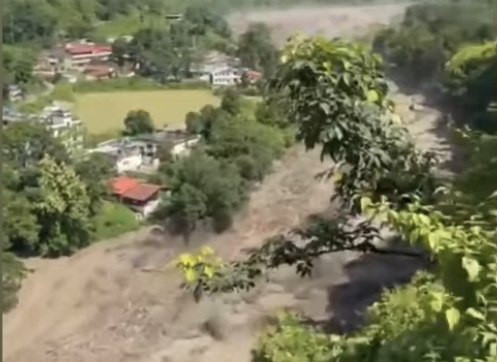
The underlying disaster occurred on Aug. 26, when a mass of ice and rock broke away from a glacier front on the northern slopes of Langtang Lirung, in Nepali territory, and fell roughly 1,200 meters to the valley floor below. The falling material temporarily blocked the Lhende Khola river, forming a lake that later burst through, unleashing a surge of water and mud that swept away the Gyirong border crossing and cascaded down the Bhote Koshi and Trishuli rivers, devastating communities along the border corridor between Nepal and Tibet. As of Tuesday morning, reports indicated the death toll stood at roughly 1,000, with nearly 4,000 people still missing.
China's embassy in Buenos Aires responded forcefully to Carreira's claims, accusing him of spreading malicious rumors and attempting to damage China's international reputation. The embassy's statement, issued Monday night Argentine time, characterized the official's remarks as ideologically driven and factually baseless.
"A certain Argentine official, driven by biased ideological prejudices, is maliciously spreading rumors to defame the Communist Party of China and tarnish China's international image," the embassy said, calling on Carreira to stop speculating and avoid politicizing or instrumentalizing a natural disaster.
The embassy maintained that Chinese and Nepali experts and relevant institutions had jointly investigated the cause of the disaster and determined it stemmed from a glacier collapse on Nepali high ground, characterizing the event as a natural disaster rather than the result of any infrastructure failure. Separately, China's embassy in Nepal offered a similar account, attributing the disaster to a seismic tremor on the morning of Aug. 26 that triggered a severe snow and rock avalanche on the Nepali side of the border, which then blocked river flows and released debris across the border zone.
"Blame solves nothing; cooperation saves lives," the Chinese embassy in Nepal said, urging governments and commentators to prioritize humanitarian cooperation over assigning fault.
Beyond disputing the factual basis of Carreira's claims, China's embassy also warned that politicizing the natural disaster risked damaging the broader relationship and cooperation between China and Argentina, framing the episode as a matter with potential diplomatic consequences extending well beyond a single official's personal social media commentary.
The controversy has drawn criticism from within Argentina's own political opposition. Opposition lawmaker Pablo Juliano argued that the country's foreign policy should not be shaped by the social media activity of government officials, and called on President Milei to either remove Carreira from his post or press him to resign. Juliano's criticism reflected a broader concern that, given Carreira's senior position as the presidency's chief digital communications official, his remarks targeting a foreign government could not reasonably be dismissed as merely a personal opinion disconnected from official government messaging.
Facing the mounting controversy, the Argentine government moved to distance itself from Carreira's statements, clarifying that his remarks did not represent the government's official position. Even so, the episode's political fallout has not been easily contained, given that Carreira has served as one of President Milei's central online communications figures dating back to Milei's presidential campaign, and has been a consistently vocal public supporter of the president throughout his tenure.
Carreira, reported to be under 30 years old, has been identified as a central figure within Argentina's ultra-libertarian online network known as "Las Fuerzas del Cielo," a group aligned with other prominent pro-Milei online commentators. He has led the government's Digital Communications Directorate since April 2024, building a reputation as one of the administration's most vocal and combative online voices.
The dispute arrives at a sensitive moment in the broader relationship between Argentina and China, which remains one of Argentina's most significant commercial trading partners despite Milei's history of sharply critical public comments about communism and China more broadly since taking office. Tensions between the two countries had already been building in recent weeks. China's embassy had separately issued statements in the preceding month accusing U.S. Ambassador Peter Lamelas of obstructing cooperation between Argentina and China. Earlier in August, an Argentine company negotiating a deal with Chinese technology firm Huawei said it had received communication indicating that the United States was restricting or revoking visas for executives involved in expanding Huawei's operations within Argentina, a development the Argentine company characterized as an implicit threat against proceeding with the deal.
Scientific analysis and satellite imagery gathered in the hours and days following the Nepal disaster have pointed toward a natural glacier collapse on the Nepali side of the border as the immediate trigger of the catastrophe, according to accounts of the episode, rather than any infrastructure-related failure tied to Chinese-operated facilities in the area, undercutting the central premise of Carreira's initial social media claims.
As of this report, President Milei's government had not announced any personnel action regarding Carreira's continued role within the administration, despite mounting domestic political pressure and the ongoing diplomatic friction with Beijing stemming from his remarks. The broader humanitarian response to the Nepal flood disaster, meanwhile, continues separately, with search and recovery operations ongoing for the thousands of people still reported missing in the affected border region between Nepal and Tibet.
© Copyright 2026 IBTimes AU. All rights reserved.