

(VIDEO) Nepal Flood Death Toll Hits 162 as Hundreds of Tourists Remain Missing, Cause Revised to Landslide
International Rescue Efforts Underway as Death Toll Rises in Nepal-Tibet Flood Disaster
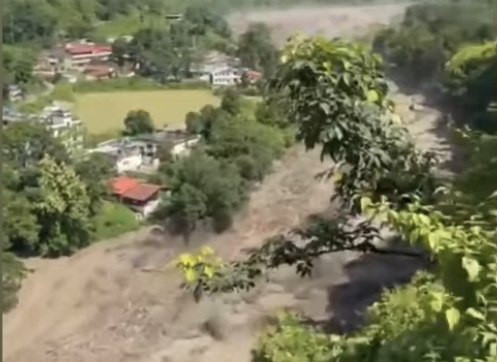
KATHMANDU, Nepal — The death toll from a catastrophic flash flood that struck the Nepal-Tibet border has risen to 162, with more than 500 tourists, including dozens of Americans, Britons, Australians and Ukrainians, still unaccounted for nearly 24 hours after the disaster began, Nepali police said Thursday.
Nepali police confirmed the updated death toll in a statement, saying 64 bodies were found in downstream areas of Chitwan district, while another 26 were recovered in Nawalparasi East. Twenty-eight police officers remain among the hundreds still unaccounted for, according to the statement. Chitwan, a tourism hotspot known for its jungle safaris, is one of several municipalities placed on high alert as floodwaters continue to rise.
On the Tibetan side of the shared border, the number of people missing in the Gyirong county mudslide disaster has climbed to 558, China's state broadcaster CCTV reported Thursday morning, including 260 foreign nationals. The death toll in Tibet remained at three as of that report. Gyirong serves as the main crossing point for tourists and traffic between China and Nepal.
Investigators have revised their understanding of what triggered the disaster. Nepali authorities initially believed an earthquake had caused the flash flooding, but the U.S. Geological Survey has since determined otherwise. "Additional analysis of long period seismic waves indicate that the seismic energy was instead generated by a landslide," the USGS said. Officials with Nepal's department of meteorology and hydrology told the BBC that a massive chunk of ice may have collapsed from a mountain, pulling down rocks and other sediment with it. While scientists say climate change is known to be accelerating glacial melt across the Himalayas, they caution it remains too early to determine whether it played a specific role in this event. Researchers are also examining whether a glacial lake suddenly drained or whether the river became blocked, alongside data on recent rainfall.
The scale of foreign nationals caught in the disaster has drawn international attention and pledges of assistance from numerous governments. According to Nepal's tourist board, the missing include more than 100 people from India, 54 from the United States, 34 from Australia and 33 from the United Kingdom, along with more than 100 from Nepal itself. Ukraine's foreign ministry separately told BBC News Ukraine that 53 Ukrainian citizens are currently missing, though it added there is no information indicating any of them are among the dead or injured.
Sanket Pandey, managing director for tour operator Himalayan Glacier US, described the situation facing one group of pilgrims caught in the disaster. "We have a group of 47 total, including our guides that are missing and out of contact since the event," Pandey said, detailing a group that included 15 Australians, 10 Canadians, nine Nepalis, eight Americans, two Singaporeans, two Britons and one dual U.S.-Russian citizen. The group were Kailash Yatris, pilgrims making a sacred journey to Mount Kailash and nearby Lake Manasarovar in a remote, high-altitude region of Tibet.
Kumar Adhikari, manager of a separate tour company with a dozen missing British clients, described the anguish of fielding calls from worried families while having little information to offer. "We were hoping that inside it was safe," Adhikari told the Press Association, "but later the video came from China's government which [showed] even Tibet's side was hit by the flood." He said he had lost contact with four of his company's Nepali guides after 8:40 a.m. the previous day. "I feel so sad. We are just thinking about what to do next," Adhikari said. "We are in pain at the moment, deep pain."
Survivors have described harrowing scenes as the floodwaters swept through their communities. Keshav Prasad Baral, 68, told Reuters the flood looked like "a huge gush of mud coming straight towards us." Speaking from a hospital bed where he was being treated, Baral said the water rose "higher and higher" before entering his home, and that he tried to grab his wife's hand but she was "swept away." He said the mud reached the top floor of his home before subsiding about an hour later. "Four or five hours later, a helicopter came to rescue me. My wife is still somewhere beneath the mud. She's gone," he said.
Nepal's Prime Minister Balendra Shah said the entire nation is "shocked and deeply distressed" by the disaster. Approximately eight tonnes of relief supplies, including mosquito nets, blankets, solar lights, solar panels and sleeping bags, have been dispatched via Nepal army trucks to affected areas in the Rasuwa region, according to the prime minister's office.
International leaders have offered condolences and assistance. United Nations Secretary-General António Guterres said he was "saddened by the severe flooding" and pledged that U.N. teams and partners are mobilizing supplies and personnel to support Nepal's government-led response. The United States pledged $500,000 in aid for emergency shelter, water, sanitation and other relief items, with the State Department saying it "extends its deepest condolences to the families and loved ones of those who lost their lives." India's Prime Minister Narendra Modi said his country is "prepared to provide Nepal with all possible types of humanitarian assistance," while the European Union, United Kingdom, Canada and Pakistan have each also pledged support or condolences. Australian Prime Minister Anthony Albanese confirmed 34 Australian citizens are among the missing.
The remote, high-altitude area affected by the flood is a major pilgrimage destination for Hindus, Buddhists and Jains, home to Lake Mansarovar near Mount Kailash in Tibet and the Gosaikunda lake in Nepal's Rasuwa district. Tens of thousands of tourists, particularly from India, travel through the region annually, with this time of year drawing especially large crowds due to a full moon considered auspicious for ritual bathing in the sacred lakes.
With search and rescue operations continuing across the heavily damaged border region and officials warning the death toll is likely to rise further as the true scale of the disaster becomes clear, governments around the world remain in close contact with Nepali and Chinese authorities as they work to determine the fate of the hundreds of tourists, guides and residents still unaccounted for nearly a full day after the flood first struck.
© Copyright 2026 IBTimes AU. All rights reserved.