(VIDEO) Man Dressed as Grim Reaper Climbs Hospital Roof in Wales and Is Fined for Nuisance
Leon Gillespie's rooftop antics at Ysbyty Glan Clwyd highlight security challenges in hospital settings
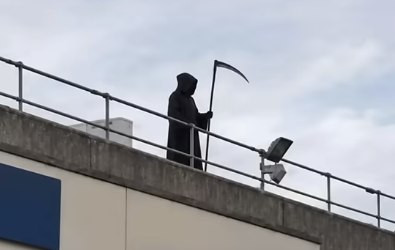
BODELWYDDAN, Wales — A 26-year-old man who climbed onto the roof of a North Wales hospital dressed in a black hooded costume resembling the Grim Reaper and stared at patients and staff has been fined after pleading guilty to causing a nuisance on National Health Service premises.
Leon Gillespie, of Deganwy, appeared at Llandudno Magistrates' Court in connection with the incident on June 6 at Ysbyty Glan Clwyd hospital in Denbighshire. Witnesses reported seeing him overlooking the entrance while wearing an all-black outfit and holding what appeared to be a long blade or scythe. He paced along rooftop walkways, made unusual noises and gestured toward people both inside and outside the building.
North Wales Police and the North Wales Fire and Rescue Service responded. The disturbance lasted roughly 50 minutes before Gillespie was brought down with the assistance of negotiators and a ladder. He was charged with causing a nuisance or disturbance without reasonable excuse on NHS grounds and refusing to leave when asked by a constable.
In court, Gillespie admitted the offence. District Judge Gwyn Jones imposed a £200 fine and ordered him to pay costs. The judge observed that Gillespie appeared to have been experiencing mental health difficulties at the time. Defence solicitor Michael Pugh described the episode as a "cry for help," noting that Gillespie had been diagnosed with bipolar disorder. Gillespie was later detained under the Mental Health Act for nearly a fortnight, beginning about 10 days after the hospital incident.
Court proceedings also addressed two separate shoplifting matters. Gillespie admitted stealing cat food and litter valued at £30 to £40 from a Pets at Home store in Llandudno in March and taking food and drink from a Sainsbury's supermarket in the same town in May. Additional fines, compensation and prosecution costs were ordered in relation to those offences.
A spokesman for Betsi Cadwaladr University Health Board, which operates the hospital, said the organisation maintains a "zero tolerance approach to abuse, aggression or nuisance within its hospital sites."
Accounts of Gillespie's appearance varied slightly. Some reports described a Grim Reaper-style costume complete with hood and scythe-like object, while others referred to a black gown and plague-doctor-style mask or an outfit resembling a crow. One account noted that he squawked like a seagull and directed remarks at hospital staff. Whatever the precise characterisation of the clothing, the sight of a figure in dark robes positioned above the hospital entrance caused distress among patients, visitors and staff.
The hospital is a busy district facility serving communities in North Wales. Incidents involving unauthorised access to roofs or other restricted areas trigger coordinated responses from police and fire services because of the potential risks to public safety and the disruption to clinical operations. In this case, multiple police vehicles and fire service resources attended while the situation was brought under control.
Gillespie's guilty plea meant the court focused on sentencing rather than a contested trial. The relatively modest fine reflects the nature of the specific offence under legislation that addresses nuisance behaviour on NHS premises. The additional penalties for the earlier retail thefts were handled alongside the hospital-related charge.
Mental health considerations featured in both the prosecution summary and the defence mitigation. The judge's comments and the subsequent period of detention under the Mental Health Act indicated that underlying difficulties formed part of the background to the rooftop episode. No detailed clinical assessment was released publicly beyond the statements made in open court.
The incident has drawn attention to the vulnerability of hospital environments and the impact that unusual or threatening behaviour can have on people who are already unwell or under stress. Hospitals routinely manage a range of security challenges, from verbal abuse to more serious threats, and many UK health boards have adopted explicit zero-tolerance policies in recent years.
Gillespie's case combined an unusual costume and elevated location with more ordinary low-level criminal matters. The shoplifting offences involved everyday consumer goods rather than high-value items, yet they added to the overall picture presented to the magistrates. The court imposed financial penalties across the board rather than custodial sentences.
Local reporting indicated that Gillespie climbed over the entrance area and remained visible for the duration of the standoff. Emergency responders prioritised a controlled resolution, using negotiation before deploying a ladder to bring him down. Once on the ground he was arrested and processed through the criminal justice system in the normal way.
The outcome leaves Gillespie with a criminal record for the nuisance offence and the thefts, along with the associated financial obligations. Whether further mental health support or restrictions followed the period of detention was not detailed in public court records. The health board's statement reinforced its institutional stance against behaviour that disrupts care or frightens those present on hospital grounds.
In the wider context of NHS security, the episode stands out for its theatrical elements rather than for violence or prolonged disruption. Most reported nuisance cases on hospital sites involve more conventional forms of aggression or refusal to leave. The combination of costume, height and prolonged staring produced a distinctive set of circumstances that required a multi-agency response and ultimately a court appearance.
Gillespie's actions on the roof of Ysbyty Glan Clwyd resulted in a formal finding of guilt, a fine and associated costs. The case closed with the magistrates' decision, the health board's reaffirmation of its zero-tolerance policy, and a reminder of the distress such incidents can cause to patients and staff who expect a hospital to remain a place of care rather than spectacle.
© Copyright 2026 IBTimes AU. All rights reserved.
- Recommended For You