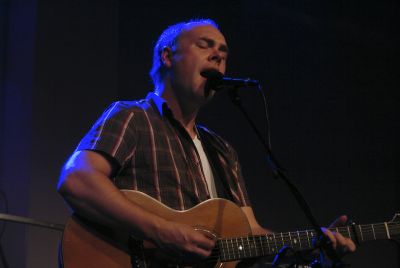
Duncan Sheik, 'Barely Breathing' Singer and Tony-Winning 'Spring Awakening' Broadway Composer, Dies at 56
The Grammy-nominated musician died in a Manhattan hospital from organ failure, his mother confirmed, after his family said he had been critically ill.

NEW YORK — Duncan Sheik, the singer-songwriter whose 1996 hit "Barely Breathing" made him a fixture of pop radio before he reinvented himself as a Tony- and Grammy Award-winning Broadway composer, has died at age 56.
Sheik died Thursday at a hospital in Manhattan, his mother, Suzanne Sheik, confirmed to The New York Times, saying the cause was organ failure. She did not provide further details about his underlying medical condition or the circumstances that led to it. His family had disclosed two days earlier, in a statement posted to his official Instagram account Wednesday, that Sheik was hospitalized and in "critical but stable condition," adding, "Duncan is currently receiving medical care and remains in critical but stable condition. Out of respect for Duncan and our family, we will not be sharing any further medical details at this time. We kindly ask for privacy during this incredibly difficult time and will provide updates when appropriate. Thank you for the continued love and support."
His death was announced publicly Friday through a statement posted to his Instagram account. "It is with profound sadness that we confirm the passing of Duncan Sheik," the post read. "The world has a lost a singular talent, and deeply influential voice in music and theater. From his Grammy-nominated hit 'Barely Breathing' to his groundbreaking, Tony and Grammy Award-winning work on Spring Awakening, Duncan's artistry touched many and leaves an indelible mark on the cultural landscape." The statement continued, "Duncan was a father, husband, son, brother, and friend. He will be remembered for his sensitivity, wit, inteligence, and depth of spirit he brought to those who knew and loved him. We are deeply grateful for the outpouring of love from his fans, friends, collaborators, and the artistic community. His musical legacy will continue to inspire generations to come." A separate message from his family described his final moments, saying, "Duncan passed away last night surrounded by love."
Sheik, a New Jersey native, first drew wide attention as a musician in the mid-1990s. He attended Brown University, where he was a college bandmate of singer Lisa Loeb, and released his self-titled debut album in 1996. The record's breakout single, "Barely Breathing," earned Sheik a Grammy nomination for Best Male Pop Vocal Performance, reached No. 16 on the Billboard Hot 100, and spent 55 weeks on the chart, an unusually long run for a single that never climbed higher than the middle of the top 20. Though "Barely Breathing" remained the song most closely associated with him for the rest of his career, and remains the top track on his Spotify page, Sheik went on to release nine studio albums in total, with his most recent arriving in 2022. Reflecting on the song's outsized legacy in a 2020 interview with HuffPost, Sheik said he had once resented performing it because "it lived on the radio far longer than it should have."
Sheik's career took a significant turn in 2001 with the release of "Phantom Moon," an album conceived as a tribute of sorts to Nick Drake's "Pink Moon." That record marked the beginning of his creative partnership with poet and songwriter Steven Sater, whom Sheik met while both were practicing Nichiren Buddhism. The two had first collaborated in 1999 on Sater's play "Umbrage," with Sheik composing music to Sater's lyrics. Their partnership eventually produced the work for which Sheik would become best known within musical theater: "Spring Awakening," a rock musical based on an 1891 German coming-of-age play, which the two developed together over several years.
"Spring Awakening" opened off-Broadway before transferring to Broadway in 2006, where it ran for more than 860 performances over two years. The show, which helped launch the careers of Lea Michele, Jonathan Groff and John Gallagher Jr., won Best Musical at the 2007 Tony Awards, with Sheik personally winning Tony Awards for Best Original Score and Best Orchestrations, shared with Sater, and the production also earned a Grammy Award for Best Musical Show Album. Speaking to The Associated Press in 2007 as the show swept that year's Tony nominations, Sheik described the creative ambition behind the project. "With the exception of our director, we are all kind of Broadway outsiders," he said. "We wanted to shake things up a bit. And we just set out to make this really cool piece of theater."
Sheik continued working in musical theater in the years that followed, composing scores for stage adaptations of "American Psycho" and "Alice in Wonderland." At the time of his death, he had a new musical, "Memoirs of Amorous Gentlemen," an adaptation of Moyoco Anno's manga graphic novel, scheduled to begin performances off-Broadway later this month, with a first preview set for September 25 and an official opening planned for October 15. An off-Broadway revival of "Spring Awakening" had also been in the works separately from Sheik's newer project.
In the weeks before his death, Sheik had shared periodic updates from his hospital room on social media, including a post on September 6 in which he wrote that he was "still bored in hospital," suggesting he had been receiving inpatient care for at least several weeks before his condition became critical.
Sheik is survived by his wife and children, according to the tribute posted by his family, which described him as "a father, husband, son, brother, and friend." Tributes continued to circulate across the music and theater industries following the announcement of his death, with collaborators and fans reflecting on both his enduring pop hit from the 1990s and the influential body of theatrical work he built in the decades that followed, a career that spanned two distinct creative eras and left a lasting mark on both popular music and the American musical theater stage.
© Copyright 2026 IBTimes AU. All rights reserved.
- Recommended For You