Tony Burke Unveils Labor's Long-Delayed Migration Overhaul Targeting Temporary Visas and Overstayers
The package includes tighter family visa rules, a ballot for some backpacker visas and stronger action against visa overstayers.

CANBERRA, Australia — Home Affairs Minister Tony Burke on Thursday unveiled the federal government's long-delayed overhaul of Australia's migration system, announcing a series of regulatory changes aimed at cutting net overseas migration to 225,000 people by 2028 after negotiations with the opposition Coalition over stronger legislation collapsed.
Speaking at the National Press Club in Canberra in an address titled "The Work of Managing the Migration Program: Who Arrives, Who Stays, Who Leaves," Burke said every measure in the package had been developed and formalized by February this year, rejecting suggestions the announcement was shaped by recent political pressure.
"It's simply demonstrably wrong to suspect that somehow this is a recent bit of work done to deal with a political climate. It's not," Burke said. "It's when we sat down and looked at the pace we could get for new housing, and we looked at where immigration was at, we knew we needed to have ways to bring those numbers down."
The speech had originally been scheduled for early August but was postponed at the last minute amid disagreement within Cabinet over the scope of the changes. Burke acknowledged Thursday that the measures being announced do not go as far as he would like, saying additional powers would require legislation the government has so far been unable to secure.
The announcement came hours after the Australian Bureau of Statistics released figures showing net overseas migration fell to 292,100 people in the year to March 2026, down from 309,500 in the previous 12-month period. Despite the decline, Australia's population grew by 392,700 people over the same period to reach a total of 27.9 million, with Western Australia recording the fastest population growth at 2.1%, followed by Victoria at 1.6%.
Burke used the figures to push back on claims from some politicians that Australia is experiencing "mass migration."
"There are parts of the world where mass migration is something that they are dealing with," Burke said. "It's not something we're dealing with in Australia."
He said Australia's migration intake is now 47% below the peak reached in the years following the COVID-19 pandemic, and he dismissed claims that the country was prioritizing low-value temporary visa holders over skilled workers.
"In the life of this government, the number of yoga teachers we have brought in is zero. Zero. And yet this claim is constantly made about yoga teachers," Burke said.
Under the package, the government will restrict most visas for family members of international students seeking to join them in Australia, and will overhaul the Working Holiday Maker Program by introducing a ballot system for second- and third-year backpacker visas. Previously, only first-year working holiday visas were subject to a ballot process.
Burke also confirmed the government will update Ministerial Direction 119, a directive first issued in July governing visa processing priorities, to expand its coverage to additional sectors including construction, healthcare and agriculture. The government will introduce stronger compliance mechanisms aimed at ensuring an estimated 77,000 visa overstayers currently in Australia leave the country, and will expand the "No Further Stay" condition to apply to all visitor visas.
In his address, Burke identified what he described as three genuine problems facing the migration system. The first, he said, was a legacy of policy thinking dating to the Hawke and Howard governments that assumed a demand-driven migration program — where employers could bring in workers they needed and universities could enroll fee-paying international students — would naturally be matched by adequate housing and infrastructure.
"That is no longer the experience of Australians," Burke said.
The second issue Burke raised was what he termed "visa hopping," though he stressed that not all movement between visa categories represents a problem. He cited the example of a person moving from a student visa to a graduate visa, then into a skills-shortage occupation and eventually citizenship, describing that pathway as the system working as intended. But he said the practice needed to be addressed where it was being used to circumvent migration settings.
"We need to deal with it, it's a genuine problem," Burke said.
The third issue, Burke said, was housing. He said the current housing shortage was not caused by immigration, but that migration needed to be part of the solution, noting fewer people are now living per dwelling than in the past. He said migration levels needed to soften to give housing supply room to catch up.
"Drastic cuts, wherever you make them, hurt the economy in every part, in every area," Burke said, adding that claims the economic cost of migration cuts was confined to regional areas showed a misunderstanding of the Australian economy.
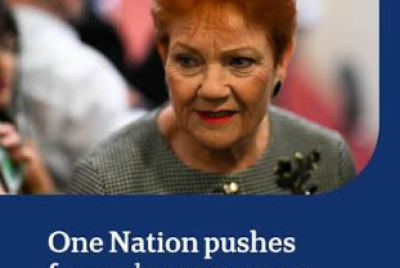
The government's approach contrasts with rival plans from the opposition and the minor party One Nation. One Nation this week proposed cutting the temporary migrant population by more than 750,000 over three years, a plan that would push net overseas migration into negative territory before settling at an annual ceiling of 130,000, reviewed yearly. Both Labor and the Coalition have criticized the proposal, saying it would severely disrupt the construction, health and aged care sectors.
Opposition Leader Angus Taylor, speaking to reporters before Burke's address, said the Coalition would release its own migration policy in the near future and dismissed the government's plan in advance.
"Right now, the numbers are too high and the standards are too low, and both must change and they are not changing as they should under this government," Taylor said. "All we're going to get from this government today on migration is more of the same. They've overreached on every single one of their targets. Their targets are too high and Australians are being let down."
Talks between the government and the Coalition over migration settings broke down in the past week, with the opposition pushing for deeper cuts to net overseas migration and stronger deportation powers. Burke said Thursday he hoped the Coalition would return to negotiations to help legislate further measures, which he said would allow the government to pursue changes beyond what can be achieved through regulation alone.
© Copyright 2026 IBTimes AU. All rights reserved.
- Recommended For You