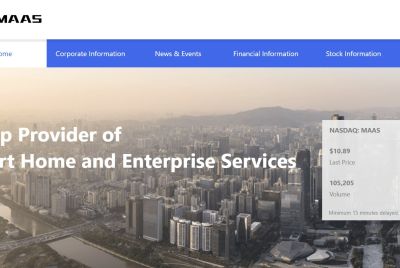
Maase Inc Stock Surges 32% to $9.84 on AI Acquisition Momentum and Market Enthusiasm
Shares of Maase Inc. skyrocketed more than 31% Friday, climbing to $9.84 in midday trading on the Nasdaq as investors piled into the small-cap stock following its recent strategic shift toward becoming a full-stack artificial intelligence player through the completed acquisition of China's Huazhi Group.

The stock jumped $2.37, or 31.62%, by 1:45 p.m. EDT, marking one of the sharpest single-day gains in recent sessions for the volatile name. Trading volume surged well above average as retail traders and momentum investors reacted to ongoing enthusiasm around the company's pivot from traditional financial technology and wealth management services into high-growth AI infrastructure and applications.
Maase Inc., formerly known as Puyi Inc. or Highest Performances Holdings Inc., has aggressively transformed its business model through a series of acquisitions in 2025 and 2026. The most significant catalyst remains the March 30 completion of its purchase of 100% equity in Times Good Limited, which controls Huazhi Future (Chongqing) Technology Co., Ltd. and its subsidiaries, collectively known as the Huazhi Group.
The deal, initially announced in January and valued at approximately RMB1.1 billion (about $152 million), was paid through a combination of newly issued Class A ordinary shares and cash. Management described the transaction as a pivotal move that elevates Maase from a "scenario operator" focused on financial services to an "AI industry player" with full-stack, self-controlled capabilities in computing power, algorithms and intelligent applications.
Huazhi Group brings expertise in high-performance computing infrastructure, proprietary AI algorithms and solutions for smart governance, enterprise digital transformation and energy optimization. Company executives have signaled plans to integrate these assets tightly with Maase's existing operations, targeting applications in urban intelligence, commercial networks and industrial efficiency within China's rapidly expanding AI ecosystem.
The acquisition closed on March 30, resulting in the issuance of 87,400,144 Class A ordinary shares to the sellers. As of that date, Maase had approximately 442 million ordinary shares outstanding, with the new shareholders holding about 19.77% of the equity but only 7.93% of the voting power due to the company's dual-class structure.
Friday's explosive move builds on earlier gains triggered by the deal's announcement and completion. Shares had already shown strength in March and early April as investors bet on the AI narrative amid global enthusiasm for artificial intelligence infrastructure. The stock has traded in a wide 52-week range between roughly $2.41 and $14.00, reflecting both the high-risk nature of its transformation and the potential rewards of successful execution.
Before the AI pivot, Maase operated primarily as a financial technology services provider in China, offering wealth management, insurance agency and claims adjusting services. The company, founded in 2010 and headquartered in Chengdu with additional operations in Qingdao, has used a series of strategic deals to diversify. Earlier transactions included entries into new-energy technologies, healthcare and wellness, and even a premium tea producer, though the Huazhi move represents the clearest bet on high-growth tech.
Analysts and market observers remain divided on the stock's long-term prospects. The company's financials show modest revenue from its legacy segments, with recent reports indicating challenges in scaling traditional operations amid China's evolving regulatory and economic environment. However, bullish voices highlight the potential for Huazhi's assets to drive future top-line growth and improved margins if integration proceeds smoothly.
Short interest in Maase dropped significantly in March, falling 18.3% to just 3,579 shares as of March 31 — representing only 0.2% of the float and a short-interest ratio of about 0.5 days to cover. The decline suggests some bearish positions were covered as positive acquisition news circulated.
Maase's market capitalization has fluctuated with its share price volatility but recently hovered in the low billions following the latest rally. The company maintains a relatively small public float, which can amplify price swings on news or increased trading interest.
Beyond the Huazhi deal, Maase has pursued other growth initiatives. In late March, a subsidiary completed delivery of mobile charging robots valued at RMB3.2 million, expanding its footprint in intelligent hardware for the southwest China market. Earlier moves included acquisitions in new-energy technologies and healthcare, illustrating management's serial approach to reshaping the business.
Risks remain substantial. As a China-based entity listed on Nasdaq via American Depositary Receipts or sponsored shares, Maase faces geopolitical tensions, regulatory scrutiny over cross-border deals and potential U.S. investor concerns regarding variable interest entity structures or accounting transparency common among Chinese firms. Integration challenges with newly acquired businesses could also pressure near-term results.
The stock's recent performance has drawn attention from retail traders active on platforms tracking small-cap momentum names. Friday's surge occurred amid broader market interest in AI-related plays, even as many larger technology stocks traded more modestly.
Maase did not immediately release new commentary on Friday's trading action. Its most recent official updates focused on the successful closure of the Huazhi transaction and integration plans. Executives have expressed confidence that the combination will create a vertically integrated AI ecosystem spanning computing infrastructure, algorithms, hardware and operational services.
For investors, the story centers on execution. Can Maase successfully leverage Huazhi's capabilities to generate meaningful revenue and profitability in the competitive Chinese AI sector? Or will the transformation dilute focus on legacy financial services while adding operational complexity?
The company's history includes multiple name changes and strategic shifts, underscoring its adaptability but also raising questions about long-term consistency. Earlier segments in insurance agency and wealth management provided steady but modest revenue, while the new AI direction promises higher growth potential at the cost of greater uncertainty.
As trading continued Friday, technical analysts noted the stock breaking above recent resistance levels on heavy volume, potentially signaling further short-term momentum if buyer interest persists into next week. Longer-term charts show the shares remain well off their 52-week highs, leaving room for recovery — or additional volatility.
Broader market context also plays a role. With artificial intelligence dominating investor conversations globally, even smaller companies announcing AI-related moves can experience outsized reactions. Maase's pivot aligns with this theme, though its scale and execution track record differ markedly from established AI leaders.
Looking ahead, investors will watch for updates on post-acquisition integration, any new partnerships or pilot projects involving Huazhi technology, and eventual financial reporting that reflects the combined entity. Quarterly results could provide the first concrete metrics on how the AI assets are contributing to overall performance.
For now, Friday's 31% surge underscores the high-beta nature of Maase shares and the market's willingness to reward perceived strategic repositioning in the red-hot AI space. Whether the momentum sustains or fades will depend on the company's ability to deliver tangible progress beyond press releases.
Maase Inc. operates in a dynamic environment where technological ambition meets the realities of execution in China's regulated markets. Its latest rally reflects hope that the Huazhi acquisition marks the beginning of a successful new chapter — one that could transform a modest financial services player into a meaningful participant in the global AI revolution.
© Copyright 2026 IBTimes AU. All rights reserved.
- Recommended For You