

At Least 18 College Basketball Players Will Earn More Than LeBron James Next NBA Season With NIL Deals
LeBron James' salary drop highlights the rise of college basketball's NIL deals.
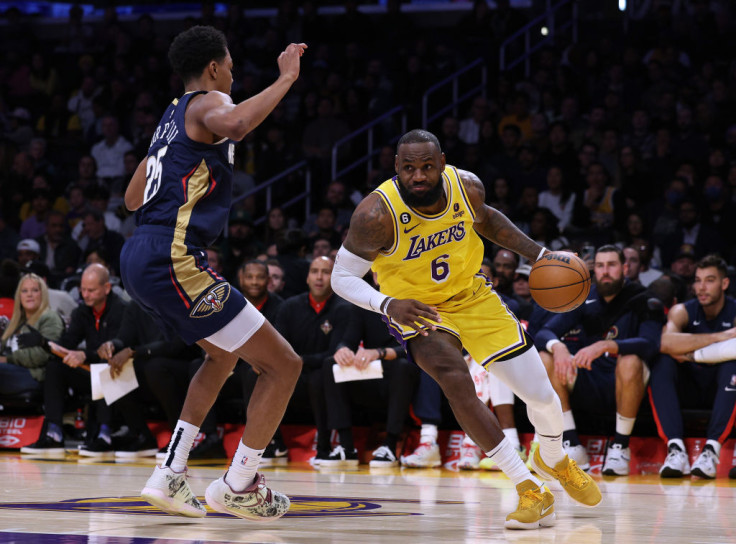
LeBron James just took the largest single-season pay cut in NBA history. Now comes an even stranger way to put it in perspective: at least 18 college basketball players are expected to earn more money next season than the four-time NBA champion.
A historic pay cut
James, who made $52.63 million during his final season with the Los Angeles Lakers, agreed to a two-year deal worth roughly $8 million with the Philadelphia 76ers, including a player option for the second year. His base salary for the 2026-27 season will come in at approximately $3.9 million, the NBA's veteran minimum. According to HoopsHype, the drop from $52.63 million to roughly $3.9 million represents a pay cut of nearly $48.75 million, the largest single-season salary decrease in NBA history.
The scale of the sacrifice becomes even more striking when compared to where James now stands leaguewide. According to reporting from USA Today cited by Forbes, nearly 300 NBA players are set to earn more than James next season, including relatively unheralded rotation pieces like New York Knicks reserve guard Deuce McBride, who is set to make $3,956,523, and San Antonio Spurs rookie Jayden Quaintance, at $3,902,760, both modestly outearning the future Hall of Famer.
College basketball's new financial reality
What makes James' situation even more unusual is the growing number of college basketball players now out-earning him entirely outside the professional ranks. According to reporting from The Athletic's Brendan Marks and Joe Rexrode, at least 18 college players are expected to receive Name, Image and Likeness compensation exceeding James' 76ers salary during the 2026-27 season, a threshold that has become increasingly common as NIL deals continue climbing across major college programs.
Several of the specific figures involved have been reported publicly. Kentucky forward Milan Momcilovic, who pulled out of the NBA Draft betting he could land a larger NIL package instead, is reportedly set to earn $6 million this season, more than $2 million above James' new salary. St. John's guard Tounde Yessoufou, who transferred from Baylor after averaging 17.8 points per game as a freshman, reportedly signed a similar $6 million deal rather than risk being a second-round draft pick. Louisville added former Kansas center Flory Bidunga with a reported package in a similar range, while other programs, including Indiana, Texas, Duke, Tennessee, Gonzaga, Michigan, Texas A&M and Marquette, have also been tied to seven-figure NIL commitments for key returning or transferring players this offseason.
A dramatic escalation from just one year ago
The scale of this year's NIL spending marks a significant jump from the previous season, when only a handful of college players approached the $4 million range, despite an unusually strong incoming freshman class led by AJ Dybantsa and Cameron Boozer. Analysts have pointed to an unusual market dynamic driving this year's surge: several players who could have been selected in the NBA Draft instead chose to return to or transfer within college basketball, prompting programs to effectively bid against NBA rookie-scale contracts in order to keep or acquire top talent.
A reminder of James' career earnings
Despite the size of his pay cut, James remains, by a wide margin, the highest-paid player in NBA history by total career earnings. His new Philadelphia contract will push his career NBA salary total to roughly $585 million, extending his lead over Kevin Durant, who has earned approximately $545 million, and Stephen Curry, at around $532 million, according to career salary tracking. Curry, notably, is set to be the NBA's highest-paid active player next season at $62,587,158, playing for the Golden State Warriors, one of the teams James considered before ultimately signing with Philadelphia.
Reaction from around the basketball world
The scale of James' pay cut, paired with the rise of college NIL earnings, has drawn commentary from analysts across the sport. ESPN's Jay Bilas, addressing the significance of James' decision, framed it as a deliberate choice rather than a financial necessity. "One, LeBron chose to accept far less than his value," Bilas said, noting that James had a player option worth roughly $50 million available to him with the Lakers before ultimately walking away from that money to sign with Philadelphia instead.
Winning, not money, driving the decision
James has been clear throughout the process that his decision was not financially motivated. At 41 years old and entering his 24th NBA season, James has said repeatedly that he views the 76ers, who feature a roster built around Joel Embiid, Tyrese Maxey, Jaylen Brown and rookie guard VJ Edgecombe, as offering his best remaining shot at a fifth NBA championship. Despite his advancing age, James remained one of the league's most productive players during his final season with the Lakers, averaging 20.9 points and 7.2 assists per game in the regular season before elevating his scoring average to 23.2 points per game once the playoffs began, a performance that underscored just how far James was willing to look past pure compensation in choosing his next team.
A striking symbol of college sports' new economy
For college basketball, the comparison offers a striking symbol of just how dramatically the sport's financial landscape has shifted since NIL compensation became legal in 2021. Players once barred from earning any compensation beyond scholarships are now commanding multimillion-dollar packages that, in at least 18 known cases this season, exceed what one of the greatest professional basketball players in history will earn in the NBA. Because most college NIL deals remain privately negotiated and are not publicly disclosed in full, the actual number of college players out-earning James next season is likely higher than the 18 currently confirmed through reporting.
As James begins his final NBA chapter in Philadelphia this fall, the contrast between his modest veteran-minimum salary and the seven-figure NIL packages now common among top college recruits is likely to remain a talking point throughout the season, a vivid illustration of how thoroughly both professional and amateur basketball economics have been reshaped in recent years.
© Copyright 2026 IBTimes AU. All rights reserved.