

(VIDEO) Amazon Cargo Jet Left a Miami Runway at 129 mph in a Crash That Killed Five; NTSB Opens Inquiry
Amazon Prime Air cargo jet overruns runway at Miami International Airport, resulting in five fatalities and five injuries. Investigation by NTSB is ongoing.
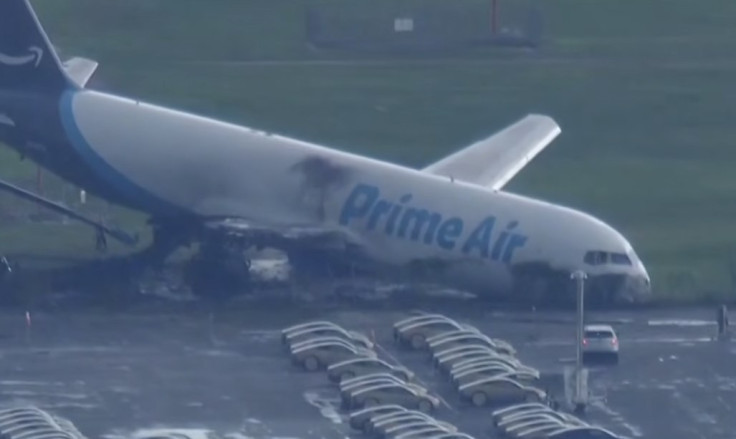
MIAMI — An Amazon Prime Air cargo jet was still moving at about 129 mph when it ran off a Miami International Airport runway, crossed a perimeter road and struck vehicles, killing five people and injuring five others on a busy Labor Day weekend afternoon.
The Boeing 767-300 freighter, Prime Air Flight 7598, arrived from San Juan, Puerto Rico, and overran Runway 30 around 2 p.m. Sunday. Tracking data compiled by Flightradar24 put the jet at 112 knots — roughly 129 mph — as it left the usable pavement. Miami-Dade Fire Rescue Chief Ray Jadallah said five people died, three were taken to a trauma center in critical condition and two others were hospitalized with less severe injuries. Officials had not said by Sunday night whether the dead were in the cockpit, in cars on the road, or both.
The National Transportation Safety Board sent a go-team led by Chair Jennifer Homendy and scheduled the agency's first public briefing for Monday. Investigators are expected to start with a simple question captured on video and flight tracks: where the airplane touched down, and why the crew did not abandon the landing if the jet floated past the normal zone.
Aviation safety specialist Steve Arroyo said the typical touchdown area is within the first 3,000 feet of a runway. If the cargo jet was beyond that, he said, the pilots should have gone around. Mary Schiavo, a pilot and former inspector general of the Transportation Department, said online video showed the Amazon plane remaining airborne well down the strip without the usual flare that puts the main gear on the pavement. It was not raining, she said, but dark storm clouds were nearby and strong winds had been reported. "A tail wind would certainly add to your troubles if you've already given up a good chunk of the runway by not touching down and landing right away," Schiavo said.
CNN's review of air-traffic control audio found the crew did not declare an emergency before landing. Flightradar24 data showed the jet rose above the normal approach path to Runway 30, then dropped back toward the glide path. The runway is more than 9,000 feet long. That length did not keep the airplane on airport property.
The 767 crossed a safety area and a fence, then hit vehicles on a road used by warehouse workers and businesses that ring the field. It came to rest on its belly near two semitrucks and a parking lot that serves an Amazon warehouse. Thick black smoke rose as fire burned. Jadallah said crews trapped in the cockpit had to be reached through a window by ladder and that occupants were cut from cars. Firefighters also freed a person pinned under a vehicle. Miami-Dade Fire Rescue sent more than 60 units and about 200 people. Jadallah said crews arrived within about 30 seconds of the first call and were still dealing with a fuel leak later in the afternoon.
Miami-Dade Mayor Daniella Levine Cava said at least five people had lost their lives and five others were injured, and that rescue crews reached the scene within seconds. Sheriff Rosie Cordero-Stutz put the time near 1:58 p.m. A student pilot, Rohan Ellis, who saw the wreckage, told a reporter the vehicles "were mangled." Names of the dead had not been released.
The airplane, registered N1997A, is 32 years old. It was built as a passenger 767 around 1994, flew for airlines for more than two decades and was converted to a freighter in 2015, according to Cirium and Flightradar24 records. 21 Air, a Greensboro, North Carolina, cargo carrier that also flies for DHL, operated the trip under contract. Amazon does not hold the air-operator certificate for those flights. 21 Air said it was devastated by the accident involving one of its aircraft. CEO Keith Winters said the company was cooperating with federal investigators. Boeing said it was supporting the inquiry.
Amazon spokesperson Kelly Nantel said the company was "heartbroken to learn that five people lost their lives" and extended sympathies to families and others affected. In another statement she said Amazon was "still gathering details" and would "cooperate fully with any investigation." Schiavo said investigators will review the jet's maintenance history, including periods of foreign ownership.
Miami International is among the busiest U.S. airports for freight. It does not have an engineered materials arresting system — the crushable bed the FAA says has been installed at more than 120 airports and credited with helping save at least 497 lives in overruns. Mike O'Donnell, the FAA's former director of airport safety and accident investigations, said Miami appears to meet federal rules because it has a 1,000-foot safety area beyond the runway. That standard followed the 1999 American Airlines Flight 1420 overrun in Little Rock, Arkansas, which killed nine.
The crash shut the airport's runways and taxiways on a holiday Sunday. FlightAware logged more than 160 cancellations and nearly 325 delays by late day. Some flights diverted to Orlando, more than 200 miles north. Two of four runways later reopened and flights resumed Sunday evening, but the disabled 767 remained at the northwest end of the field.
The accident follows last year's UPS crash in Louisville, Kentucky, in which a jet lost an engine on takeoff and killed three people in the cockpit and 12 on the ground. Sunday's sequence was different: a landing, not a departure; a long runway; no declared emergency on the frequency CNN reviewed; and enough leftover speed to leave the airport and hit traffic.
What investigators will pull first is mechanical and human at once. Flight data and cockpit voice recorders should show airspeed, thrust, spoiler and reverse-thrust use, brake pressure and what the pilots said in the last minutes. Weather records will show whether a tail wind was on Runway 30. Maintenance logs will show the converted 767's recent work. Videos and ADS-B tracks already sketch a long float and a high-speed exit. They do not explain it.
Until Homendy speaks, the confirmed picture is narrow and grim. A contracted Amazon 767 from San Juan did not stop on Runway 30. It left the pavement at highway-plus speed, hit vehicles on a working road and burned. Five people are dead. Five are in hospitals. The airport is moving airplanes again. The reason the jet used up the runway is the question the NTSB came to Miami to answer.
© Copyright 2026 IBTimes AU. All rights reserved.