

(VIDEO) Four Injured in Air Canada Plane Collision with Port Authority Vehicle at LaGuardia Airport
New York — An Air Canada Express regional jet collided with a Port Authority of New York and New Jersey firefighting vehicle on a runway at LaGuardia Airport late Sunday night, injuring at least four people and forcing the temporary closure of the busy New York City airport, authorities said early Monday.
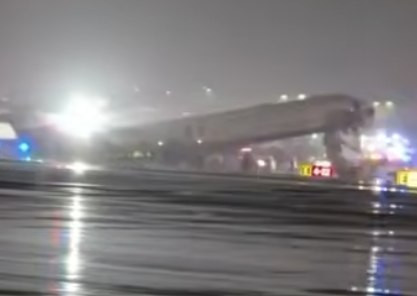
The incident occurred around 11:38 p.m. ET on March 22 when Jazz Aviation Flight 8646, operating on behalf of Air Canada and arriving from Montreal-Trudeau International Airport, struck the emergency vehicle on Runway 4 while slowing after landing. The Bombardier CRJ-900 aircraft sustained severe damage to its nose and front section, as shown in photos and videos circulated on social media and by news outlets.
Port Authority officials confirmed the collision involved a Jazz Aviation flight and a Port Authority Aircraft Rescue and Firefighting vehicle responding to a separate incident on the airfield. "At approximately 11:40 p.m. on Sunday, a Jazz Aviation flight operating on behalf of Air Canada was involved in an incident on Runway 4 at LaGuardia Airport in which the aircraft struck a Port Authority Aircraft Rescue and Firefighting vehicle," the Port Authority said in a statement.
The New York Police Department and New York City Fire Department responded quickly. Firefighters arrived within minutes of the initial report. Multiple sources, including the New York Post and NBC News, reported that four individuals were critically or seriously injured. The injured included personnel from the Port Authority, with reports specifying two officers or firefighters sustaining broken limbs but remaining in stable condition at a local hospital. Some accounts indicated the plane's pilot and co-pilot were badly injured, though official confirmations on exact identities and conditions remained pending as investigations continued into early Monday.
Air Canada and Jazz Aviation stated the flight carried 72 passengers and four crew members. No passengers were reported seriously hurt in initial assessments, though all were being evaluated following the incident. The aircraft was taxiing at a low speed—approximately 24 mph according to flight-tracking data—when the collision happened, likely as some passengers were beginning to deplane from the rear.
LaGuardia Airport, one of the nation's busiest domestic hubs, was shut down immediately after the crash, with the Federal Aviation Administration issuing a ground stop. Arrivals and departures halted, stranding thousands of travelers amid already disrupted operations from a partial federal government shutdown affecting Transportation Security Administration staffing. The closure lasted into the early morning hours of March 23, with officials working to clear the runway and assess damage before resuming limited service.
Videos posted by witnesses depicted the CRJ-900 jet stationary on the runway with its nose crumpled and emergency vehicles surrounding it. Fire trucks lined up nearby as responders attended to the scene. The Port Authority emphasized that the firefighting vehicle was responding to an unrelated matter when the accident occurred, raising immediate questions about ground movement coordination and air traffic control clearances.
The National Transportation Safety Board was notified and expected to lead the investigation, with preliminary focus on runway incursion protocols, visibility conditions, and communication between air traffic control, the aircraft crew, and ground vehicles. Aviation experts noted that ground collisions at major airports, while rare, often stem from miscommunications or procedural lapses during low-visibility or high-traffic periods.
Air Canada issued a brief statement expressing concern for those involved and cooperation with authorities. "We are deeply concerned about this incident and are working closely with the relevant authorities to understand what happened," the airline said. Jazz Aviation, the regional operator, echoed similar sentiments and confirmed the flight's details.
LaGuardia, known for its challenging operations due to tight airspace and short runways, has seen previous ground incidents, though none recently matching this severity. The airport's proximity to residential areas and reliance on precise sequencing amplify risks during ground movements.
As of early Monday, March 23, 2026, the airport remained closed or operating under severe restrictions. Travelers faced widespread delays and cancellations across the Northeast corridor. The incident added to ongoing aviation challenges, including staffing shortages and weather-related disruptions earlier in the season.
Investigators are reviewing air traffic control recordings, black box data from the aircraft, and witness statements. The FAA and Port Authority promised swift updates as more information becomes available. No fatalities have been confirmed, but the extent of injuries underscored the potential dangers of airfield operations even at low speeds.
Passengers on the flight described a sudden jolt as the plane was slowing, with some reporting confusion but no panic in the cabin. Emergency slides were not deployed, and evacuation proceeded orderly once the aircraft stopped.
The collision highlights ongoing concerns about runway incursions nationwide. The FAA has implemented enhanced monitoring and training programs in recent years to reduce such risks, but incidents persist amid growing air traffic volumes.
Authorities urged passengers with travel plans to LaGuardia to check airline updates before heading to the airport. Recovery efforts continued through the night, with cleanup and structural assessments underway to reopen runways safely.
© Copyright 2026 IBTimes AU. All rights reserved.