

(VIDEO) Amazon Delivery Drone Drops Texas Woman's Package Into Pool as Prime Air Plans 500-City Expansion
Viral video captures Amazon drone dropping package into Texas pool as company announces major expansion of Prime Air service.
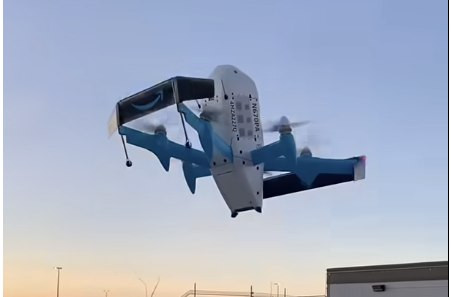
A Texas woman's first experience with Amazon's drone delivery service ended with her package landing squarely in her backyard swimming pool, according to viral video footage that surfaced the same week Amazon announced a major nationwide expansion of its Prime Air drone delivery program.
The video, filmed by Texas resident Lindsey Austen on Monday, Aug. 17, shows the moment she ran outside after hearing the loud buzzing of an approaching delivery drone, eager to witness her first drone-delivered order in person. According to footage shared by ABC 7 News, the clip captures the drone hovering directly above Austen's pool before opening its cargo bay and releasing her package straight into the water. Austen can be heard repeating "Oh my God" in anticipation as the drone hovered overhead, before reacting with an expletive as the package dropped into the pool. "When it went into the pool, I was shocked," Austen said.
An Amazon customer in Texas was not enthused when her first drone-delivered order was dropped into her swimming pool. After hearing the loud buzzing of the drone arriving, she ran outside to record the delivery, and to her surprise, it landed in her pool. pic.twitter.com/6TIcrJIVAR
— ABC7 News (@abc7newsbayarea) August 19, 2026
ABC 7 News, in its social media post sharing the footage, noted an important detail about how Amazon's drone delivery service operates: customers select the precise drop-off location themselves through the Amazon app before the delivery takes place. The outlet's post speculated, somewhat tongue-in-cheek, that Austen "must have selected the pool area. Potentially deliberately to get this video."
The viral clip surfaced during the same week Amazon announced plans to significantly expand its Prime Air drone delivery service, according to Tom's Hardware. The company said Wednesday it intends to expand the service to nearly 500 cities and towns across the United States by the end of 2026, representing a sixfold increase in coverage that Amazon says will benefit tens of millions of additional customers. According to the company, Prime Air's delivery selection includes millions of items spanning groceries, electronics, cosmetics, medications and household products, with some orders deliverable in as little as 30 minutes. Amazon currently operates Prime Air service across seven states, including Texas, where Austen's pool delivery took place.
Amazon has emphasized safety as a core priority for the drone program. According to the company, Prime Air "is built to operate responsibly, and the safety of the employees, customers, and communities Amazon serves is the top priority," and the service holds Federal Aviation Administration certification governing its operations.
Thursday's viral pool delivery is not the first time an Amazon drone has ended up dropping a package into a customer's backyard water feature. In a separate, similar incident from summer 2025 in Avondale, Arizona, an Amazon MK30 delivery drone dropped a package into a customer's backyard pool after the aircraft's propeller wash pushed the box off course during its final descent, according to footage captured by the property owner, Daniel Muniz. Speaking to Arizona's Family news station at the time, Muniz explained that he had simply accepted Amazon's default suggested drop-off location rather than selecting a different spot himself. "It had the drone option, so we did it just to see how it was," Muniz said regarding his decision to try the drone delivery option in the first place.
Following that earlier Arizona incident, Amazon issued a formal response through spokesperson Steve Kelly, who offered an apology while characterizing the mishap as an isolated occurrence. "Through Prime Air, our goal is to provide safe, fast delivery and great service to customers and the results we've seen in Tolleson have been overwhelmingly positive. Incidents like this are rare across our network and we apologize for the inconvenience this caused Mr. Muniz. Our team stands ready to answer any questions Mr. Muniz may have," Kelly said. Muniz told the outlet that, going forward, he would only use the drone delivery service when he was home to personally receive the package.
Amazon's Prime Air program has encountered a handful of other publicized mishaps over the past year and a half beyond the pool incidents. In May 2025, an MK30 drone made what Amazon described as a "precautionary controlled landing" at a Tolleson, Arizona, apartment complex, coming to rest on its side and startling nearby residents, though the company said the incident caused no injuries and attributed the landing to unspecified "external factors." Separately, in January 2025, Amazon temporarily paused all drone deliveries in Arizona following a crash at the company's Oregon test site, though the company maintained at the time that the pause was related to routine software adjustments rather than a broader safety concern.
Amazon's MK30 delivery drones are capable of carrying packages weighing up to five pounds within a roughly seven-mile radius of a company fulfillment or delivery site, with a maximum flight time of approximately 11 minutes per trip. The drones are also subject to weather-related operating restrictions, including limitations during storms and periods of high wind, which can affect service reliability in certain conditions.
Amazon has continued to stand behind Prime Air's overall safety record despite the string of publicized incidents. In a statement provided following a separate, similar pool-related mishap, the company emphasized both the rarity of such incidents and its broader customer protection policies. "Prime Air's goal is to provide customers with fast, reliable delivery across a broad selection of products. The response from customers using Prime Air has been overwhelmingly positive. Incidents like this one are extremely rare and not representative of our drone delivery service as a whole. We're taking steps to prevent this from happening in the future," the company said, adding that its A-to-z Guarantee ensures customers can receive a refund or replacement "in the rare instances when items do not arrive as expected."
Amazon has stated it aims to eventually scale Prime Air to support as many as 500 million drone deliveries globally by the end of the decade, positioning the service as a significant long-term component of its broader logistics and delivery strategy. As the company moves forward with its announced expansion to nearly 500 additional cities and towns, incidents such as Austen's viral pool delivery are likely to continue drawing public attention to the ongoing technical challenges involved in scaling autonomous drone delivery, even as Amazon maintains that such mishaps remain rare relative to the overall volume of successful deliveries completed through the program.
© Copyright 2026 IBTimes AU. All rights reserved.