

(VIDEO) Artemis II Pilot Victor Glover's Emotional Gratitude Goes Viral After Historic Lunar Return
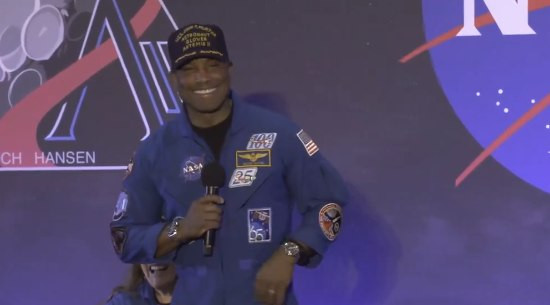
HOUSTON — NASA astronaut Victor Glover stood before a packed auditorium Saturday, voice cracking with emotion, as he thanked God, his crewmates, families and the thousands who made Artemis II possible — a raw moment of gratitude captured on video that has since rocketed across social media following the crew's triumphant return from humanity's first crewed lunar flyby in more than 50 years.
"We are fortunate to be in this agency at this time together."
— NASA Artemis (@NASAArtemis) April 11, 2026
Artemis II pilot Victor Glover expresses gratitude for everyone who supported him throughout his lunar mission. pic.twitter.com/xWhOs5Ie3I
"We are fortunate to be in this agency at this time together," Glover, the mission pilot, told the crowd at NASA's Johnson Space Center on April 11, one day after the Orion spacecraft splashed down safely in the Pacific Ocean off San Diego. The 1-minute-56-second clip, shared by the official NASA Artemis account on X, has already drawn nearly 600,000 views and thousands of heartfelt replies praising the four-person crew's humility and teamwork.
Glover, the first Black astronaut to orbit the Moon, struggled to contain his feelings as he addressed the audience. "I wanted to thank God in public and I want to thank God again," he said, pausing to compose himself. He described the mission as too vast for one person to process alone, crediting everyone from ground teams to the families who supported the crew through years of training.
Seated nearby were Commander Reid Wiseman, mission specialist Christina Koch and Canadian Space Agency astronaut Jeremy Hansen. The quartet had just completed a 10-day journey that took them farther from Earth than any humans since the Apollo era. Launched April 1 from Kennedy Space Center, the crew looped around the Moon's far side on April 6, breaking distance records and conducting critical tests of Orion's systems ahead of future landings.
Splashdown occurred April 10 at approximately 8:07 p.m. EDT, with the capsule hitting the water at Mach 33 after a fiery re-entry. U.S. Navy recovery teams aboard the USS John P. Murtha pulled the astronauts to safety. All four emerged healthy and smiling, waving to cameras as they began medical checks and debriefings.
Glover's remarks struck a chord far beyond the space community. Replies poured in from around the world, with users calling him a "class act," a future NASA leader and an inspiration. One commenter wrote, "Their gratitude is exactly why this mission felt so personal for everyone watching." Another posted side-by-side photos of the crew post-splashdown, captioning them "Great job, Artemis II crew!"
The emotional outpouring reflects the mission's broader significance. Artemis II marked the first time humans traveled beyond low-Earth orbit since Apollo 17 in 1972. It tested life-support systems, navigation and the Orion heat shield under real lunar-return conditions — data essential for Artemis III, the planned crewed lunar landing targeted for 2027 or 2028.
NASA Administrator Bill Nelson hailed the flight as a "gift to the world," emphasizing international partnership with Canada and the European Space Agency. The program aims to land the first woman and first person of color on the Moon, establish a long-term presence and eventually prepare for Mars. Glover's words underscored the human element often overshadowed by technical achievements.
During the flyby, Glover delivered another memorable message from roughly 240,000 miles away, reminding listeners of the power of love and faith before the crew lost radio contact behind the Moon. That earlier downlink also circulated widely, amplifying the sense that this mission connected deeply with the public.
Crewmates echoed Glover's humility in post-mission briefings. Wiseman, Koch and Hansen each expressed awe at the views of Earth and the lunar surface. Koch, who previously set a record for longest spaceflight by a woman, called the experience "profound." Hansen, Canada's first astronaut to leave low-Earth orbit, highlighted the mission's collaborative spirit.
Public reaction mixed celebration with forward-looking excitement. Social media users shared memes, fan art and calls for faster progress toward Artemis III. Some drew parallels to Apollo, noting how Glover's visible faith and gratitude humanized the high-tech endeavor. Others praised the crew's diversity as a symbol of progress.
NASA officials confirmed all systems performed as expected, with only minor anomalies under review. The heat shield held up during re-entry, and Orion's guidance systems delivered pinpoint accuracy for splashdown. Teams will spend weeks analyzing data before clearing Orion for the next flight.
The mission's success arrives amid renewed global interest in lunar exploration. China plans its own crewed landings in the coming years, intensifying what some call a new space race. Artemis, however, emphasizes sustainable exploration and international cooperation, with plans for a lunar Gateway station and eventual Mars missions.
Glover, a U.S. Navy captain and former International Space Station crew member, has become an overnight ambassador for the program. His military background, calm demeanor under pressure and willingness to share vulnerability have resonated widely. In the press conference, he gestured broadly, thanking not only immediate families but "all of you" — a nod to the millions who followed the mission online and in person.
As the crew returns to Houston for further debriefings and reunions, attention turns to crew selection for Artemis III. NASA has hinted an announcement could come soon, building on the momentum from Artemis II. The program's long-term goal remains establishing a permanent human presence on the Moon by the end of the decade.
For Glover and his crewmates, the immediate future includes rest, medical evaluations and sharing their stories with students and the public. Glover's closing words in the viral clip — "I love you. Thank you." — captured the sentiment of a nation and world inspired by their journey.
The Artemis program has faced delays and technical hurdles, but Artemis II's flawless execution has restored confidence. Congressional leaders from both parties praised the achievement, with some calling for increased funding to maintain America's leadership in space.
As the video continues to circulate, it serves as a reminder that space exploration is ultimately about people — their courage, teamwork and gratitude. Glover's message, delivered just 24 hours after touching down, resonated because it was authentic. In an age of polished social media, his unscripted emotion stood out.
NASA plans additional briefings in coming days as the crew transitions from microgravity back to Earth life. The agency also released stunning new images and video from the lunar flyby, showing Earth as a distant blue marble and the Moon's cratered terrain in crisp detail.
For millions who watched the mission unfold, Glover's words provided the perfect coda: a celebration not just of technological triumph but of shared human endeavor. As one reply to the NASA post summed it up, "We are fortunate to be alive at this exact moment in history watching you legends make humanity's next giant leap."
With Artemis II now in the history books, the road to the lunar surface grows shorter. The four astronauts who flew farther than any humans in half a century have returned home safe, their gratitude reminding everyone why the journey matters.
© Copyright 2026 IBTimes AU. All rights reserved.