

Poland Constitutional Crisis Erupts as President Nawrocki Turns Plane Around Amid Tusk Showdown Over Court
President Karol Nawrocki and Prime Minister Donald Tusk's government traded accusations of a coup as police guarded the court amid a dispute dating back to 2015.
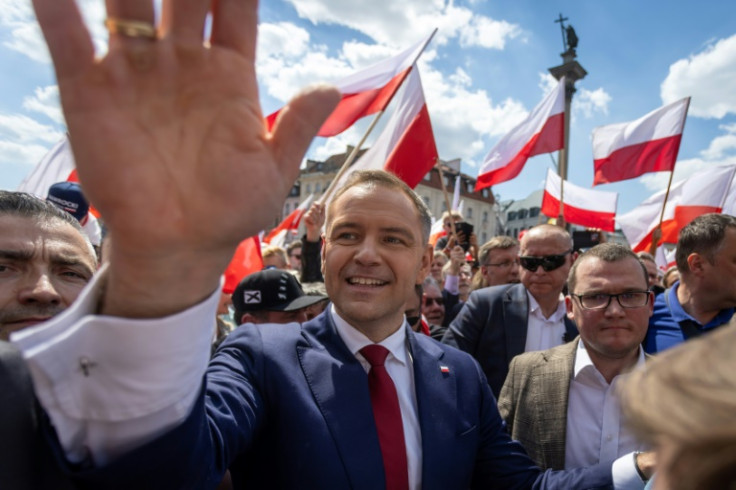
WARSAW, Poland — Poland plunged into a deepening constitutional crisis this weekend after judges backed by Prime Minister Donald Tusk's government moved to take control of the country's top court, prompting President Karol Nawrocki to turn his plane around midflight and rush back to Warsaw.
Hundreds of protesters gathered outside the Constitutional Tribunal for a second night Saturday, as riot police guarded the building and the two sides traded accusations of lawbreaking in a long-running dispute over who legitimately controls the court.
Nawrocki's camp and the opposition Law and Justice party, known as PiS, called the events a coup. Tusk's government said it was acting to restore judicial independence after years of what it describes as political capture of the court by the previous PiS government.
A midnight standoff
The crisis erupted Friday evening when judges chosen this year by the parliamentary majority entered the tribunal. Judge Anna Korwin-Piotrowska announced she had suspended the court's president, Bogdan Święczkowski, for failing to properly exercise his duties, and said that as the judge with the longest experience, she had taken over as acting head.
An announcement on the tribunal's website also ordered the suspension of Vice President Bartłomiej Sochański. The tribunal's leadership later challenged the announcement, saying its website had been unlawfully taken over and accusing those behind the move of a "coup d'etat."
Riot police surrounded the building and held back protesters, including opposition politicians. Święczkowski himself was blocked by police from entering the grounds after some of his supporters used a power tool to cut through a fence.
At the time, Nawrocki was flying to Senegal for a state visit. "I am cutting short my flight to Senegal," he announced, ordering his plane to return to Warsaw.
President pushes into the court
Nawrocki went to the tribunal late Friday night and said he helped the suspended court president enter the building.
Video shared around 1 a.m. Saturday by Maciej Berek, a close Tusk associate recently chosen as a tribunal judge, showed the president asking Korwin-Piotrowska to move aside and pushing past her at the doors.
The two sides gave sharply different accounts. Presidential aide Marcin Przydacz said Korwin-Piotrowska and another judge, Krystian Markiewicz, had violated the inviolability of the head of state. Berek denied that and said it was the president who forcefully barged into the judge.
A second video showed Nawrocki inside the building in a heated exchange with the judges. "You are not judges of the Constitutional Tribunal," the president was heard saying.
Nawrocki left around 5 a.m. In a statement read by his chief of staff, Paweł Szefernaker, the president described the night's events as a breach of Poland's constitutional order and "a forceful takeover of a constitutional body."
"We're dealing with a massive constitutional crisis in Poland," Przydacz told The Associated Press.
Government stands firm
Tusk said Saturday that his government would press ahead with efforts to restore the independence of the tribunal. He described the PiS response, including attempts to forcibly enter the building Friday, as another stage in what he called the destruction of the rule of law in Poland by PiS and the president.
In an earlier social media post, Tusk wrote that restoring the rule of law requires decisive action.
Justice Minister Waldemar Żurek said Friday he was seeking to have Święczkowski's immunity from prosecution lifted. Speaking to broadcaster TVN on Saturday, Żurek backed Korwin-Piotrowska's actions, called Nawrocki's conduct at the tribunal shameful and said he hoped prosecutors would act.
Opposition cries coup
Leaders of the right-wing opposition reacted with fury. "It's true: a coup d'état is underway," former PiS Justice Minister Zbigniew Ziobro wrote on X.
PiS leaders described the events as an assault on the Constitutional Tribunal. Some protesters outside the court prayed and held rosaries, while others accused Tusk's government of attacking Poland's constitutional order.
The crisis also drew attention abroad. U.S. Ambassador to Poland Tom Rose posted a statement calling the events at the tribunal very serious.
A decade-long dispute
The confrontation is the latest chapter in a battle over the tribunal that dates back to 2015, when the PiS government began reshaping the court and other parts of the judiciary.
Since taking power in 2023, Tusk's coalition, which spans the left to the center-right, has refused to recognize the court's legitimacy. It argues that three of the tribunal's judges were unlawfully appointed under PiS, a view supported by earlier court rulings, and regards Święczkowski, a former deputy justice minister in the PiS government, as illegitimate. The European Union long criticized the PiS-era judicial changes as a threat to judicial independence.
As a result, the government has ignored the tribunal's rulings and, until this year, declined to fill vacancies on its 15-member bench. That changed in March, when the ruling coalition began appointing new judges. Parliament has chosen eight so far this year, giving its nominees a majority in theory.
But Polish law requires new judges to swear an oath before the president. Nawrocki, who is aligned with PiS though not a party member, has refused to swear in five of the eight, including Korwin-Piotrowska, Markiewicz and Berek. Those judges held their own swearing-in ceremonies in parliament, but Święczkowski refused to accept them onto the court.
Nawrocki and his supporters argue the president has the right to refuse appointments he considers improper and that the government is undermining the constitutional order. Government officials counter that the president's role in confirming judges is a formality and that he has overstepped his powers.
Nawrocki, a conservative historian who won the presidency in 2025 with 50.9% of the vote, has clashed repeatedly with Tusk's pro-European government, including by refusing earlier this year to appoint dozens of judges nominated through the government's reforms.
Talks and divisions
Seeking to defuse the crisis, Nawrocki invited all parliamentary parties to urgent consultations Saturday afternoon aimed at restoring legal order.
The invitation exposed cracks within Tusk's coalition. Szymon Hołownia, founder of the centrist Poland 2050 party, said his group would attend and urged Tusk to sit down with the president. Hołownia said the night's events brought shame on Poland, and while he criticized Święczkowski and PiS-appointed judges, he warned that trying to fix the tribunal by force would only deepen its decline.
Deputy Prime Minister Władysław Kosiniak-Kamysz, leader of the center-right Polish People's Party, also said he would personally attend.
The Left, another coalition partner, refused. Its parliamentary leader, Anna-Maria Żukowska, said the party could not accept an invitation from someone she held responsible for the tribunal crisis and said politicians should not tell independent judges what to do.
What comes next
As of Saturday, police remained at the tribunal, and the question of who lawfully leads Poland's highest constitutional court was unresolved.
The standoff raises the prospect of competing claims to authority over the court, with the government and president each refusing to recognize the other's position. Analysts say the dispute could paralyze the tribunal and further strain relations between the two branches of power ahead of Poland's next parliamentary elections, due in 2027.
© Copyright 2026 IBTimes AU. All rights reserved.