Is Claude AI Down? Current Status and Outages Hit Anthropic in March 2026 (Claude Outage)
Anthropic's popular AI assistant Claude experienced another round of service disruptions on Friday, March 27, 2026, with users reporting elevated errors particularly affecting the Opus 4.6 and Sonnet 4.6 models. As of midday UTC, the company's official status page showed ongoing investigation into connection reset errors and degraded performance across claude.ai and related services, though some components showed signs of recovery.

Downdetector and other outage trackers recorded increased user reports starting around 4:03 AM EDT, with complaints centered on slow responses, failed generations, authentication issues and "service unavailable" messages. While not a complete global outage on the scale of earlier March incidents, the problems disrupted workflows for developers, students and professionals relying on Claude for coding, writing and analysis.
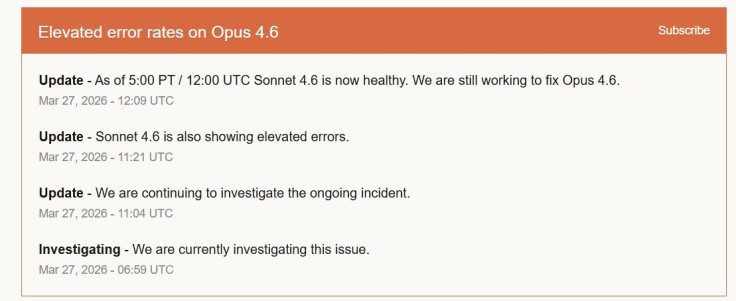
Anthropic's status.claude.com page posted updates throughout the morning: an initial "Investigating" notice at 11:04 UTC, followed by confirmation of elevated errors on Claude Opus 4.6 and later Sonnet 4.6. By 12:09 UTC, engineers reported Sonnet 4.6 returning to healthy status, but work continued on Opus 4.6. Earlier in the day, elevated connection reset errors were flagged in the Cowork feature.
This latest hiccup adds to a pattern of instability for Claude in March 2026. Previous disruptions included a major outage on March 2 that affected login paths and claude.ai for several hours, another wave of elevated errors around March 11, and partial outages reported on March 25. Users have expressed growing frustration on platforms like Reddit, with some noting repeated impacts on paid Pro and Team subscribers who depend on reliable access for time-sensitive tasks.
What Users Are Experiencing
Affected individuals report a range of symptoms: chats failing to load new responses, models returning generic error messages, slower than usual performance, and occasional session timeouts. The Claude API appears less impacted in some reports, allowing developer integrations to continue functioning at reduced capacity, while the consumer web interface and mobile apps bore the brunt of complaints.
Free-tier users often face stricter rate limits during high-demand periods, exacerbating the sense of disruption. Enterprise and government users accessing Claude for Government have also noted intermittent issues. Social media posts and community forums filled with screenshots of error pages and questions about when service would fully restore.
Why Claude Faces Recurring Issues
Rapid growth in Claude's user base has strained Anthropic's infrastructure. The company has released increasingly powerful models, including Opus 4.6 touted for advanced coding and agentic capabilities, drawing heavy demand. High computational requirements for large language models, combined with traffic spikes, can lead to cascading failures in authentication, inference servers or load balancing.
Anthropic has acknowledged the challenges of scaling while maintaining the helpful, harmless and honest principles that define Claude. In statements during prior outages, the company expressed gratitude to users and emphasized efforts to match "incredible demand." However, repeated incidents have sparked discussions about infrastructure resilience, multi-region redundancy and the trade-offs of pushing frontier AI capabilities.
Unlike some competitors with broader cloud partnerships, Anthropic's focused approach on safety and constitutional AI may influence its scaling strategy, potentially contributing to occasional bottlenecks during peak loads or model updates.
How to Check Claude Status and Troubleshoot
When suspecting problems:
- Visit https://status.claude.com/ for official real-time updates and incident details.
- Check Downdetector.com/status/claude-ai for user-reported graphs and regional maps.
- Test across devices and networks — try the web version at claude.ai, desktop app or mobile clients.
- For API users, monitor api.anthropic.com status separately.
Basic troubleshooting steps include refreshing the page, logging out and back in, clearing browser cache, switching networks or waiting 15-30 minutes as many issues resolve through backend fixes. Paid users can sometimes access priority support channels during incidents.
Impact on Users and Businesses
For individuals, outages interrupt creative work, research and casual conversations. Developers building on Claude face delayed projects, while businesses using the AI for customer support, content generation or internal tools risk productivity losses. In education, students relying on Claude for tutoring or essay assistance encounter frustration during critical study periods.
Enterprise adoption of Claude has grown rapidly due to its strong performance in coding and reasoning tasks, making reliability a key concern for IT leaders evaluating long-term commitments. Some organizations have begun implementing fallback strategies, such as multi-model setups with alternatives like Grok or open-source options, to mitigate single-point failures.
The March 2026 cluster of disruptions has amplified calls for greater transparency and proactive capacity planning from Anthropic. Community feedback highlights the need for better communication during incidents and potential service credits for affected subscribers.
Broader Context for AI Reliability in 2026
Claude's issues reflect wider challenges facing frontier AI companies as adoption surges. Major models from OpenAI, Google and others have faced similar outages amid explosive growth. The events underscore the gap between rapid capability advances and the operational maturity required for always-on services.
Anthropic continues investing in safety research and scalable infrastructure while expanding features like Cowork for collaborative tasks. The company's focus on responsible scaling aims to balance innovation with dependability, but real-world demand often tests those boundaries.
As AI assistants become integral to daily workflows, expectations for near-100% uptime rise. Users increasingly demand not just powerful responses but consistent availability, prompting the industry to prioritize redundancy, monitoring and graceful degradation during stress.
Looking Ahead
As of late March 27, 2026, Anthropic engineers were actively addressing remaining issues with Opus 4.6 while confirming improvements in Sonnet 4.6. Most users should see gradual restoration, though full stability may take additional time. The company typically provides post-incident summaries to explain root causes and preventive measures.
In the meantime, alternatives remain available for those needing immediate AI assistance. Anthropic has not issued a detailed public statement beyond status page updates, consistent with its approach during prior events.
For the latest information, monitor the official status page directly, as situations can evolve quickly. While Claude has demonstrated impressive capabilities when operational, today's disruptions serve as a reminder of the growing pains in scaling advanced AI systems to millions of users worldwide.
Anthropic's track record shows quick recovery in most cases, and the team's focus on safety suggests careful handling of underlying infrastructure. Still, frequent March outages may prompt users and enterprises to diversify their AI toolkit to ensure uninterrupted productivity.
© Copyright 2026 IBTimes AU. All rights reserved.
- MOST POPULAR IN Technology