

SanDisk Shares Climb 3.5% as AI Storage Rally Pushes Year-to-Date Gains Above 650% in Historic 2026 Surge
Sandisk's transformation into an AI infrastructure leader drives stock surge
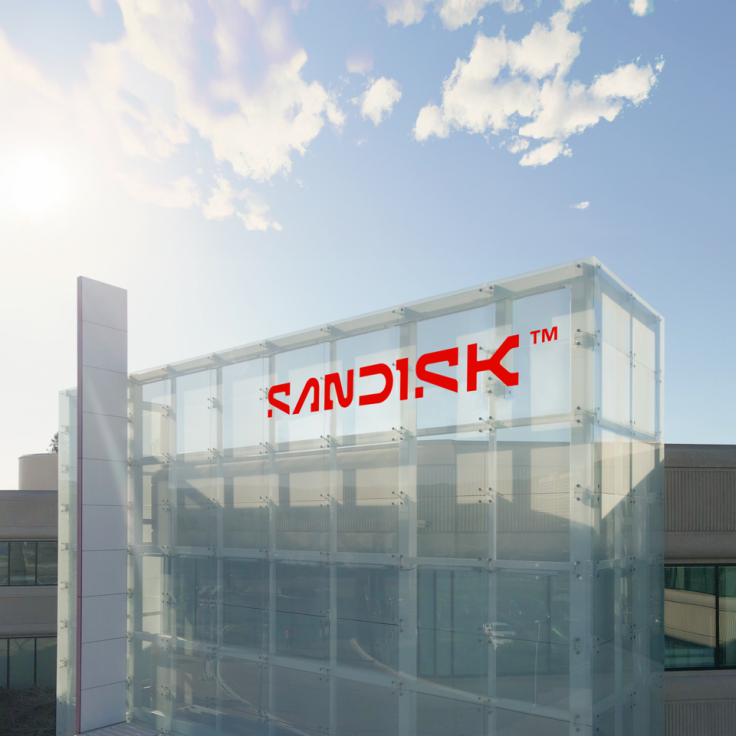
Shares of Sandisk Corporation climbed 3.49%, or $54.82, to $1,623.69 as of 10:46 a.m. EDT Thursday, extending a historic rally that has made the flash memory maker the best-performing stock in the S&P 500 this year, even as the shares remain volatile day to day amid one of the most dramatic single-year runs in recent market history.
Sandisk's stock has surged roughly 653% so far in 2026, according to FX Leaders, a run driven primarily by surging demand for NAND flash memory used in artificial intelligence data center infrastructure. The stock touched a 52-week high of $2,354.39 on June 22 before pulling back, and even after Thursday's gains remains nearly 20% to a third below that peak, illustrating both the scale of the rally and the significant volatility that has accompanied it in recent weeks.
The company's transformation from a traditional NAND flash supplier into what investors increasingly view as core AI infrastructure has been central to the stock's re-rating. According to FX Leaders, the combination of a bullish Investor Day presentation, new U.S. restrictions on Chinese memory suppliers, and continued confidence in AI infrastructure spending has driven the shift in how the market values the company. Sandisk's high-bandwidth flash technology has drawn particular attention from analysts; a five-star-rated Bernstein analyst described the technology as a "game changer for AI" in comments reported by TipRanks earlier this month, helping fuel a 3.5% jump in the stock at the time.
At its 2026 Investor Day, Sandisk outlined an ambitious long-term financial roadmap, projecting mid-to-high-teens annual revenue growth from fiscal 2028 through fiscal 2030, alongside a targeted non-GAAP gross margin of approximately 80% and a non-GAAP operating margin near 75%, according to Investing.com. The company also disclosed fiscal fourth-quarter 2026 revenue of $8.965 billion on Aug. 5, with full-year data center revenue surging 437% year over year. Earlier this month, Sandisk added $14 billion to its share repurchase authorization, bringing its total exercisable buyback limit to $15.5 billion, a significant capital return commitment that has further reinforced investor confidence in the company's cash flow generation.
Wall Street analysts have responded to the company's improving fundamentals with a wave of price target increases. According to FX Leaders, J.P. Morgan resumed coverage of Sandisk with an Overweight rating and a $2,250 price target, while Wedbush maintained an Outperform rating with a $2,000 target. Some 81% of analysts covering the stock now rate it a buy, according to the same report, marking the highest proportion of buy ratings the company has received since its spin-off from Western Digital. Separately, Investing.com reported that 20 analysts currently recommend buying the stock, against just one sell recommendation, with an average 12-month price target of $2,107.70, implying meaningful additional upside from current trading levels, though individual analyst targets vary widely, ranging as high as $3,600 and as low as $1,000.
Despite the bullish analyst consensus, some market observers have flagged the stock's elevated valuation as a source of caution. FX Leaders noted that Sandisk, trading around $1,786.85 earlier in the week, carried a market capitalization of $280.5 billion on a price-to-earnings multiple of roughly 62 times, a valuation the report characterized as reflecting "excessively high expectations" alongside the market's enthusiasm for the company's structural shift toward AI infrastructure.
The stock's day-to-day trading has remained highly volatile even amid its dramatic year-to-date gains. According to StockAnalysis, Sandisk and fellow memory chipmaker Micron Technology both fell sharply in premarket trading earlier this week, reversing a powerful rally from the prior session as investors trimmed exposure to what has become one of 2026's hottest trading themes. CNBC's Jim Cramer has pointed to a broader structural shift underpinning the volatility, arguing that the AI boom has transformed the historically cyclical memory chip industry, with surging demand and greater supply-side discipline among manufacturers supporting stronger and more durable profits than in past memory cycles.
Institutional investor interest in Sandisk has also drawn attention. According to StockAnalysis, Leopold Aschenbrenner's investment fund, Situational Awareness, built stakes exceeding $5 billion combined in Sandisk and Micron before the fund encountered difficulties in July, an episode that nonetheless underscored the scale of institutional capital that has flowed into the memory chip trade this year. Separately, Morgan Stanley has offered a comparative analysis contrasting Sandisk with Nvidia, characterizing the two stocks' respective ownership positioning within institutional portfolios as reflecting different stages of investor conviction in the broader AI trade.
Sandisk's rise has been remarkably steady in its trajectory, if not always smooth session to session. The stock began 2026 trading around $235, following a strong 2025 in which the company's shares had already returned 105% year-to-date by mid-February, according to earlier coverage from Barchart, driven at the time by expectations that Sandisk would double the price of its high-capacity 3D NAND memory devices amid surging AI-driven demand. By late February, the stock had climbed to $650, up 142% for the year at that point, according to TIKR's analysis of the company's blowout fiscal second-quarter results, which showed revenue of $3.03 billion, up 31% sequentially and 61% year over year, comfortably surpassing analyst estimates of $2.69 billion at the time.
As Sandisk approaches its next scheduled earnings report on Nov. 5, according to TradingView, investors are likely to continue closely watching whether the company's aggressive long-term growth targets, robust data center demand, and expanded share buyback program can sustain the stock's extraordinary valuation, particularly given the significant volatility that has periodically punctuated its rally throughout the year even as the broader upward trajectory has remained largely intact.
© Copyright 2026 IBTimes AU. All rights reserved.