

SanDisk Stock Rebounds Nearly 3% as AI Storage Boom Keeps NAND Tight Ahead of Oct. 29 Earnings Report
The stock has surged more than 600% in 2026, but analysts warn that rising production capacity could eventually trigger a downturn in the cyclical NAND market.
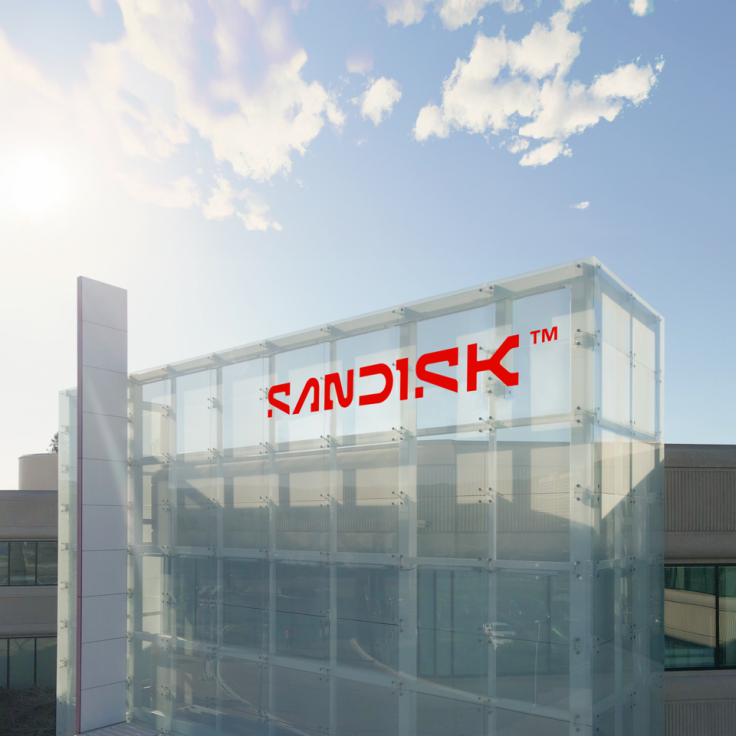
NEW YORK — Shares of SanDisk rose nearly 3% on Wednesday morning, recovering part of the previous session's decline as investors continued to bet on soaring demand for flash memory from artificial intelligence data centers ahead of the company's quarterly results later this month.
The flash storage maker's stock gained $46.67, or 2.81%, to $1,707.13 in morning trading on the Nasdaq. The move reversed early weakness, after the shares had traded about 2% lower in premarket activity.
SanDisk closed Tuesday at $1,660.46, down 2.56%, as memory chip stocks including Micron Technology and SK Hynix moved lower.
There was no company-specific news driving Wednesday's move.
A historic run
SanDisk has been one of the best-performing stocks on Wall Street over the past year, riding a dramatic surge in prices for NAND flash memory, the type of chips used in solid-state drives that store data in computers, smartphones and data centers.
The stock has gained more than 600% so far in 2026 and is up roughly 1,400% over the past 12 months. A $10,000 investment made at the start of October 2025 would have been worth about $159,000 by Oct. 1, according to an analysis by Trefis.
At current prices, SanDisk has a market value of roughly $250 billion, based on about 146 million shares outstanding.
Still, the stock has been volatile. It has pulled back from the record high it reached on June 22, and has moved more than 5% in a single session on about 118 of the last 252 trading days, according to Stock Titan data. Its largest one-day gain over the past year was 27.6% in January.
The shares closed at $1,787.69 on Oct. 1 after Micron's strong earnings report lifted memory stocks, before slipping in the following sessions.
AI fuels demand
The rally has been driven by explosive demand for data storage from companies building AI data centers, which require enormous amounts of memory to store and process the data used to train and run AI models.
At the same time, supply has been constrained. Memory makers cut production after a downturn in 2023, leaving the industry unprepared for the surge in demand.
The result has been a dramatic jump in prices. Flash memory prices roughly doubled in the first half of 2026, according to market research firm TrendForce. Research firm Gartner estimates NAND flash prices could rise 293% for the full year and global NAND revenue could surge 372%.
Gartner expects prices to rise another 30% in 2027, with favorable conditions continuing through the end of the decade.
However, the pace of price increases is expected to slow. TrendForce projected NAND contract price gains of 10% to 15% for the current quarter, down from 70% to 75% in the spring quarter, as some consumer device makers reach the limit of what they are willing to pay.
Record results
SanDisk's financial results have been transformed by the boom.
Revenue rose 175% to $20.25 billion in fiscal 2026, which ended July 3. The company's adjusted gross margin reached 84.6% in its fiscal fourth quarter, an extraordinarily high level for a memory chipmaker. Management forecast an adjusted gross margin of 83% to 85% for the first quarter of fiscal 2027.
Data centers have become SanDisk's fastest-growing market, accounting for 38% of its memory at the end of fiscal 2026, up from roughly 12% a year earlier, according to Trefis. Management has said customers want more memory than SanDisk can supply.
The company has signed multiyear agreements carrying a minimum of $93.9 billion in revenue at floor pricing, backed by $16.5 billion in financial guarantees from customers, according to 24/7 Wall St. It also has $15.5 billion remaining under its share buyback authorization.
SanDisk held about 11% of the global NAND flash market in the second quarter, according to Counterpoint Research. It produces most of its chips in Japan through a joint venture with Kioxia.
Analysts weigh in
Wall Street remains largely bullish. Citi reiterated its buy rating on SanDisk after Micron's earnings last week, seeing about 20% upside as the NAND market stays tight.
Supporters argue that strong AI demand could keep NAND supply tight for years, supporting prices and profits. SanDisk has also committed to a $31 billion expansion of NAND production capacity.
Skeptics warn that memory chips are commodity products with a long history of boom-and-bust cycles. They caution that shortages often lead customers to over-order, and that new capacity could eventually lead to oversupply and falling prices.
The stock trades at about 16.9 times book value and 12.5 times sales, rich multiples for a cyclical business, according to 24/7 Wall St.
Spun off from Western Digital
SanDisk was acquired by Western Digital in 2016 and spun off as an independent company in 2025. Since then, its stock has become one of the market's biggest AI winners.
Western Digital, which kept its hard disk drive business, has also benefited from strong data storage demand.
SanDisk will report results for its first quarter of fiscal 2027 on Oct. 29. Investors will be watching for updates on pricing trends, data center demand, profit margins and the company's capacity expansion plans.
The report comes as investors closely monitor whether the AI-driven memory boom can be sustained, with Micron, SK Hynix and other memory makers also set to update investors in the coming weeks.
© Copyright 2026 IBTimes AU. All rights reserved.