

LG Display Unveils FLiPP OLED Technology Promising Brighter, Longer-Lasting Panels for TVs and Wearables
FLiPP Technology Eliminates Production Bottlenecks, Enhances OLED Performance
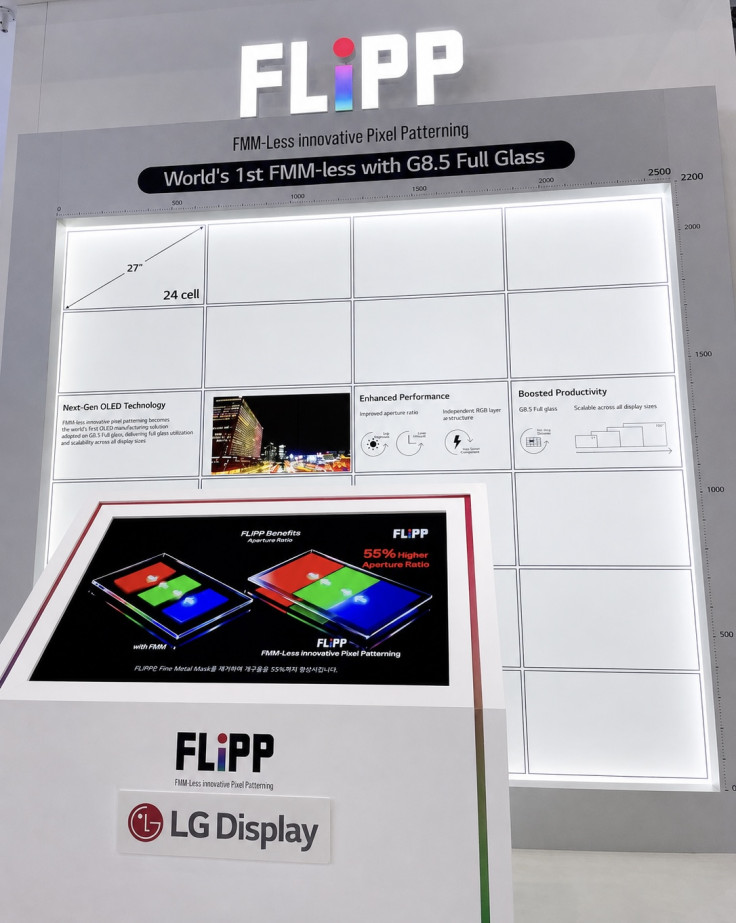
BUSAN, South Korea — LG Display has unveiled a new OLED manufacturing technology it says eliminates a decades-old production bottleneck, promising displays that are significantly brighter, longer-lasting and more energy-efficient across products ranging from tiny wearable screens to massive televisions.
The technology, called FLiPP, or FMM-Less innovative Pixel Patterning, was publicly introduced at the International Meeting on Information Display 2026 in Busan beginning Aug. 19, according to Techgenyz. LG Display describes the approach as a "dream technology" because it removes the need for conventional fine metal masks, a manufacturing method that has served as the mainstream approach for producing RGB OLED pixels for more than a decade.
In traditional OLED manufacturing, red, green and blue organic materials are evaporated through tiny openings in a metal plate, known as a fine metal mask, to form individual RGB subpixels, a process TechPowerUp compared to a stencil art technique. That method carries several significant drawbacks: fine metal masks are expensive to produce and must be remade whenever a panel's size, resolution or pixel layout changes, according to PR Newswire's coverage of LG's announcement. Additionally, due to the physical properties of metal, large masks tend to sag under their own weight at the center, which can cause misalignment and result in color-mixing defects during production.
FLiPP takes a fundamentally different approach. According to Engadget, the technology coats RGB pixels directly onto panels in a precise, ordered sequence, then uses photolithography and ultraviolet light to "erase unnecessary areas during OLED pixel patterning," eliminating the need for a physical metal stencil entirely.
The performance improvements LG Display is claiming for the new process are substantial. According to Forbes, FLiPP-manufactured panels are 1.6 times brighter than equivalent fine-metal-mask panels, offer a lifespan 2.4 times longer, and consume 13% less power, improvements the company attributes to a 55% increase in the display's aperture ratio, the proportion of the total display area occupied by actual RGB pixels rather than surrounding mask structure. By reclaiming space previously occupied by the metal mask itself, LG Display is able to give each pixel a larger surface area through which light can escape, according to OC3D's analysis of the technology, directly improving both brightness output and overall energy efficiency, since the display retains less heat during operation.
Choi Young-seok, chief technology officer at LG Display, characterized the breakthrough as the culmination of the company's accumulated OLED manufacturing expertise. "We were able to successfully realize FLiPP, a next-generation OLED patterning technology referred to as a 'dream technology,' by bringing together our proprietary WOLED technologies and know-how," Choi said, according to TFTCentral.
Beyond the performance gains, LG Display says FLiPP delivers significant manufacturing efficiency improvements. According to TechPowerUp, the company has become the first display manufacturer to produce FMM-less OLED panels using an entire 8.5th-generation mother glass substrate as a single, whole piece, rather than requiring the substrate to be divided into smaller sections as some competing FMM-less approaches require. For OLED laptop panels of comparable size, LG Display says FLiPP delivers up to 64% higher mother-glass utilization efficiency compared with both traditional fine-metal-mask production and other existing FMM-less manufacturing methods, a gain the company says translates directly into reduced substrate material waste, higher overall productivity and lower manufacturing costs.
One of FLiPP's most significant advantages, according to multiple outlets covering the announcement, is its apparent lack of the panel-size and resolution constraints that have historically limited fine-metal-mask-based OLED production. Neowin reported that the technology could theoretically be used to produce displays ranging from just one inch, suitable for small wearable devices, all the way up to 100-inch televisions, positioning FLiPP as what LG Display has described as a genuinely universal OLED manufacturing approach applicable across an unusually broad range of product categories, including potential use in virtual reality and augmented reality display panels alongside more conventional monitors and televisions.
LG Display has indicated it plans to introduce FLiPP-manufactured panels gradually rather than across its entire product lineup immediately. According to Engadget, the company intends to begin deploying the technology in tablets and monitor panels first, before gradually expanding its use to cover the full range of products the technology theoretically supports, from one-inch wearable device displays up through ultra-large television panels, tailoring the rollout to specific customer and product requirements as manufacturing capacity scales up.
LG Display has also moved to protect the intellectual property surrounding its new manufacturing process. According to TechPowerUp, the company has filed trademark applications for the FLiPP name in South Korea and in key global markets, reflecting its ambitions to establish the technology as a distinct, branded manufacturing platform within the broader display industry.
The announcement arrives amid broader industry-wide interest in eliminating fine metal masks from OLED production more generally. According to Notebookcheck, rival display maker Japan Display Inc. has separately been testing its own maskless OLED technology, called eLEAP, which the company says extends OLED panel lifespan by more than three times compared with fine-metal-mask panels while more than doubling brightness. Samsung Display has also reportedly considered pursuing similar maskless production research, while Chinese OLED manufacturer Visionox has been developing its own non-FMM production approach under the branding ViP, according to the same report, suggesting FLiPP represents LG Display's entry into a broader competitive race across the display industry to solve the same underlying fine-metal-mask limitations through different technical approaches.
Neowin's coverage of the announcement placed FLiPP within the context of LG Display's longer competitive history in OLED technology, noting that the company continued investing heavily in OLED manufacturing even after rivals Sony and Panasonic abandoned their own OLED display partnership in 2013 and Samsung shifted its primary display strategy toward Q-LED technology in 2015. That sustained investment eventually positioned LG Display as a key OLED panel supplier to major consumer electronics brands including Sony, Panasonic, Toshiba, Philips and Loewe by 2017, and has since enabled the company to develop distinctive OLED-based products such as its Wallpaper TV and rollable television lines, showcasing the flexibility the underlying technology offers compared with more conventional LCD-based display manufacturing.
As with any newly announced manufacturing technology, FLiPP remains, for now, a production process rather than a feature consumers can purchase directly. Neowin cautioned that the technology's real-world impact will depend on how successfully and how quickly LG Display can transition FLiPP from initial demonstration into large-scale commercial production across its planned range of applications, a process the company has indicated will begin with tablets and monitors before gradually expanding into the broader array of products the underlying technology is theoretically capable of supporting.
© Copyright 2026 IBTimes AU. All rights reserved.