10 Must-Know Facts About World Quantum Day 2026: Global Celebration of Quantum Science on April 14
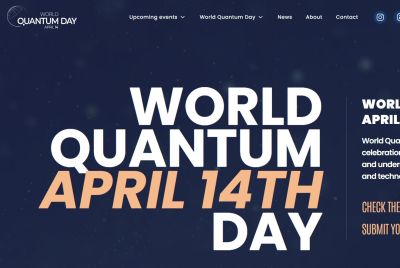
NEW YORK — World Quantum Day returns Tuesday as a decentralized global celebration of quantum science and technology, building momentum after the 2025 International Year of Quantum Science and Technology with hundreds of events worldwide aimed at making complex physics accessible to the public.

Observed annually on April 14, the day promotes awareness of quantum mechanics — the rules governing the subatomic world — and its emerging technologies in computing, sensing, cryptography and medicine. Organizers from more than 65 countries describe it as a bottom-up initiative inviting scientists, educators, artists and enthusiasts to host talks, lab tours, exhibitions and creative activities.
Here are 10 essential things everyone should know about World Quantum Day as the 2026 edition unfolds.
- The Date Honors Planck's Constant April 14 was chosen because 4.14 represents the first three digits of Planck's constant (4.1356677 × 10⁻¹⁵ eV·s), the fundamental physical constant that Max Planck introduced in 1900, laying the foundation for quantum theory. This numerical tie-in mirrors Pi Day on March 14, turning a scientific constant into a memorable global hook.
- It Began as a Grassroots Initiative Launched on April 14, 2021, as a countdown to the first full celebration in 2022, World Quantum Day grew from a group of quantum scientists across more than 65 countries. It is deliberately decentralized and bottom-up, encouraging local organizers rather than top-down programming. The first official day in 2022 featured over 200 events in more than 40 countries across five continents.
- Events Exploded in Scale By 2023, the number of registered activities surpassed 400. In 2026, following the momentum of the 2025 International Year, events span lectures, panel discussions, laboratory tours, artistic installations and school programs. Examples include public talks in Hanoi, Vietnam; experimental afternoons in Brno, Czechia; lab visits at ICFO in Spain; and celebrations at NTNU in Norway, among dozens more listed on the official site.
- It Builds on the 2025 International Year The United Nations proclaimed 2025 as the International Year of Quantum Science and Technology to mark 100 years of quantum mechanics. World Quantum Day 2026 serves as a continuing platform, shifting focus from formal international recognition to sustained public engagement and education as quantum technologies move from labs toward real-world applications.
- Focus on Public Understanding and Inclusion Organizers emphasize outreach to non-scientists. Activities often blend quantum concepts with humanities, philosophy, art and ethics. The goal is to demystify superposition, entanglement and uncertainty — ideas that challenge everyday intuition — while highlighting societal implications such as quantum computing's potential to break current encryption or accelerate drug discovery.
- Quantum Cities and Global Reach The initiative highlights "Quantum Cities" and encourages participation from every country. A Quantum City Prize has recognized communities advancing quantum awareness. In 2026, events occur on every continent, with strong participation from universities, research institutes like those at the University of Arizona, and companies such as HPE and Pasqal, which host webinars, panels and demonstrations.
- It Addresses Real-World Quantum Impact Beyond theory, the day spotlights practical advances. Quantum sensors promise ultra-precise measurements for navigation and medical imaging. Quantum computers could revolutionize optimization problems in logistics, finance and climate modeling. Quantum communication aims for unhackable networks. World Quantum Day frames these developments as collective achievements requiring broad societal literacy.
- Decentralized and Open to Everyone Anyone can participate by submitting events via the official website. Suggested activities include outreach talks, exhibitions, interviews, artistic creations or simply sharing quantum-inspired content on social media with hashtags #WorldQuantumDay and #QuantumCity. The bottom-up model keeps the celebration vibrant and culturally diverse rather than uniformly scripted.
- It Connects Science with Culture and Ethics Many 2026 events explore quantum ideas through art, philosophy and societal questions. Discussions often address ethical guardrails for quantum technologies, workforce development needs, and how quantum concepts challenge classical notions of reality. This interdisciplinary approach helps bridge the gap between experts and the general public.
- It Signals the Quantum Era's Arrival With quantum computing companies achieving milestones in error correction and hybrid systems, and governments investing billions through national quantum initiatives, World Quantum Day underscores that the technology is transitioning from science fiction to practical tools. The day serves as an annual reminder that understanding quantum science is increasingly relevant for citizens, policymakers and future generations.
World Quantum Day's growth reflects surging global interest in quantum technologies. National programs in the United States, Europe, China and elsewhere have funneled substantial funding into research and workforce training. Private sector involvement from tech giants and startups has accelerated progress, making public literacy more important than ever to navigate hype versus reality and to inform policy on issues like post-quantum cryptography.
Events on and around April 14, 2026, vary widely in scale and format. Some universities host open lab tours or guest speakers from industry leaders like Quantinuum. Others organize hands-on activities for children or public panels on quantum's societal role. Corporate participants, including HPE, use the day to showcase customer stories and technical advancements in quantum-inspired computing.
The decentralized nature ensures cultural adaptation. In some regions, events tie quantum concepts to local traditions or pressing challenges such as sustainable energy. In others, they focus on education to inspire the next generation of scientists and engineers.
Critics sometimes note that quantum technologies remain in early stages, with practical "quantum advantage" still limited to specific tasks. Organizers counter that raising awareness now prepares society for disruptions and opportunities ahead, much as the internet's foundational years required broad understanding before widespread adoption.
For educators, World Quantum Day offers ready-made resources and community support. For researchers, it provides a platform to share excitement and address misconceptions. For the public, it turns intimidating physics into approachable conversations, often using everyday analogies like polarized sunglasses to explain photon behavior or Schrödinger's cat to illustrate superposition.
As April 14, 2026, arrives, the official World Quantum Day website serves as a hub for event listings, resources and calls to action. Organizers encourage everyone — from professional physicists to curious students and families — to engage, whether by attending a local event, hosting a discussion or simply learning one new quantum fact.
The day's enduring message is optimistic: quantum science is not reserved for elites in white coats but belongs to humanity's shared quest to understand the universe. By celebrating together on April 14, participants worldwide reaffirm that discovery thrives on curiosity, collaboration and communication.
In 2026 and beyond, World Quantum Day will continue evolving alongside the technology it honors. Whether through groundbreaking hardware announcements, new educational tools or creative expressions, the annual observance ensures quantum science remains in the public conversation — one April 14 at a time.
© Copyright 2026 IBTimes AU. All rights reserved.
- Recommended For You