AMD Stock Buy or Sell in 2026? Analysts Say Strong Buy as AI Momentum Powers Record Run
NEW YORK — Advanced Micro Devices Inc. shares have surged dramatically in 2026, trading near $400 after a blockbuster first-quarter earnings beat that sent the stock up more than 15% in a single session, prompting fresh debate on whether investors should buy, hold or consider taking profits amid the ongoing AI boom.
As of May 7, 2026, AMD closed at approximately $398.73 on Wednesday, reflecting robust gains driven by accelerating data center revenue and upbeat guidance. The chipmaker's market capitalization now exceeds $650 billion, positioning it as a major beneficiary of hyperscaler spending on AI infrastructure.
Wall Street's consensus remains overwhelmingly bullish. Out of roughly 40-44 analysts covering the stock, the vast majority rate it a Buy or Strong Buy, with an average 12-month price target around $385-$390 and highs reaching $530. No major firm currently recommends selling. Recent upgrades, including DA Davidson's move to Buy with a $375 target and multiple analysts lifting targets above $500, underscore confidence in AMD's trajectory.
Q1 2026 Earnings: AI Demand Fuels Outperformance
AMD delivered stronger-than-expected results for the quarter ended March 31. Revenue reached $10.25 billion, up 38% year-over-year and beating estimates of $9.89 billion. Adjusted earnings per share hit $1.37, topping forecasts of $1.29. Data center revenue — the key AI driver — soared 57% to $5.8 billion, powered by EPYC processors and Instinct GPUs.
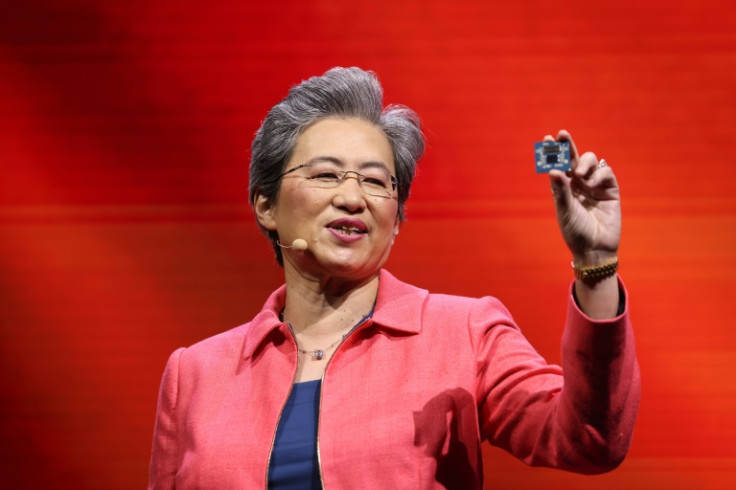
CEO Lisa Su highlighted "accelerating demand for AI infrastructure," noting strong momentum in inferencing and agentic AI workloads. The company guided Q2 revenue to approximately $11.2 billion, well above consensus, with non-GAAP gross margin expected near 56%. Free cash flow reached a record $2.6 billion.
The results triggered a sharp rally, with shares jumping as much as 18% in early trading the following day. Investors rewarded the company's ability to gain share in CPUs while building credibility in accelerators as a viable alternative to Nvidia.
Bull Case: AI Supercycle Has Room for Multiple Winners
Proponents of buying AMD point to several tailwinds. The AI opportunity is massive, with data center spending projected to grow at high double-digit rates through the end of the decade. AMD's full-stack offerings — combining CPUs, GPUs, and rack-scale solutions like Helios — appeal to customers seeking diversification and better economics.
Major wins include Meta's planned deployment of up to 6 gigawatts of Instinct GPUs and partnerships with AWS, Google Cloud and Microsoft. Upcoming products such as the MI450 series position AMD strongly in the fast-growing inference market, where it claims advantages in performance-per-dollar.
Analysts like those at Wells Fargo, Bernstein and KeyBanc have raised targets significantly, citing sustained market share gains and operating leverage. Long-term forecasts see data center revenue growing at more than 80% annually in coming years under optimistic scenarios.
At current valuations — trading around 30-40 times forward earnings depending on estimates — many view AMD as reasonably priced relative to its growth potential, especially compared to Nvidia's premium multiple.
Risks and the Sell Case
Skeptics caution that AMD still trails Nvidia significantly in high-end AI accelerators, with market share estimates in the 5-15% range for GPUs. Execution risks remain on supply chain constraints, particularly advanced packaging and high-bandwidth memory. Geopolitical tensions and potential export restrictions could also weigh on results.
Near-term challenges include competition in client and gaming segments, as well as heavy capital expenditures that could pressure free cash flow if AI ramps slow. Some analysts note the stock's volatility and warn of profit-taking after the recent run-up.
Valuation remains a point of debate. While bullish targets imply substantial upside, more conservative forecasts see limited near-term gains if growth moderates. Macro factors such as interest rates and broader tech spending could influence sentiment.
Balanced Outlook for Investors
For long-term investors, the consensus leans heavily toward buying or holding AMD as a core AI play. The company's diversified portfolio — spanning data center, client, gaming and embedded — provides resilience that pure-play GPU makers may lack. Management's track record under Su has consistently delivered on key milestones.
Short-term traders may consider tactical selling into strength, particularly ahead of potential volatility around upcoming product launches or macro events. However, with no Sell ratings on Wall Street and strong momentum post-earnings, the path of least resistance appears higher for patient holders.
Institutional ownership remains high, and retail enthusiasm has returned following the earnings beat. Options activity shows continued bullish positioning, though implied volatility reflects awareness of risks.
Strategic Considerations for 2026
Investors evaluating AMD should consider portfolio allocation, risk tolerance and time horizon. Those seeking growth exposure in semiconductors may view it as a compelling complement or alternative to Nvidia. Diversification across the AI stack — including software, systems and energy efficiency — strengthens the investment thesis.
AMD's "Advancing AI 2026" event scheduled for July could serve as a major catalyst, showcasing next-generation technologies. Continued execution on guidance and customer wins will be key to sustaining the rally.
As the year progresses, focus will remain on data center traction, margin expansion and progress toward long-term targets. While nothing is guaranteed in the fast-moving tech sector, AMD enters the remainder of 2026 with strong fundamentals and analyst backing.
Whether buying on dips, holding through volatility or adding on confirmed milestones, the overwhelming Wall Street view supports AMD as a core holding for those bullish on AI's multi-year transformation. The stock's performance will ultimately hinge on delivering tangible results in one of the largest technology shifts in decades.
© Copyright 2026 IBTimes AU. All rights reserved.
- Recommended For You